
Wamkelekile, Welkom
Helping African adolescents achieve their potential
20 March 2019 | Story Joanne Carew. Photo Inge Wessels. Read time 10 min.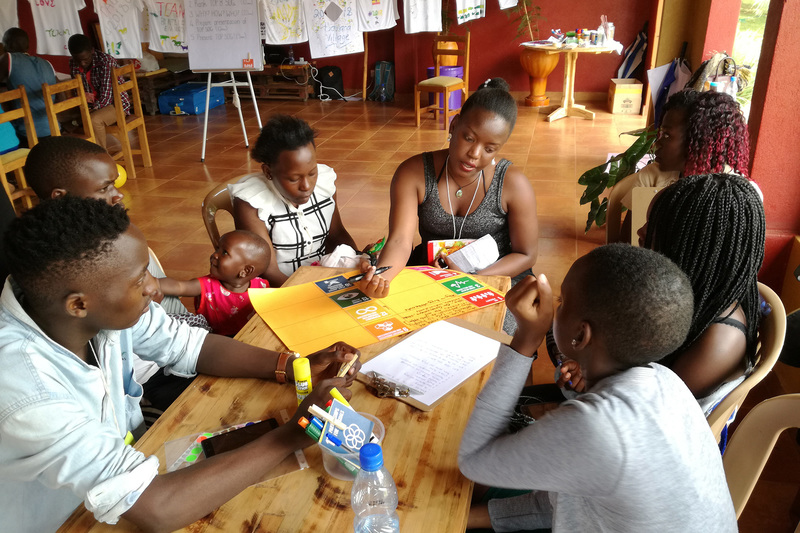
An international team of researchers – including Dr Elona Toska, Professor Cathy Ward and Siyanai Zhou from the University of Cape Town (UCT) – led by Oxford University, has been awarded a five-year grant to tackle the most pressing issues facing African adolescents.
The Accelerating Achievement for Africa’s Adolescents Hub is one of 12 research hubs being set up by the United Kingdom Research and Innovation (UKRI) and funded through the Global Challenges Research Fund (GCRF). All of the hubs support research that addresses challenges faced by developing countries and makes the world safer, healthier and more prosperous. UCT is involved in two of the hubs.
About the Hub
The Oxford University–UCT hub is a multi-disciplinary research initiative to help African adolescents achieve their potential. It is co-directed by Professor Lucie Cluver of Oxford University and honorary professor at UCT’s Department of Psychiatry and Mental Health.
“I am honoured and excited to be leading a UKRI GCRF Hub,” says Cluver. “This is a chance to work together with excellent academics, policy-makers and adolescents in Africa, with a common goal and mission.”
“This is a chance to work together with excellent academics, policy-makers and adolescents in Africa, with a common goal and mission.”
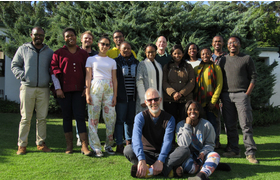
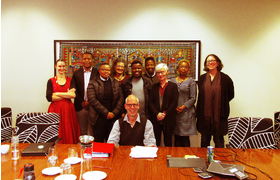
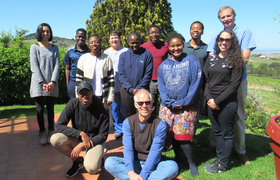
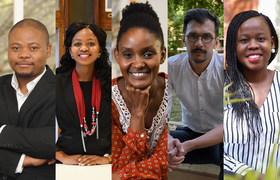
UCT academics Professor Cathy Ward from the Department of Psychology, Dr Elona Toska from the Centre for Social Science Research and Department of Sociology, and Siyanai Zhou from the AIDS and Society Research Unit are the UCT-based researchers. They will lead a team of eight based at UCT and provide capacity-sharing opportunities for more than 35 early-career researchers across 15 countries in Africa, where the Hub’s partner institutions are based.
“Our focus is supporting adolescents across the continent to reach their potential over multiple aspects of their lives beyond health,” explains Toska, who notes that Africa is currently experiencing a population boom that will see the number of adolescents on the continent double by 2050.
“Adolescence is a time of immense change and transition: young people are presented with countless opportunities, but they are also exposed to complex vulnerabilities and considerable risks,” says Zhou. “Not only are they experiencing physical growth – in the body and the brain – they are negotiating the social and emotional issues that go hand-in-hand with adolescence.”
Working with collaborators, including adolescents themselves, the Hub aims to identify combinations of services, programmes and policies that most efficiently and cost-effectively help adolescents.
By testing different combinations of interventions – such as malaria prevention, business skills and violence prevention – the researchers will identify specific combinations that boost adolescents’ outcomes across several United Nations Sustainable Development Goals (SDGs): nutrition, health, schooling, employment, gender equality and safety.
“Adolescence is a time of immense change and transition: young people are presented with countless opportunities, but they are also exposed to complex vulnerabilities and considerable risks.”
The Hub will thus provide policy-makers with the evidence they need to choose programmes that work, are cost-effective and scalable, while also accessible to adolescents themselves.
Identifying accelerator synergies
Creating solutions that accelerate positive outcomes for African youths requires identifying interventions that have multiple benefits.
“We have evidence, for example, that supporting an adolescent girl or young woman to remain in school for as long as possible is associated with a reduction in unintended pregnancy, as well as a decreased risk of contracting HIV,” explains Toska.
“In addition, the more time these young women spend in school, the more employable they are in the long run. This addresses some of the structural drivers at the core of inequitable sexual and romantic relationships.
“And, if they are part of a school feeding scheme, it’s likely that they will be healthier because they are properly nourished.”
This example shows how a single intervention – keeping girls in school – can have many positive outcomes. This is an accelerator, a term adopted by the United Nations Development Programme to describe policies or programmes that improve multiple SDGs concurrently.
“There is pretty decent evidence around a few of these cause–effect accelerators – but we aim to identify more,” she continues.
Accelerator synergies are combinations of interventions that work alongside each other to have a greater – accelerated – impact across multiple SDGs.
“We have evidence, for example, that supporting an adolescent girl or young woman to remain in school for as long as possible is associated with a reduction in unintended pregnancy, as well as a decreased risk of contracting HIV.”
Using the example above, a parenting programme might complement efforts to keep girls in school by supporting parents with communication and problem-solving skills that ensure adolescents receive the care they need, explains Ward. In combination, these two programmes may have a greater impact on improving multiple SDGs.
The way forward
The Accelerating Achievement for Africa’s Adolescents Hub will operate as a combination of five work packages. The packages will be run in collaboration with 54 partner organisations from a range of fields and across 15 African countries.
- Co-creation, impact and capacity-building
The first step involves bringing people together to figure out what the Hub will do, including through consultations with adolescents themselves through multi-country Teen Advisory Groups that will devise and sound out ideas.
- Existing data, new combinations
By collaborating with early-career researchers, the Hub’s team will use existing data to see if they can learn how past research might inform their current ideas and efforts, particularly regarding accelerator synergies.
- Innovation lab
The Hub’s researchers will work together to explore how the accelerators and synergistic combinations of accelerators could be transferred from one context to another.
“If you have findings for a successful combination in South Africa, it may not make sense to conduct large-scale research in a setting with similar challenges and opportunities,” notes Toska. “The innovation lab would look at the transferability of this data across different regions and policy environments.”
- Testing combination interventions in large randomised trials
The researchers will put their findings to work and test their ideas using randomised control trials. These will assess evidence-based accelerator synergies delivered in sequence or concurrently.
The trials are planned for Kenya, Sierra Leone, South Africa, South Sudan, Tanzania and Zambia.
- From evidence to scale
By presenting their research to a broad team of advisors, the researchers will open their interventions to feedback, so that they can figure out effective ways to implement their findings and impact policy.
“By bringing together people from different disciplines, we’re essentially cross-pollinating our ideas and approaches to analysis,” Toska says. “And by involving the young people that stand to benefit from the Hub’s findings, we are giving them the chance to get involved in a more structured and valuable way.”
 This work is licensed under a Creative Commons Attribution-NoDerivatives 4.0 International License.
Please view the republishing articles page for more information.




New Generation of Academics Programme (nGAP)
UCT has responded energetically to the New Generation of Academics Programme (nGAP), an opportunity provided by the Department of Higher Education (DHET) to build a new generation of black South African academics. The DHET’s 2015 vision document, “Staffing South Africa’s Universities Framework: A comprehensive, transformative approach to developing future generations of academics and building staff capacity”, proposes a suite of initiatives to address the challenge, with nGAP being the major instrument to increase the numbers of black South African academics.
The programme “involves the recruitment of highly capable scholars as new academics, against carefully designed and balanced equity considerations and in light of the disciplinary areas of greatest need”. The nGAP scholars are appointed into permanent positions where from the outset their conditions are customised to ensure their successful induction into the ranks of established academics.
The DHET provides funding over a six-year period to support the appointment of an nGAP lecturer, and their time is protected to provide the best possible opportunity for the completion of a doctorate degree in the shortest possible time. Once the degree is completed, the nGAP lecturer’s teaching commitments are steadily increased until they shoulder a full teaching load.
Since the first advertisement for nGAP posts in 2015, UCT has been awarded 17 nGAP positions: 5 (Phase 1), 4 (Phase 2), 3 (Phase 3) and 5 (Phase 4). These are distributed across all faculties.
UCT’s nGAP scholars operate as a single cohort, managed and coordinated by Dr Robert Morrell. Lecturers meet for quarterly meetings, writing retreats and various capacity-building activities all designed to support the completion of postgraduate qualifications (particularly doctorates) and to develop records of achievement that will testify to their emergence as self-standing, excellent academics. Each lecturer is mentored by a senior scholar, who provides support and guidance on the challenges that routinely face academics.
The nGAP manager sets great store in building the cohesion of the cohort and encouraging the establishment of new UCT networks while producing a collaborative, mutually supportive and embracing work culture.
According to Dr Morrell, “This group of academics will lead UCT in 15 to 20 years’ time ... Their vision of excellence, of being African and South African, of serving a wider community and producing knowledge for the planet, the continent and the country, will power UCT in years to come.”
Newsletters
In the news