
Wamkelekile, Welkom
Rehane Abrahams reimagines decolonisation through performance
02 April 2026 | Story Myolisi Gophe. Photos Supplied. Read time 7 min.
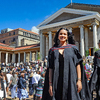
When the University of Cape Town (UCT) conferred a doctoral degree on performing artist Rehane Abrahams on Monday, 30 March, it marked more than an academic milestone. It signalled the arrival of a body of work that refuses to sit neatly on a bookshelf – a thesis that lives, breathes and moves between land, water, memory and flesh.
Titled “Eco-erotic decolonisation and Khoisan Revivalism”, Rehane’s PhD is not only written – it is performed. It unfolds across landscapes, rituals and embodied encounters, asking urgent questions about how South Africans might reimagine their relationship with land beyond ownership, beyond history’s violence, and beyond the limits of language itself.
At the heart of her work is a deceptively simple but radical idea: the body is not separate from the land.
“For someone encountering this idea for the first time,” she explained, “it begins with understanding the body as part of a networked ecology – not as an isolated unit, but as something constantly in exchange with its environment.”
This “eco-erotic” relationship, as she terms it, is not about romance in the conventional sense. Rather, it gestures towards a deeper, generative life force – one that binds humans to land, water and non-human beings in intimate and reciprocal ways. It is a concept rooted in indigenous knowledge systems, where land is not property but a living, conscious presence.

Rehane’s work draws heavily on Khoisan cosmologies, particularly the hydromythic figure of Die Waterslang – the Water Snake – a being that moves between myth and memory, symbolising the enduring relationship between people and water. Through this figure, she explores how ancestral stories continue to live within bodies, even in the aftermath of colonial erasure.
Her research is as personal as it is scholarly. One formative moment took place in the Northern Cape, where she attended a Griqua Ncabasas ritual. There, she witnessed the introduction of a young woman to the Grootslang – a great serpent believed to inhabit the river.
“That Khoi stories still tell of human intimacies with beings of the water speaks to indigenous survivance across genocide and erasure. I became curious about how our bodies retain and retrieve these stories with land and water.”
That curiosity became the foundation of a research approach that blurs the boundaries between performance, ethnography and spirituality. Rehane describes her methodology as “research-creation” – a process in which knowledge is not merely observed or recorded but actively made through embodied practice.
Conventional academic frameworks
Her performances are staged at sites rich in historical and political meaning around Cape Town and Stellenbosch. These include Spier Wine Farm, Iziko Slave Lodge and the contested Liesbeek River confluence, where development debates have reignited conversations about land, heritage and belonging.
In these spaces, performance becomes a way of listening – to the land, to history, and to what lies beneath both.
“Knowledge is co-produced by the body and the site,” she said. “It emerges in ways that exceed the individual, forming within a relational field as it comes into being.”
This approach challenges conventional academic frameworks, which often prioritise distance and objectivity. Instead, Rehane embraces what she calls “visceral performance-making” – drawing on ritual, trance and sensory engagement to access forms of knowing that cannot be easily written down. It is also a deeply political act.
“Knowledge … emerges in ways that exceed the individual, forming within a relational field as it comes into being.”
By positioning the “eco-erotic” as a space of encounter, her work seeks to disrupt the lingering violences of colonialism – particularly those imposed on bodies through systems of patriarchy, heteronormativity and religious control. In doing so, she opens possibilities for new narratives that centre pleasure, intimacy and relationality as forms of resistance.
In the South African context, where land remains a deeply contested issue, this reframing is significant. Rather than approaching land solely through legal or economic lenses, Rehane invites a reimagining of land as kin – as something to be in relationship with, rather than something to be owned.
Khoisan revivalism
Her work also contributes to a growing movement of Khoisan revivalism, which seeks to reclaim and reassert indigenous identities, practices and knowledge systems that have long been marginalised. Yet, for all its conceptual depth, Rehane resists being positioned as an “expert”.
“I believe that if your PhD makes you feel like an expert, you’ve done it wrong,” she explained. “I wish for continual co-becoming with the humans and more-than-human beings I share life with.”
That sense of openness extends to her hopes for the future of her work. Beyond academia, she envisions a multimodal book that invites readers into their own intimate encounters with land – possibly through interactive or playful elements that blur the line between reader and participant.
“I hope it encourages people to come into intimacies with land. And that it inspires, in the same way that I have been inspired.”
Her journey into performance itself, she admitted, was less a choice than a calling.
“It’s not a straight or easy path,” she reflected, noting the challenges of sustaining a career that exists outside conventional economic structures. “But it has been deeply rewarding in other ways.”

Now, Rehane stands at the threshold of what she describes as an “emerging co-becoming” – a state of ongoing transformation shaped by her research, her practice and her relationship with the world around her.
In many ways, her PhD resists closure. It does not offer neat conclusions or definitive answers. Instead, it invites an ongoing process – of listening, of feeling, and of re-learning how to belong.
The significance of Rehane’s achievement will not only lie in the degree itself, but in what it represents: a bold reimagining of knowledge-making – one that honours the body as archive, the land as teacher, and performance as a powerful site of decolonial possibility.
 This work is licensed under a Creative Commons Attribution-NoDerivatives 4.0 International License.
Please view the republishing articles page for more information.