
Wamkelekile, Welkom
Graduand’s PhD brings hope and healing
23 March 2026 | Story Niémah Davids Photo Lerato Maduna. Read time 10 min.
Jill Samukimba was just a baby when both her parents passed away, leaving her and her two siblings orphaned. With no family to care for them, the trio was sent to SOS Children’s Villages in Lusaka, Zambia.
Fortunately, Jill, her twin sister, Joy, and their brother, Jasper, were never separated. And at SOS Children’s Villages, the siblings gained a family – two mothers and dozens of siblings. It was the only home they knew – built on strong values such as integrity and honesty. And just like other happy families, the importance of love, respect and trust guided each new day.
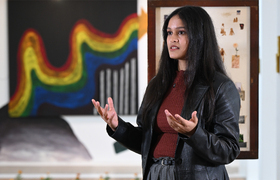
As Jill prepares to take the academic walk of fame across the stage in the University of Cape Town’s (UCT) Sarah Baartman Hall to receive her PhD in sociology, the moment will mark a significant milestone – one defined by tenacity, resilience and sacrifice. But more than anything, Jill is overcome with gratitude. She is grateful that she has reached the finish line, and thankful for her village: her supervisor, Professor Elena Moore; academics in UCT’s Umthombo Centre for Student Success; her friends in academia; and the SOS Children’s Villages that set the wheels in motion for a high school scholarship that ultimately led her to UCT. And, of course, for her son, 11-year-old Ray Zulu, who associates a PhD with an enormous assignment that takes years to complete (and he’s not far off) – for his patience, love and understanding. Their motivation to reach graduation day was not different: all this mother-son-duo wanted was to spend more time together. Now they will.
A culture shock
Jill arrived at UCT from boarding school in 2014. As one of the crème de la crème students at the orphanage, she received a fully funded scholarship to complete her International General Certificate of Secondary Education and International Baccalaureate – prestigious, globally-recognised curricula offered at international schools – at a school in Tema, Ghana. This scholarship opened the door for her tertiary studies.
“This is how I exited the orphanage in 2009, and my life changed forever.”
“This is how I exited the orphanage in 2009, and my life changed forever. This one window of opportunity was all I needed to be where I am today,” she said.
Arriving on campus was a “massive culture shock”. Jill described both Zambia and Ghana as conservative countries where sensitive conversations were often muted, overt displays of intimacy strictly prohibited, and where a girl child was always told to “cover up”. What she witnessed among her peers left her dumbstruck. At UCT she learned the nuances around identity, particularly in relation to same-sex relationships and where she witnessed open displays of intimacy among same-sex couples. For the first time ever, she saw people arriving at lectures in very short shorts, their pyjamas or barefoot. She was intrigued.
On some reflection and on the advice of a curriculum advisor, Jill took up gender studies and sociology. That was more than a decade ago, and she’s not looked back. Following her undergraduate programme, she completed her honours and master’s at UCT.
Healing through research
And for the cherry on the cake, Jill will graduate with her PhD in sociology on Monday, 30 March. Her research focuses on African family dynamics and customary practices. Her thesis is titled: “Sustaining father involvement: Exploring non-resident fathers’ sustained involvement in their children’s lives over a 5-year period”. The qualitative longitudinal study explored what it takes for non-resident, unmarried isiXhosa fathers to be involved and sustain their involvement in their children’s lives. Jill’s research is motivated by her own lived experience as a single mother.
“I went into this study with a dominant narrative of absent fathers; that financial instability drives this absence. I intentionally worked with fathers who had access to economic means. This made sure I got a picture of fathering that goes beyond economic provision of care. My child’s father had access to economic means but was still not involved in my child’s life. It was important for me to eliminate this factor early on,” she said.
“My research became a site of healing and hope and an opportunity to turn a wound into wisdom.”
Jill’s research found that neither relational aspects, material resources or ideological beliefs alone can sustain a father’s involvement in his child’s life. Instead, what is takes is a commitment to all three aspects to grow and maintain this relationship over time. The fathers surveyed were 100% involved in their children’s lives.
“I needed to set aside my experiences and perceptions to tell their story objectively. My research became a site of healing and hope and an opportunity to turn a wound into wisdom,” she said.
A rigorous, mentally draining undertaking
For Jill, the PhD journey was intense. It took a massive toll on her mental health and her sleep schedule, and despite being an avid runner and weightlifter, she struggled to prioritise physical activity.
“I never snacked or drank so much Coke as I did during the final stretch of my PhD. It really took over my life. I am a fitness fanatic, but my fitness schedule took a back seat. My advice to anyone who enjoys a good level of fitness and who’s doing a PhD is to spare at least 30 minutes every day for a run or time in the gym,” she said.
“It felt like I was released from prison.”
Yet nothing beats finally submitting a thesis you’ve taken years to complete. Jill likened the feeling to the runner's high she experiences at the end of a big race – absolutely nothing can beat that.
“It felt like I was released from prison. A weight was lifted off my shoulders,” she joked.
“Somehow, only then did the thought of being called Dr Samukimba kick in and I was excited about life and academia again. But during the writing process, I was certain that that was the last academia would see of me. I was determined to leave it for good.”
The ultimate test
But Jill’s ultimate test had nothing to do with her PhD. In 2020, after presenting with swollen lymph nodes and an abscess on his head, Ray was diagnosed with langerhans cell histiocytosis – a rare disorder where abnormal immune cells accumulate – forming tumours and damaging tissue on the bones or skin. Following two successful surgeries to remove the tumour and the swollen lymph nodes, a biopsy revealed traces of cancerous cells in the lymph nodes.
“My mind immediately interpreted that as death. In my mind, my son was dying, and my life was over,” she said.
For the next five years, Ray was placed under close medical surveillance. He underwent various blood tests, scans and different examinations with several clinicians. Thankfully, she said, the cancer cells had not spread to other parts of his body and chemotherapy wasn’t necessary.
“I’ve overcome many tests, but emotionally this one took the cake. Since I don’t have my own family history, interactions with doctors were quite triggering for me. They would ask questions related to my family history to determine if there were incidences of cancer or other hereditary diseases. Unfortunately, I didn’t have access to that information. So, not only was I processing the news; I was also reminded of my orphan identity,” she said.
Jill and Ray weathered the cancer storm and on 25 February 2025, he rang the bell of remission.
The power of community
Throughout Ray’s cancer scare and the highs and lows of her PhD, Jill always sought comfort in her community. Special friends like Vayda Megannon and others in her writing group carried her through the dark days. She also has high praise for Professor Moore, who has been a beacon of light, a voice of reason and the driving force behind the success of her PhD.
“I’ve always enjoyed the gift of good people around me, and what a privilege that has been.”
“Even though I am a single mother and an orphan, I can’t say that I’ve done all this alone. I’ve always enjoyed the gift of good people all around me, and what a privilege that has been. They have held me protectively and I am grateful to each and every one of them,” Jill said.
Her advice to current undergraduate and postgraduate students who are struggling to stay afloat: stay the course, even when it feels like the hardest thing you’ve ever done, and find your community of care – people who you can count on and who will hold you accountable.
Best believe there’s life after a PhD and Jill is excited about hers. She has already established a non-profit organisation (NPO), Yatilink Youth Development Center, which focuses on empowering orphaned youth and setting them up for success. The NPO offers a range of development programmes, including mental health support initiatives and career guidance. Jill has also started a postdoctoral research fellowship at the Umthombo Centre for Student Success, and her research is directly linked to Yatilink’s work, as well as African family dynamics.
The research never stops, and who knows, an associate professor title might be on the cards next.
Onwards and upwards, Dr Samukimba!
Joy and Jasper stayed at SOS Children’s Villages in Zambia when Jill left for Ghana. Joy studied hotel and tourism management and currently works at Kenneth Kaunda International Airport; Jasper opted not to pursue tertiary studies.
 This work is licensed under a Creative Commons Attribution-NoDerivatives 4.0 International License.
Please view the republishing articles page for more information.