
Wamkelekile, Welkom
Reflecting on research milestones at the Annual Research Celebration
17 December 2025 | Story Ayanda Mthethwa. Photos Lerato Maduna. Read time 5 min.
This is the second of two articles by UCT News, which reflect on the research highlights and discussions of the Annual Research Celebration.
While the University of Cape Town’s (UCT) research community navigated a challenging year marked by significant uncertainty, it closed 2025 with a heap of triumphs recently showcased at the Annual Research Celebration. Honouring the distinguished accomplishments from the past year despite the disruptions.
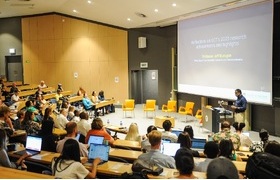
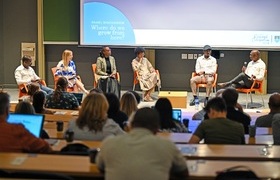
The celebration held on 2 December at the New Lecture Theatre on Upper Campus, provided an overview of the activities, challenges and achievements that characterised the university’s research landscape over 2025. The event was hosted under the auspices of the acting Deputy Vice-Chancellor: Research and Internationalisation, Professor Jeff Murugan and acting Executive Director: Research, Christina Pather.
“There’s an old Chinese curse that says, ‘may you live in interesting times.’ I’ve never understood why it’s a curse. We should all want to live in interesting times. But I think after 2025, I understand why it’s a curse.”
Professor Murugan’s remarks prefaced a reflection on the implications of the withdrawal of several United States (US) federal grants, which affected projects across the university and disrupted funding for staff, postgraduate students and postdoctoral fellows.
“For instance, in 2024, the National Institutes of Health (NIH) alone funded over 140 projects at the university and contracts to the value of R650 million were concluded. While this fact is a point of immense pride, our learning has been the importance of renewing efforts to harness that same excellence and credibility to secure comparable support from a broader range of funders,” he said.
While acknowledging that the university mobilised at the drop of the hat, Murugan said the experience brought into focus the need for stronger preparedness and greater diversification of research funding, even as UCT holds an unparalleled record in securing US federal research support.
He mentioned being encouraged by the stability to the research enterprise that the incoming Deputy Vice-Chancellor for Research and Internationalisation, Professor Thokozani Majozi, would bring. Professor Majozi’s term is set to commence at the start of 2026.
“Despite a difficult year, we continued to support one another and produce work that matters.”
All challenges considered, UCT retained its position as the leading university in Africa across all five major global rankings in 2025. The DVC pointed out that while rankings are an imperfect measure, they remain important indicators of the university’s public standing.
“They [rankings] have been criticised for being overvalued and for reinforcing global, regional and national inequalities, running the risk of limiting how we think about education systems as a whole. Still, they cannot be ignored. Rankings matter because reputation matters,” he said.
Significant research achievements and recognitions further marked the year. Murugan highlighted some of the honours and funding secured by UCT researchers, including the Oppenheimer Memorial Trust’s New Frontiers Research Award conferred to Associate Professor Katye Altieri, the Harry Oppenheimer Fellowship received by Professor Anthony Figaji and the five-year continuation of the South African Medical Research Council (SAMRC)/UCT Drug Discovery and Development Research Unit led by Professor Kelly Chibale.
UCT researchers also featured prominently at the National Research Foundation (NRF) Awards, receiving lifetime achievement, emerging researcher and next-generation researcher accolades, alongside a notable share of the country’s P-ratings.


Advances in partnerships, innovation and global engagements also received a hat-tip. These included the launch of UCT’s dual collaborative degree with Sciences Po, UCT being named the first African host of the 2026 THE World Academic Summit and the establishment of the African Hub on AI Safety, Peace and Security. Supported by the department of Research, Contracts & Innovation the university recorded six new spin-off companies in 2025 – the highest in over two decades – bringing the total number of spin-offs supported since 2004 to 40.
The Conversation Africa awards
Founding editor of The Conversation Africa’s (TCA), Caroline Southey presented two awards. The first recognised the author of the most-read article in 2025, Dr Jacinta Delhaize. Her article, ‘South African telescope discovers a giant galaxy that’s 32 times bigger than Earth’s’ received 86 500 reads.
The other recognition was conferred to Dr Misheck Mutize for the highest output of five articles, of which four have been translated into French.
Launching research communication and marketing products
Developed by the Research Office, a selection of research communication and marketing products were unveiled, including the latest addition to the Research Snapshots, the ‘Accelerating research with advanced digital infrastructure’. This new insert to the suite showcases UCT’s first-rate technology enabled research offerings (eResearch) that encompass systems for storage, transfer, analysis, preservation and dissemination of data.
Looking back
Acting ED: Research, Christina Pather, acknowledged the support that enabled UCT’s research successes during the year: “I am proud of what our researchers, with the support of our professional administrators, achieved – especially given how trying the past 12 months were. I hope you will walk away accepting our acknowledgement of your efforts in taking us through another cycle.”
*The first article in this two-part series is: UCT invested in nurturing the next generation of researchers.
 This work is licensed under a Creative Commons Attribution-NoDerivatives 4.0 International License.
Please view the republishing articles page for more information.




Research & innovation