
Wamkelekile, Welkom
UCT leads Africa in two major international rankings
02 December 2025 | Story Lara Dunwell. Photo Lerato Maduna. Read time 3 min.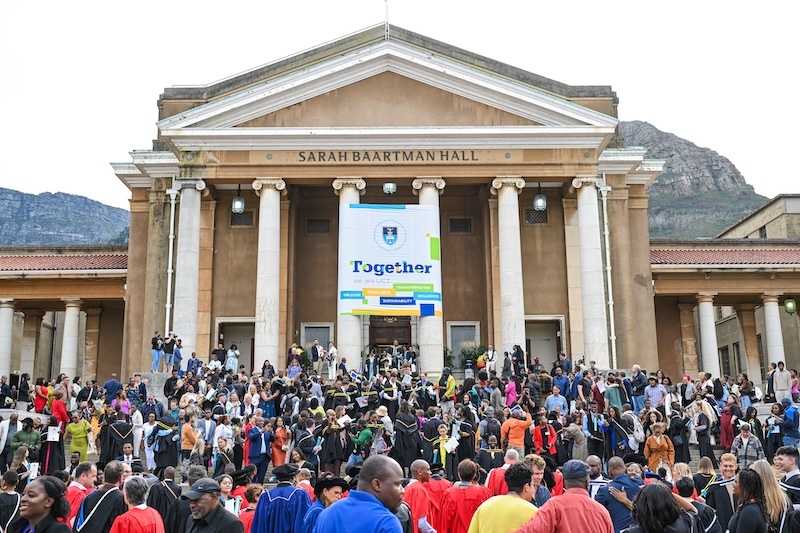
The University of Cape Town (UCT) has recorded strong performance in two major international rankings released in November 2025.
The ShanghaiRanking’s Global Ranking of Academic Subjects (GRAS) 2025 reported consistent results for UCT across several subjects, while the Quacquarelli Symonds (QS) Sustainability Rankings 2026 confirmed the university’s positive activity in environmental, social and governance-related indicators.
Top in South Africa in 10 subjects
Published on 19 November, the latest GRAS results place two UCT subjects in the global top 50 and four in the global top 100. All four subjects ranked first in South Africa:
- Geography – ranked 47th (previously 43rd in 2024)
- Public Health – ranked 49th (improved from the 51–75 band)
- Oceanography – ranked 51–75 (up from the 76–100 band)
- Mining & Mineral Engineering – ranked 76–100 (entering the top 100 for the first time)
Three of these subjects improved their positions compared to 2024. In addition, five other UCT subjects were ranked in the 101–150 band: Pharmacy & Pharmaceutical Sciences, Environmental Science & Engineering, Clinical Medicine, Atmospheric Science, and Ecology.
UCT had more subjects listed in the 2025 GRAS than any other university in Africa and ranked first in South Africa in 10 subjects, including Economics and Human Biological Sciences (both in the 151–200 band). Ecology was the only listed subject not ranked first nationally.
“It is encouraging to see UCT’s subject-level research strengths recognised.”
This year, GRAS evaluated nearly 2 000 universities across 57 subjects. The GRAS methodology is metrics-based, using indicators such as publication output, citation impact, international collaboration, papers in high-impact journals and major academic awards. GRAS rankings do not include reputation surveys.
Strong performance in QS Sustainability Rankings 2026
For these rankings, released on 18 November, UCT tied at 59th place globally with Queen’s University at Kingston, Canada. With 1 994 institutions included this year, UCT emerged in the top 3% worldwide.
UCT’s category positions were:
- 55th in Environmental Impact
- 111th in Social Impact
- 38th in Governance.
In the previous edition, UCT tied at 45th place out of 1 751 universities, again in the top 3%. The QS Sustainability framework evaluates universities across environmental (45%), social (45%) and governance (10%) indicators.
Commenting on the two rankings outcomes, Professor Jeff Murugan, acting deputy vice-chancellor for Research and Internationalisation, said: “They reflect the commitment of our researchers, students and professional staff to advancing knowledge that prioritises academic excellence and social responsiveness.”
He added that universities are expected to incorporate sustainability into their core missions of education, research and outreach: “It is encouraging to see UCT’s subject-level research strengths recognised alongside our growing contributions to sustainability. We remain focused on deepening this work through strong partnerships and a clear commitment to societal impact,” Professor Murugan said.
 This work is licensed under a Creative Commons Attribution-NoDerivatives 4.0 International License.
Please view the republishing articles page for more information.



Research & innovation