
Wamkelekile, Welkom
‘Let the science begin’
04 March 2026 | Story Niémah Davids. Photo Nasief Manie. Read time 8 min.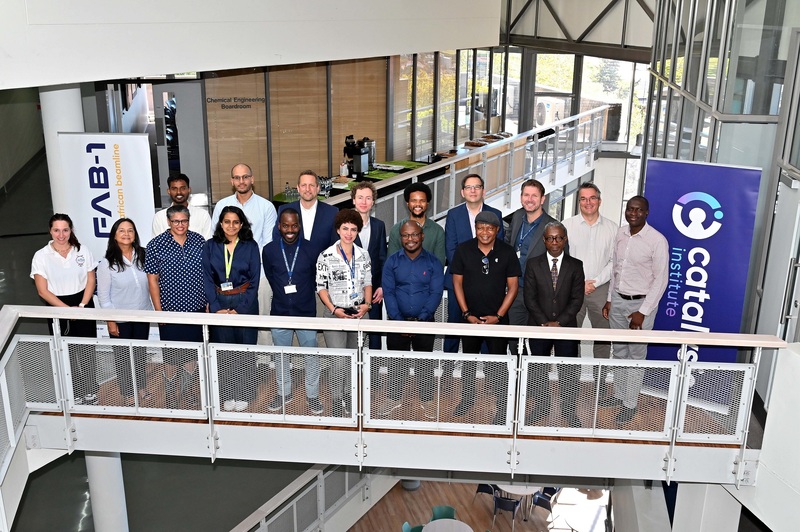
In a landmark moment for the University of Cape Town (UCT), a synchrotron beamline has finally landed on African soil. Its arrival is especially significant for the fields of science and engineering on the African continent and is set to take research, and teaching and learning into a whole new realm.
Housed in the Catalyisis Institute in UCT’s Department of Chemical Engineering, the synchrotron beamline, known as FAB-1, is a first for Africa and was officially launched on Friday, 27 February. Speaking during the launch event, UCT’s deputy vice-chancellor for Research and Internationalisation, Professor Thokozani Majozi, said the instrument is a huge step forward for UCT and marks a milestone for the university’s research, and teaching and learning enterprises.
The tool was funded by the National Research Foundation’s (NRF) National Equipment Programme (NEP) – a programme established to ensure South African researchers are not disadvantaged by the lack of access to world-class scientific tools. And they won’t be. FAB-1 enables X-ray absorption spectroscopy (XAS) – a powerful, element-specific analytical technique used to determine the local atomic and electronic structure of materials, including oxidation states, coordination numbers and bond distances. According to Professor Majozi, the two principal analytical regions of an XAS spectrum are known as the X-ray absorption near edge structure and the extended X-ray absorption fine structure. Together, he said, they allow scientists to understand not just what material is, but how it functions at an atom scale – for catalysis, for energy materials, for battery research, for environmental science and for pharmaceutical development. He said XAS has become the cornerstone of modern materials science worldwide.
Fast-tracking research
Prior to its arrival at UCT, Majozi said African researchers who needed access to the instrument were forced to travel to Europe, the United States, Asia or Australia to access it. These instruments, he said, are extraordinarily expensive infrastructure that cost hundreds of millions of dollars to build. As a result, they’re only accessibly to a fraction of researchers worldwide who need them.
“Africa, a continent of 1.4 billion people and a rapidly growing scientific talent base, had no access to this technology on home soil.”
“Africa, a continent of 1.4 billion people and a rapidly growing scientific talent base, had no access to this technology on home soil, which is likely to change from here onwards. And that’s why I’m saying this [launch] is very significant,” he said.
Now, for the first time in history, Majozi said, an African researcher, and an African student on the continent can walk into a laboratory and perform XAS – without VISA applications, international travel grants or long waiting periods for a facility thousands of kilometres away.
“This is infrastructure sovereignty. And I want to acknowledge the vision and determination of the team at the Catalysis Institute, led by Professor Nico Fischer, who pursued this with the kind of scientific entrepreneurship that this university is proud to mature,” he said.
A shared African resource
Majozi said FAB-1 won’t serve the UCT community alone. Instead, it has been designed as a shared African resource, available to researchers across the continent, supported by training programmes and embedded in an international network that gives users a credible pathway to synchrotron facilities globally.
During his address, he thanked academics from Helmholtz Zentrum Berlin – a world-class research centre for energy materials, whose X-ray source BESSY II attracts researchers from around the globe. Helmholtz Zentrum Berlin has contributed a sizeable amount towards the purchase of FAB-1, and their researchers will be actively involved in training African users – ensuring that the knowledge required to operate and exploit the technology is transferred and retained on the continent.
“Use it boldly, ask hard questions, publish, train, collaborate and teach through this instrument. Africa’s first beamline is ready. Let the science begin.”
“This partnership [with Helmholtz Zentrum Berlin] is what international scientific collaboration should look like. Not a one-way transfer, but a genuine exchange built on mutual respect and shared ambition,” Majozi said. “To every researcher and student who will use FAB-1, this instrument is yours. Use it boldly, ask hard questions, publish, train, collaborate and teach through this instrument. Africa’s first beamline is ready. Let the science begin.”
Strong foundation
The NRF’s Makobetsa Khati said the organisation is honoured and delighted to join hands with the Catalyisis Institute and UCT; and commended the university’s commitment to research excellence, transformation and capacity building.
He said funding the instrument demonstrates that the NRF doesn’t just pay “lip service” but significantly supports catalysis research at UCT and elsewhere within the national system of innovation in a sustainable manner. He told the audience that catalysis research lies at the heart of scientific and industrial innovation – from advancing sustainable energy solutions and chemical processes, to enabling cleaner fuels and more efficient manufacturing. Khati said the NRF also recognises catalysis as a strategic research priority that contributes directly to the United Nations’ Sustainable Development Goal 7 (SDG7) for affordable and clean energy.

“Catalytic science is central to addressing some of South Africa’s most pressing socio-economic and environmental challenges. And UCT has consistently demonstrated excellence in this field – producing world-class research, fostering interdisciplinary collaboration and training the next generation of highly-skilled scientists and engineers,” he said.
“The launch of the FAB-1 is a milestone. It represents far more than a technical achievement. It’s a powerful statement on Africa’s growing scientific capability, its commitment to world-class research infrastructure, and its determination to shape the future of discovery.”
Proud achievement
Reflecting on the instrument and what it means for the Catalysis Institute, Professor Fischer described XAS as a critical tool that has evolved over the last decade and developed into the pinnacle instrument for material characterisation and understanding.
Over the past couple of years, he said the lab-based beamline has made huge advances with teaching and learning and its arrival at UCT will hugely benefit researchers and students alike. He stressed that it is not just an undergraduate training tool; instead, it is a fully fledged research tool that can facilitate leading research on an undergraduate and postgraduate level. Fischer also reflected on the “fantastic opportunity” to partner with Helmholtz Zentrum Berlin, which will provide students and academics access to experts that offer them the platform to ask questions and build a team and a community that will strengthen the use and output of FAB-1.
“We want to [develop] this equipment [into] an African resource. That is very important to us. it should not be UCT equipment. It should be [for] African research,” Fischer said. “The goal is really [to produce] cutting-edge research, publish high impact journals and make use of this long-term experiment option that we have in the lab. It is the first XAS ever collected on the African continent, and I think we can be proud of that achievement.”
Others who contributed sentiments on the day included Tobias Sontheimer and Marcus Bär from Helmholtz Zentrum Berlin. A group of students also took to the podium to present how XAS has assisted and will continue to assist their research.
 This work is licensed under a Creative Commons Attribution-NoDerivatives 4.0 International License.
Please view the republishing articles page for more information.