
Wamkelekile, Welkom
Waheed Amanjee reflects on ‘deeply meaningful’ Abe Bailey Travel Bursary
02 March 2026 | Story Niémah Davids. Photos Lerato Maduna. Read time 6 min.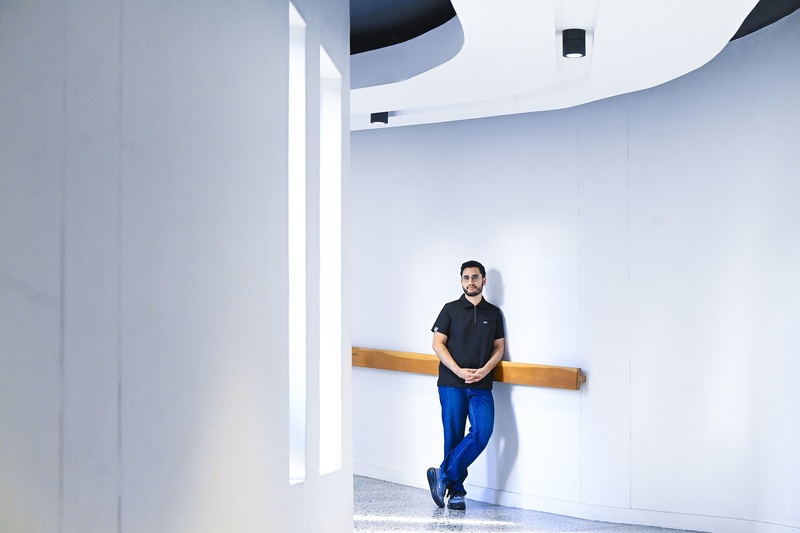
As one of 18 recipients of the Abe Bailey Travel Bursary, Waheed Amanjee described his recent trip to the United Kingdom (UK) as reflective and deeply meaningful.
On a personal level, the final-year University of Cape Town (UCT) MBChB student and 2025 Mandela Rhodes Scholar, said he had the opportunity to interrogate how legacy, power and identity continue to shape the past and the present. The experience also challenged his critical thinking, especially on what responsible leadership in a post-colonial world looks like, and what it means to carry South Africa “with integrity” in global spaces.
The Abe Bailey Travel Bursary is a prestigious leadership award and is offered to full-time students who study at South African universities, as well as academic staff members who hold junior lecture status. Unlike an academic bursary, this one recognises leadership, service, integrity and students with potential to contribute meaningfully to society. The programme joins students from diverse disciplines and institutions for a three-week educational and cultural tour of the UK. The aim is to broaden students’ perspectives, deepen critical thinking, and strengthen the capacity of young South African leaders to contribute meaningfully to their own contexts.
After his return to South Africa, UCT News caught up with Amanjee for more on his experience. Here’s what he had to say.
Niémah Davids (ND): Tell us about your experience as an Abe Bailey Bursary recipient.
Waheed Amanjee (WA): I spent three weeks in England and Scotland participating in a structured leadership programme with student leaders from across South Africa.
What made the experience so distinctive was that it was not designed as a study tour, but as a sustained conversation. Each day centred a forward-looking question – from the future of democracy to the responsibilities of global institutions. We were encouraged to engage critically rather than reverentially. Perhaps most impactful was the interdisciplinary nature of the group. As a student in the health sciences space, I found myself in rigorous discussions with peers studying law, economics, politics, engineering and the humanities. Debates about genomic innovation quickly expanded into questions of global equity, ethics and public trust. It reinforced for me that healthcare and science do not exist in isolation. They sit within legal frameworks, economic systems and social realities.
The experience expanded my sense of context. It sharpened my awareness of how South Africa is positioned globally and it deepened my commitment to contribute to institutions at home that are innovative, accountable and rooted in our own realities.
“What made the experience so distinctive was that it was not designed as a study tour, but as a sustained conversation.”
ND: What has this bursary meant to you professionally?
WA: It significantly broadened my perspective as an emerging clinician-scientist. Engaging with academic spaces such as the University of Oxford and the University of Cambridge provided insight into how longstanding institutions cultivate intellectual culture, interdisciplinary collaboration and sustained research ecosystems.
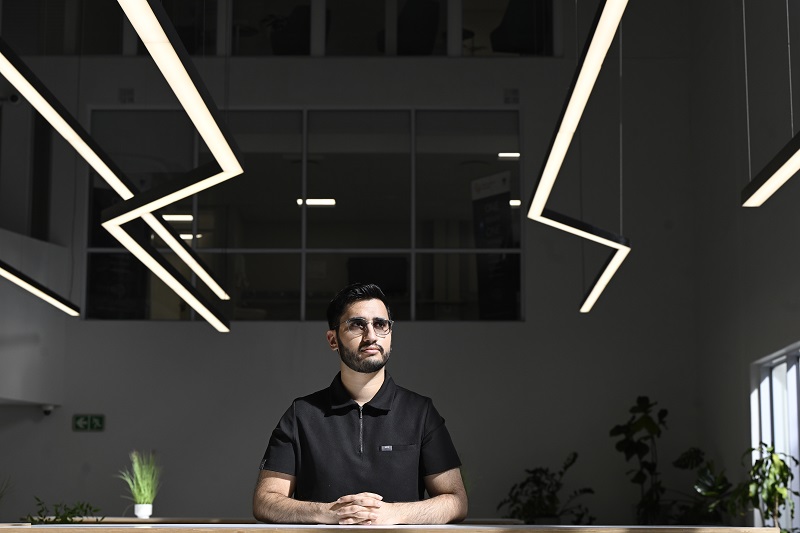
The experience strengthened my commitment to advancing African-centred genomic research while remaining globally connected. It reaffirmed that scientific excellence cannot exist in isolation from ethical responsibility and interdisciplinary awareness.
ND: As you mentioned, this experience enabled engagement with scholars from varied disciplines. What did you get from those discussions?
WA: I’d say one of the most valuable aspects of this programme was the opportunity to engage closely with student leaders from across South Africa. And because we came from such different intellectual traditions, discussions were rarely one dimensional. A discussion that started with food waste quickly evolved into debates around economic inequality and regulatory enforcement.
For me as a medical student and bioinformatics researcher, these exchanges were particularly grounding. Scientific innovation can sometimes feel technically focused and insular. Engaging with peers in law and politics pushed me to think more critically about governance frameworks, data protection, equitable access to healthcare technologies and the unintended consequences of innovation.
The outcome was not consensus, but depth. We left with a stronger appreciation for collaborative thinking and a clearer understanding that meaningful change requires interdisciplinary dialogue. For me, it reinforced that the future of healthcare, science and policy in South Africa will depend not only on technical expertise, but on our ability to listen across differences and build solutions together.
ND: Finally, what was the highlight of your trip?
WA: One of the most memorable moments of the trip was visiting Dunnottar Castle in Scotland at sunset. Standing on the edge of the North Sea, surrounded by ruins that have withstood centuries of conflict, invasion and political struggle, I was struck by how visibly history lingers in landscapes. Scotland’s own history of conflict and subjugation under English rule added a layer of complexity to the experience. It reminded me that power, resistance, and identity are not abstract concepts – they are lived realities embedded in nations across time.
“It prompted me to think more critically about how nations reconcile their past while building forward-looking futures.”
As a South African, coming from a country shaped profoundly by colonialism and its aftermath, that moment felt unexpectedly resonant. It disrupted that simplistic narrative of coloniser and colonised and instead revealed a more intricate web of histories, struggles and negotiations of identities. It prompted me to think more critically about how nations reconcile their past while building forward-looking futures. That moment stayed with me long after we left Scotland. It was a reminder that the work of nation-building and institutional reform is slow, layered and often unfinished – but also deeply human.
Waheed Amanjee has represented UCT at events abroad several times before. These events include the African Leadership University’s Health Entrepreneurship Hackathon; the Cansağlığı International Medical Student Conference; and the Reach Alliance.
 This work is licensed under a Creative Commons Attribution-NoDerivatives 4.0 International License.
Please view the republishing articles page for more information.