
Wamkelekile, Welkom
UCT researcher wins global grant to study AI and youth unemployment
11 February 2026 | Story Myolisi Gophe. Read time 6 min.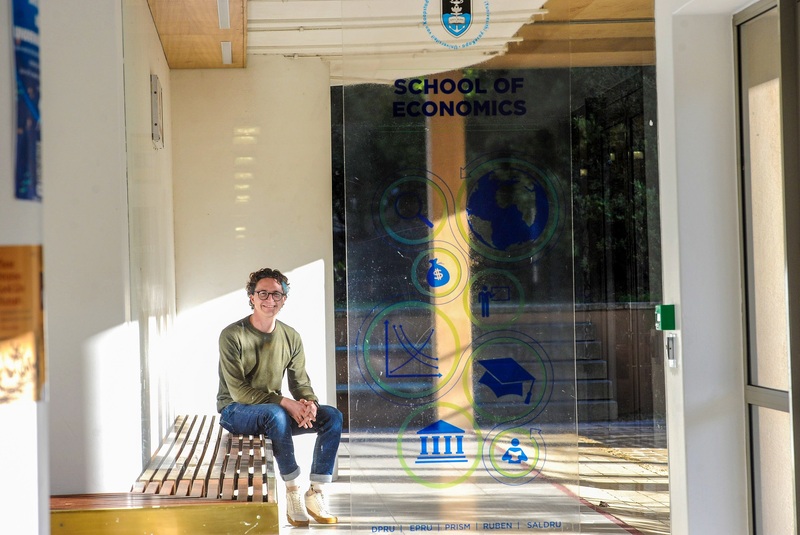
A University of Cape Town (UCT) researcher has received a prestigious international research grant to investigate whether artificial intelligence (AI) can help improve employment prospects for unemployed young people in South Africa – placing youth at the centre of a global conversation on the future of work.
Dr Tim Köhler, a senior research officer at the Development Policy Research Unit (DPRU) in UCT’s School of Economics, is among 19 early-career researchers worldwide selected from over 300 applicants to receive funding from Schmidt Sciences’ AI at Work programme, which is investing more than US$3 million (about R48 million) in real-world studies on how generative AI is transforming labour markets.
Dr Köhler’s project is the only South African-led study in the global cohort. It will generate the first rigorous evidence on how a generative AI-powered career guidance tool affects the job-search outcomes of unemployed youth in a developing-country context.
Youth unemployment remains one of South Africa’s most urgent socio-economic challenges. According to Statistics South Africa, an estimated 60% of the youth labour force aged 15 to 24 and 40% of those aged 25 to 34 are unemployed – among the highest rates globally – affecting roughly five million young people. This persistent labour-market exclusion is a key driver of inequality and poverty. For many young people, prolonged unemployment reduces not only current income but also skills accumulation, confidence, well-being, and long-term opportunities.
“A variety of factors explain these high rates, but for young jobseekers, severe information constraints can play a particularly important role,” said Köhler. “They may not know which career paths are viable given their circumstances, what skills employers are actually looking for, or how to navigate both formal and informal labour markets.”

These challenges make South Africa a critical case for understanding AI’s potential role in labour markets where unemployment is structural and opportunities are scarce.
“If AI can help young people navigate these complexities here, the lessons are likely to be relevant for many other countries across the continent and the Global South,” Köhler said.
A global programme with local relevance
The AI at Work programme, run by United States-based non-profit Schmidt Sciences, supports studies that examine how AI affects worker productivity, wages, employment and careers. Awardees were selected from more than 300 applicants and represent institutions across eight countries.
According to Schmidt Sciences, the goal is to generate credible, real-world evidence at a time when AI is rapidly entering workplaces, often faster than policy and regulation can respond.
“AI is set to transform many aspects of our lives, and the problem is, we don’t know in what way,” said Nobel laureate economist Daron Acemoglu, one of the programme’s reviewers, in a press release issued by the Schmidt Sciences. “The labour market is particularly vulnerable.”
For UCT, Köhler’s selection reinforces the university’s role as a globally recognised centre for research on inequality, labour markets and development.
“This award places UCT – and South Africa more broadly – at the forefront of an emerging global conversation about AI and work,” Köhler said. “One that has so far been dominated by evidence from high-income countries.”
The study Köhler is conducting will evaluate an AI-based career guidance tool designed specifically for unemployed young people. The tool is being co-designed with a Cape Town-based technology firm and informed by ongoing engagement with NGOs, researchers and government stakeholders working in the youth employment space.
“This award places UCT – and South Africa more broadly – at the forefront of an emerging global conversation about AI and work.”
Powered by large language models and built for low-bandwidth settings, the tool will function as a personalised, interactive assistant that young jobseekers can access on their phones or computers.
“Through a simple conversational interface, users can receive guidance tailored to their own circumstances,” Köhler explained. “That might include identifying realistic job opportunities, improving a CV, preparing for interviews, or considering training or self-employment pathways when formal jobs are limited.”
Crucially, the aim is not just to provide more information, but better information.
“Many young people receive generic advice that doesn’t reflect local labour market conditions or their personal circumstances,” said Köhler. “We want to see whether more relevant, personalised, dynamic guidance can help improve decision-making and, ultimately, well-being.”
Rigorous evidence to inform policy
What distinguishes the project is its use of a randomised controlled trial (RCT) – a method widely regarded as the gold standard for determining whether an intervention itself causes changes in outcomes.
By randomly assigning access to the AI tool, the study will be able to isolate its impact on employment outcomes, job search behaviour, confidence and expectations.
“There’s a lot of excitement about AI, but still relatively little rigorous evidence, especially in developing countries,” Köhler said. “This approach allows us to move beyond assumptions and test what actually works – for whom, and why.”
The study will also explore whether AI-based guidance has unintended consequences, such as reinforcing inequalities or raising expectations without improving access to real opportunities.
“That’s just as important as identifying any positive effects,” Köhler added.
South Africa’s youth face a labour market shaped by spatial inequality, skills mismatches and limited entry-level opportunities. Köhler is careful to stress that AI cannot solve these challenges on its own.
“There’s a lot of excitement about AI, but still relatively little rigorous evidence, especially in developing countries.”
“Our expectation is not that AI is a silver bullet for solving unemployment,” he said. “But if well designed, it may help ease specific constraints young people face as they try to navigate the labour market.”
If the tool proves effective, it could point to scalable, low-cost ways of supporting young jobseekers alongside or as part of existing labour market policies, such as public employment, training, and job-readiness programmes.
“For policy makers, the findings can help inform whether and how digital tools should form part of a broader youth employment strategy,” Köhler said. “For educators and training providers, the results may highlight the value of personalised guidance.”
The project aligns closely with UCT’s commitment to socially responsive, evidence-based research that promotes development in South Africa and beyond.
“Youth unemployment is one of the country’s most pressing development challenges,” said Köhler. “Identifying which interventions can meaningfully alleviate it is essential for inclusive and effective policy.”
“Ultimately, the aim is to support more grounded and responsible approaches to using technology,” Köhler said, “as part of a wider effort to expand opportunities for young people and reduce poverty and inequality.”
 This work is licensed under a Creative Commons Attribution-NoDerivatives 4.0 International License.
Please view the republishing articles page for more information.