
Wamkelekile, Welkom
Contribute meaningfully to develop society
17 February 2026 | Story Kamva Somdyala. Photos Je’nine May. Video Production Ruairi Abrahams, Quickclick Productions and Nomfundo Xolo. Read time 5 min.
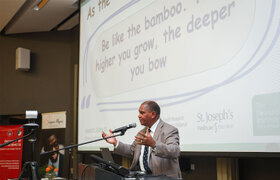
The University of Cape Town (UCT) will continue its mission as a global centre of excellence. This according to Vice-Chancellor (VC) Professor Mosa Moshabela, as he hosted the Heads of Mission Breakfast on Thursday, 12 February.
The event ordinarily falls on the day of the State of the Nation Address and provided Professor Moshabela an opportunity to strengthen UCT’s international relations. It was a platform to explore global challenges, as well as opportunities for enhanced academic cooperation, research partnerships, and support for international students.
Addressing guests, under the theme “The Future of Education, Research, Science, Technology and Innovation: Building Bridges for Global Progress”, Moshabela said: “We are here to talk about what’s going on in the country, the continent and the world. At [an uncertain] time like this in the world, we recognise that we need to step up as universities to ensure we maintain partnerships and provide spaces for thinking and make available our brain trusts across the world.”
“What we see in UCT’s plan is a redoubling of its efforts to be agile.”
He added: “If we are not fulfilling the role of advancing society socially, economically and environmentally, then the legitimacy of our role as institutions will remain in question. Ours is not a narrow function of just educating and publishing research and making evidence available – our task has to contribute actively to developing society.”
Chancellor Dr Precious Moloi-Motsepe, a vital advocate for youth, echoed the VC’s sentiments.
“Technology has massively changed the playing field for education. Access has become improved because as technology improves, more opportunities are opened for our vast population of young people.”
Benedicto Fonseca Filho, the current ambassador of Brazil to South Africa, said cooperation within the realm of humanity is key to sustaining partnerships, adding that challenges, such as funding, faced by South African institutions, are also present within their own context.
Emeritus Professor Danie Visser noted during a panel discussion: “The important thing for institutions is to be agile in these circumstances: when a particular opportunity arises, we have got to take it. Also, we must prepare the way. What we see in UCT’s plan is a redoubling of its efforts to be agile in its innovation and to be able to respond to the challenges in a way which brings together industry, academia and business. That’s an important project that the VC has put on UCT’s agenda.”

Deputy Vice-Chancellor (DVC) for Transformation, Student Affairs and Social Responsiveness Professor Elelwani Ramugondo said: “In science diplomacy, we must be intentional about legitimacy within society, and it starts with what happens within the university itself. Our VC is becoming more pronounced about innovation and entrepreneurship.”
Benefit of academic institutions
Anna Karin Eneström, the ambassador of Sweden, offered the following reflections: “It was great discussing cooperation with the panel. We’re looking at how we can use scientific diplomacy to push global progress.” South Africa’s network with Sweden can be found, among other partnerships, through the South Africa-Sweden University Forum (SASUF). “This is a platform where all universities have the same voice and the focus is to push the developmental agenda.”
UCT enjoys a harmonious relationship with the European Union (EU), according to ambassador of the EU Delegation, Sandra Kramer. “Building bridges can sometimes be daunting because you don't know how to start and [how to] foster those partnerships, but UCT has a very good international relations division. We know that there are currently over 100 students and staff from UCT in various countries of the EU doing great work.”
James Christoff, High Commissioner of Canada, added: “Some of the issues the world is wrestling with have a difficult geopolitical lens put on them. The benefit of academic institutions is taking those issues and moving them into a place where they can be looked at in their purest form and bring solutions back to political decision-makers.”
Professor Carlos Lopes, an honorary professor at the Nelson Mandela School of Public Governance at UCT, led a panel discussion on the topic.
 This work is licensed under a Creative Commons Attribution-NoDerivatives 4.0 International License.
Please view the republishing articles page for more information.