
Wamkelekile, Welkom
Celebrating a legacy of leadership in public governance
18 February 2026 | Story Kamva Somdyala. Read time 4 min.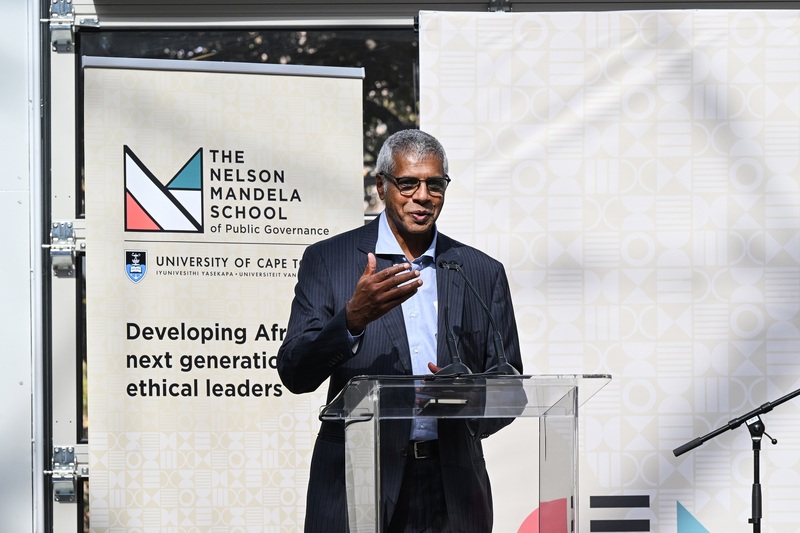
In recognition of his significant contributions to the University of Cape Town (UCT), Professor Faizel Ismail retired as emeritus professor. He is the former director of the Nelson Mandela School of Public Governance at UCT.
Since July 2015, he has convened postgraduate and master’s level courses at UCT on international trade law in the Faculty of Law; on international trade policy and practice at the UCT Graduate School of Business (UCT GSB); and on international trade negotiations and global governance at the Nelson Mandela School of Public Governance.
Emeritus Professor Ismail was the chair of the World Trade Organization (WTO) committee on trade and development negotiating group for two years (2004–2006); the chair of the WTO committee on trade and development for one year (2006–2007); and the chair of the WTO committee on trade, debt and finance for two years (2012–2014).
In welcoming him to the distinguished rank of emeritus professor, UCT Vice-Chancellor Professor Mosa Moshabela wrote: “Your investment in our success, your efforts to maintain and improve our academic standards and your service to our students are among some of the qualities that make us who we are: a community working tirelessly towards unleashing the potential of all who come to work and study at UCT.”
“We wanted to try and understand what the root causes of the disease of corruption are.”
Ismail reflected on his tenure as director, which began in 2019: “When I took over from Professor Alan Hirsch, I decided one of the key challenges the school should address is how to build a research programme that would help infuse the curriculum of the existing master’s programme so that it reflected the research that was done on the African continent.
“We built a strong relationship with the African Continental Free Trade Area (AfCFTA) secretariat in 2019, and even though engagement started in 2020 as COVID-19 hit, we were able to use technology to connect across the continent to discourse about regional economic integration on the African continent. This created excitement and led to the building of an advisory council and a significant, new adjunct faculty in the school. That’s one of my proudest moments.”
Principles of democracy
Ismail has also led the school’s effort to build three research academies: democratic governance and development; regional integration and the AfCFTA; and climate change and development. Each of these academies has succeeded in raising significant funding and the school has a robust programme of research to support both its academic teaching and its executive education programmes.
On governance, he noted: “We wanted to try and understand what the root causes of the disease of corruption are. We were looking for the analytical frameworks that could help us understand why individuals and groups behave in ways which undermine the basic foundations and principles of our democracy. We learned that the key challenge for the continent is to link issues of democracy with underlying structural challenges of economic and social development.”
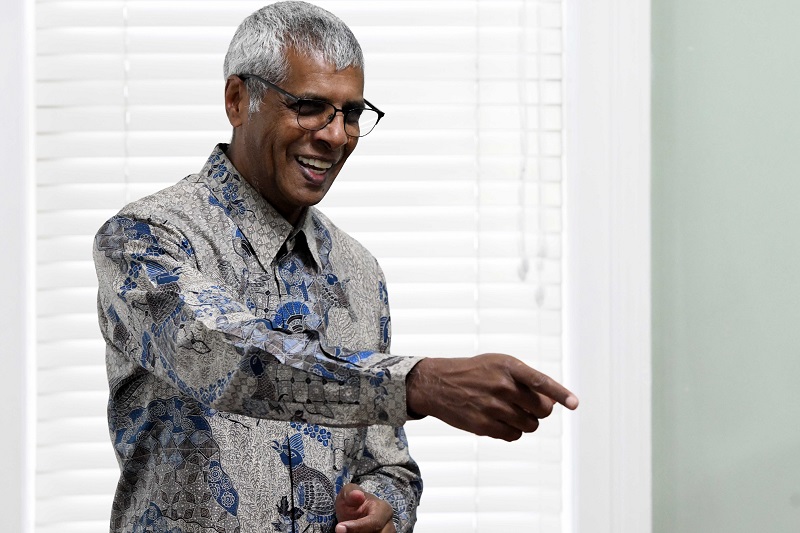
When turning to climate change, he said the school has been discussing the need to change the structure of production, the need to become more resilient and it has been participating in dialogues during Conference of the Parties.
Other successes for Ismail and his colleagues include contributing significantly to fundraising, raising more than R50 million for the school. In 2025, the school raised €1.7 million from the French Development Agency, for a large African executive education programme. He has also facilitated and led over 25 training sessions outside of UCT for public policy officials and civil society stakeholders.
The former director has played an active role in UCT and the Nelson Mandela School of Public Governance outreach and building bridges programmes, participating in over 100 events as a keynote speaker, convenor and chair of webinars and brainstorming sessions. These events included academics, students, public policy stakeholders and civil society activists on the African continent and in international forums.
Under his watch, the school welcomed a major grant of US$21.5 million to build a Nelson Mandela Memorial Centre and School of Public Governance.
“Based on my work at the school, I have been invited to participate in an integrated forum on climate change and trade by the United Nations Framework Convention on Climate Change. This forum will hold dialogues across the world and I have been appointed as one of two co-chairs of the process.”
An emeritus professor has the right to use the title in publications and official ceremonies, may continue to supervise doctoral students and may have other rights as the Council may from time to time decide. “Any person who retires after at least 10 years’ service at the university, and retires from the university as a professor or an associate professor or equivalent (including chief and principal research officers) may be elected by Senate on the nomination of the dean to be an emeritus professor or an emeritus associate professor.”
 This work is licensed under a Creative Commons Attribution-NoDerivatives 4.0 International License.
Please view the republishing articles page for more information.