
Wamkelekile, Welkom
Engineering students compete in global high-performance computing challenge
12 March 2026 | Story Justin Marthinus. Photos Jerome Leca and St Etienne. Read time 4 min.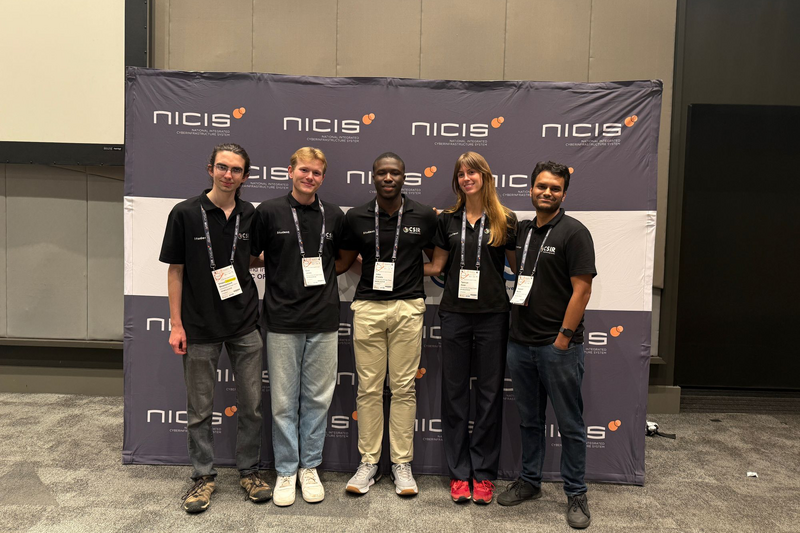
From lecture theatres to liquid-cooled computing clusters, a team of University of Cape Town (UCT) electrical engineering students has proven that technical excellence, teamwork and determination can compete on the national and soon international stage.
At the Centre for High Performance Computing (CHPC) Conference hosted in Cape Town at the end of last year, four current fourth-year electrical engineering students were crowned national champions in the Student Cluster Competition for 2025. Now, Team UCT is preparing to represent South Africa at the global finals in Germany later this year.
National champions
Mentored by Dr Yaaseen Martin, a lecturer in the Department of Electrical Engineering, the UCT team delivered an exceptional performance at the CHPC competition. Competing against top university teams from across the country, the students walked away with:
- 1st place overall
- the prestigious MathWorks Challenge Award
- the honour of representing South Africa at the international finals.
Shaun Beautement, Tamryn Osler, Iloke Alusala and Glen Jones “knocked it out of the park”, earning recognition not only for technical performance but for their ability to collaborate and innovate under pressure. “I’m incredibly proud of each and every one of the students involved in this victory,” said Dr Martin.
Shaun Beautement, team captain, said, “We worked hard in the lead-up to the national competition, automating most of the cluster and benchmark setup, which gave us some wiggle room to weather a few unexpected circumstances. Despite that, we had a fantastic time overall, spoke with many knowledgeable and kind people, and everything came together in the final hours before the results were submitted. We also want to thank Dr Yaaseen Martin, Tristyn Ferreiro, and the 2024 EEElite team for their support”.
Bridging theory and real-world application
The competition, hosted locally at the CHPC Conference and internationally at the International Supercomputing Conference (ISC), is designed to develop the next generation of engineering professionals.
The ISC Student Cluster Competition will take place from 23 to 25 June 2026 in Germany, where team UCT will compete against leading universities from around the world.
The challenge requires student teams to design, build and optimise high-performance computing (HPC) clusters under strict power constraints – a task that mirrors real-world industry environments. Participants must assemble hardware, configure software stacks, and fine-tune performance in real time.
For many students, the value lies in hands-on exposure to cutting-edge systems, including liquid-cooling technologies, high-speed interconnects, parallel programming frameworks and advanced optimisation techniques. These are critical skills in an era shaped by artificial intelligence, machine learning and big data.
In this environment, classroom theory becomes tangible engineering practice.
More than machines
While technical capability is central to the competition, success depends on far more than computing power alone.
Teams must demonstrate rigorous teamwork, strategic planning and effective communication. Under tight deadlines and power limitations, students are required to solve complex problems collaboratively and present their solutions to panels of industry experts.
This combination of technical and professional development is intentional. The competition serves as a bridge between academia and industry, creating a space where global technology firms can identify emerging talent. For students, it is both a proving ground and a launch pad.
Raising the bar for engineering excellence
Ultimately, the Student Cluster Competition aims to elevate national engineering standards while preparing students for the demands of a rapidly evolving digital economy.
With their national championship secured, team UCT now turns its focus to the international stage: carrying not only the university’s name, but South Africa’s flag, into one of the world’s most prestigious high-performance computing platforms.
Read more about the ISC Student Cluster Competition.
 This work is licensed under a Creative Commons Attribution-NoDerivatives 4.0 International License.
Please view the republishing articles page for more information.