

Wamkelekile, Welkom
Sihle Sogaula on learning from loss
09 April 2026 | Story Nicole Forrest. Photo Supplied. Read time 6 min.
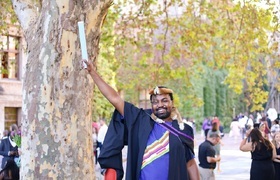
Sihle Sogaula holds a Master of Arts in Fine Arts (MAFA) in which she explored how ukugoduka – an isiXhosa concept about returning, both physically and metaphorically, to your roots – can be used as a framework for working through personal and familial histories. Her work and her journey to obtaining her master’s degree have seen Sihle be named one of the 2026 inspirational graduates.
For Sihle, her interest in fashion grew out of far more than just a liking for clothes. Having grown up in an all-female household in Qonce in the Eastern Cape as the daughter of a fashion designer, she developed a deep appreciation for the significance of the pathways that lead us to make sartorial choices, as well as the power that they carry.
“I grew up in a house of just women. It was my grandmother, my mother, my two aunts and my cousins. So, a lot of my upbringing was spent around much older women, and I was always watching them and their processes of adornment and beautifying themselves,” Sihle explained.
“My mom was also a designer, and when I walked to her studio after school in the afternoons, I would see these phenomenal conversations taking place between my mom and her clients.
“Women would come in with magazines and cut-outs and swatches of material or zips, and I would watch how conversation would turn into a garment and into joy. I was given a window to witness this small but really profound transformation and the development of genuine relationships.
“To my young mind, this wasn’t about the clothes. It was a display of a kind of shared intimacy – the transformation of an idea that eventually becomes something that you adorn your body with; that you walk around in and sees you being perceived in a particular kind of way.”
Returning to her roots
This deeply ingrained appreciation for the stories that can be told by the garments one chooses to wear and the emotional significance that an ensemble can hold had a profound influence on Sihle’s master’s research.
“I had this plaid dress, which my mother hated, that I loved. I wore it so much that my mom needed to repair it multiple times, and I even tried to get her to extend it when I started growing out of it,” she recalled.
“Unfortunately, I had sent it to her and it disappeared somewhere along the line and I experienced a kind of heartbreak. Reflecting on that moment later, I realised that there is also a kind of sense of loss that you can experience when something that at once was so deeply tied to your way of being and way of expressing yourself is no longer with you.”
“I realised that there is also a kind of sense of loss that you can experience when something that at once was so deeply tied to your way of being and way of expressing yourself is no longer with you.”
The idea of loss itself – of items, loved ones and cultural histories – became central to Sihle’s project. Yet, in working through her mother’s archive at Lindro’s House of Fashion, she discovered that loss could also be generative.
“A lot of the conversations I had in trying to make sense of my research also began from loss. What I had been curious about, initially, was the longer arc of colonial influence, how colonial contact reconfigured cultural practices and contributed to the slow erosion of traditional relationships to dress,” she said.
“I was sitting with the question of why this moment of contact had such a permanent effect. And, at the same time, I’m dealing with the loss of my mother by working through her archive and trying to meet her as a woman who was a creative – not just as my mom.
“Part of this was spending a lot of time and being in deep conversation with her friends and clients, which made me deeply aware of how generative loss can actually be. These exchanges prompted me to think with, rather than against, absence, translating lived memory into a method for engaging the archive. In this sense, the gaps are not sites of lack, but spaces of possibility: openings through which alternative narratives, embodied knowledge, and speculative forms of reconstruction can emerge.”
A proud moment
For Sihle, the recognition is meaningful precisely because it represents not an ending, but an invitation for others to follow their own curiosities, to work at the margins of institutional thinking and to contribute to expanding what scholarship can hold.
“If it means that the work is in some way valuable and it resonates, then I’m quite pleased,” she reflected. “If it means that I’ve made a small but significant contribution to shifting ideas of what is deemed legible in the academic context, I’m proud of the effort I’ve made.”
“I received generous funding from the University of Cape Town’s (UCT) Accelerated Transformation of the Academic Programme (ATAP) where the research that I’m doing sits, in some ways, on the fringe of thinking within the university ecosystem.
“So, I hope that this helps others who are studying things that are otherwise kind of unconventional see that they can access funding so that they can also pursue their questions and curiosities. If that’s the case, then I feel great about being named an inspirational grad.”
 This work is licensed under a Creative Commons Attribution-NoDerivatives 4.0 International License.
Please view the republishing articles page for more information.



.png)