

Wamkelekile, Welkom
Research shines a spotlight on the language gap in higher education
09 April 2026 | Story Myolisi Gophe. Photos Supplied. Read time 6 min.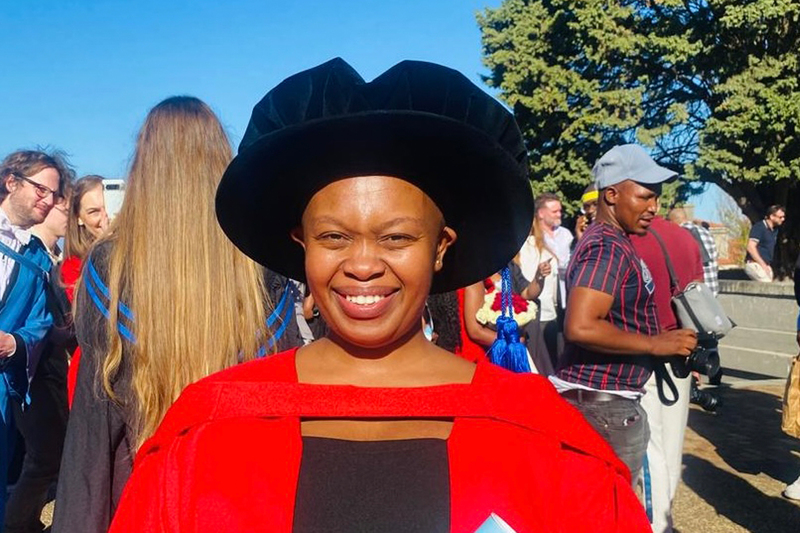
Despite South Africa’s progressive Constitution recognising 12 official languages, multilingualism in higher education remains more aspirational than actual – with English still firmly dominating lecture halls, assessments and institutional life.
Dr Naledi Maponopono, a board member of the Pan South African Language Board, graduated with her PhD last week, which focused on this disconnect, using the University of Cape Town (UCT) as a case study. Her research interrogates how language policies are implemented – and why they often fall short.
“At a policy level, South Africa affirms linguistic diversity, but this promise is not consistently reflected in university teaching, assessment, or administration,” said Naledi, a senior academic developer in language and academic literacies at Nelson Mandela University. “There is a strong discourse of transformation and inclusion, but this often contrasts with monolingual academic practices.”
Her work is rooted in a broader concern with epistemic justice – the idea that whose language is recognised in academia shapes whose knowledge counts. Naledi has long been interested in how language mediates power, belonging and student success.
Language as a problem, not a resource
Drawing on Richard Ruiz’s influential framework, which views language as a problem, a right, or a resource, her study reveals a troubling trend. “The dominant orientation in higher education remains language as a problem, particularly in relation to African language speakers,” she said. “Language difference is frequently framed as a deficit that needs to be corrected rather than a resource that can enrich teaching and learning.”
“There is also uncertainty about how to implement multilingual practices in concrete ways within lectures, tutorials, and assessments.”
This framing has real consequences. While universities may formally endorse multilingualism, implementation is uneven and often superficial. Staff, Naledi noted, are generally supportive of multilingual approaches but face significant constraints.
“There are time pressures, curriculum demands, and assessment systems that privilege English,” she said. “There is also uncertainty about how to implement multilingual practices in concrete ways within lectures, tutorials, and assessments.”
For students, the impact is deeply personal. Those who speak African languages as their first language often find themselves navigating a disconnect between their linguistic identities and the expectations of academic culture. This can affect not only comprehension, but also confidence and sense of belonging.
Compounding the issue are structural barriers that continue to privilege English as the language of academic legitimacy and global mobility. “There is limited investment in African language development – in staffing, curriculum design, and research capacity,” she explained. “There are also persistent assumptions that African languages are not suited to complex academic work.”
These assumptions, she argues, are rooted in historical inequalities shaped by colonial and apartheid legacies – and continue to reinforce deeper epistemic hierarchies that marginalise indigenous knowledge systems.
Rethinking implementation
Yet her research does not simply diagnose the problem; it also points to practical solutions. A key recommendation is the development of robust monitoring and evaluation systems to ensure that language policies translate into meaningful action.
“An effective system would focus on actual practices rather than symbolic policy statements,” she said. “This could include regular reviews of teaching and assessment practices, with clear indicators linked to multilingual goals.”

Importantly, such systems should not be punitive but enabling. “They should offer training, resources, and recognition to staff who experiment with and sustain multilingual approaches,” she added.
Looking ahead, Naledi envisions a higher education landscape in which African languages are fully integrated into all aspects of university life – not as optional add-ons, but as legitimate languages of teaching, learning, research and administration.
“A truly equitable framework would be responsive to local linguistic contexts and supported by adequate funding and institutional commitment,” she said. “Achieving this requires political will, long-term planning, and collaboration between universities, government, and language bodies.”
Central to this vision is the active participation of students and staff in shaping language practices – ensuring that policies are grounded in lived realities rather than imposed from above.
Ultimately, Naledi argues, language policy is not a peripheral concern, but a core issue in the transformation of higher education.
“Multilingualism is deeply linked to questions of access, belonging, and knowledge justice,” she said. “If South African universities are serious about transformation and decolonisation, language must be addressed as a central institutional issue.”
 This work is licensed under a Creative Commons Attribution-NoDerivatives 4.0 International License.
Please view the republishing articles page for more information.



.png)

