
Wamkelekile, Welkom
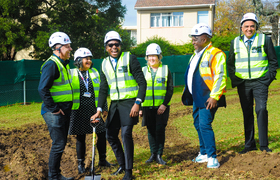
Historic moment as UCT and Services SETA break ground on skin health institute
17 February 2026 | Story Niémah Davids. Photo ARISE. Read time 10 min.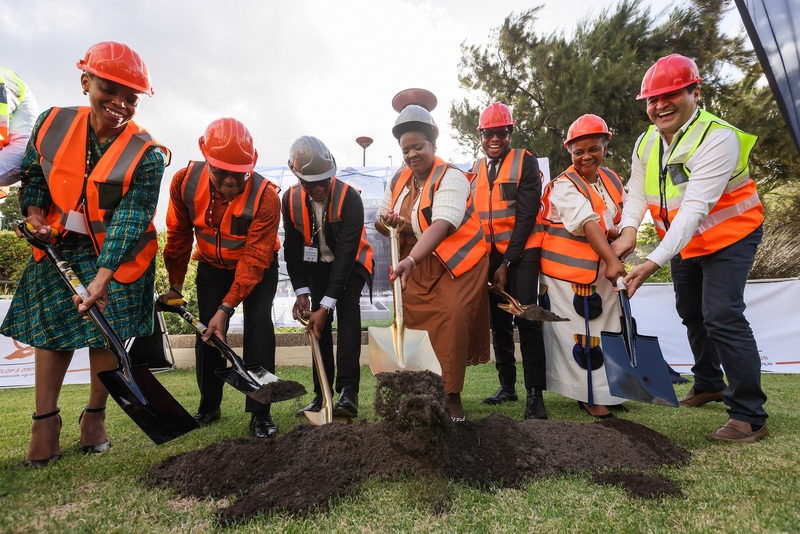
“Our skin carries powerfully for us a sense of history: where we have been [and] a sense of identity; who we are becoming.”
Professor Lionel Green-Thompson, the dean of the University of Cape Town’s (UCT) Faculty of Health Sciences (FHS), used these apt words to open an event that marked the turning of the soil. This signalled the start of construction of the brand-new African Research Institute for Skin Health (ARISE) – a research, training and skills development institute and the first of its kind for Africa. The event was held on Friday, 13 February.
Made possible by the Services Sector Education and Training Authority (SETA) through a multi-million-rand capital injection, the multi-storey ARISE building will be based in the Division of Dermatology in the Department of Medicine and will be located on the FHS campus in Observatory. Its core focus will be on bolstering research, training, and industry engagement in skin and hair health relevant to African populations.
“African skin and hair have too often been overlooked, understudied, or treated as an afterthought.”
“African skin and hair have too often been overlooked, understudied, or treated as an afterthought [or] accidental finding. For far too long have we been underrepresented in research and in product development with sufficient safety standards. Too often our knowledge has been imported rather than produced from within the continent,” Professor Green-Thompson said. “The ARISE building foregrounds African science for Africans in an African context.”
The facility will expand South Africa’s capacity for practical, industry-aligned training, applied research, cosmetic product safety testing and occupational skin health research. The new infrastructure will support increased student intake, expand short course offering and strengthen industry-facing service units. ARISE is rooted in a decade of research, postgraduate training and industry collaboration. The programme has already trained more than 100 cosmetic formulation graduates.
Reshaping the future
Welcoming the audience, UCT Vice-Chancellor Professor Mosa Moshabela said the university will soon celebrate its double centenary. And as the institution heads towards its next 100 years, it requires imagining and reimagining where it wants to be and what it wants to look like.
That imagining and reimagining, Professor Moshabela said, will help to reshape the university’s future, and projects like ARISE will contribute to shaping what that future will look like. To date, he said, it has already played a pivotal role in helping the university get to that point. And he’s proud to see that its focus is not just on research, but on training and skills development.
“I look forward to seeing what your students and graduates are going to be doing.”
“It takes research. It takes human capital development. It takes skills development. But it also takes the entrepreneurship that has been happening, and the partnerships with industry that this team has been working on for a long time. I look forward to seeing what your students and graduates are going to be doing, the products that they will continue to develop and the start-ups that are going to come out of the work that you’ll be doing.”
What sparked the idea
When she reached the podium, ARISE project lead at UCT, Professor Nonhlanhla Khumalo, said often when people think of dermatology, they think of cosmetics and botox. But it’s a lot more than that. She told the audience that getting the institute up and running had long been a dream and stemmed from seeing countless patients in the ward at Groote Schuur Hospital (a UCT teaching hospital) with severe drug reactions to cosmetics. As a result, some patients had lost all their skin.
“[Through] the significant amount of quality care they received [by clinicians], we managed to get them out of the ward and well. In the pressure of the clinical time we have, we really don’t want to waste too much time on product-associated side-effects [because] this is the kind of thing that takes up our clinical time unnecessarily,” Professor Khumalo said.
“[What we saw was patients using] products with ingredients that we know are illegal and shouldn’t be in products, yet they are. And that is really what started to get the whole ball rolling [to formally establish the institute].”
A snapshot
Khumalo’s presentation touched on the various units and labs that will form part of the ARISE building and one of it is the Hair Fibre Lab. Interestingly, she said, hair is very complicated. Research found that what you get from curly hair is different to what you get from straight hair. And according to a PhD student’s dissertation, the lipids found in curly hair are higher when compared to straight hair. What this means is that curly hair will incorporate lipid-soluble drugs at a higher concentration.
Therefore, it’s important that clinicians understand the biochemistry of hair, and the Hair Fibre Lab is dedicated to providing the answers they need. She said the lab will produce cutting-edge research, that focuses on mechanics, chemistry and imaging of hair.
But clinicians want to do more than just treat, Khumalo explained. They want to give communities access to things they can’t necessarily afford. This includes providing access to tattoo removal, especially for reformed gangsters and others who are unable to afford the procedure. She said a story that touched her involved a once-gangster patient who turned his life around, became a minister of religion and desperately wanted his tattoos removed.
“He was like: ‘Please can you just cut them out? Do something!’ We couldn’t do anything at the time. But in the ARISE building we are going to be able to offer a service of this kind [to facilitate] this rehabilitation,” Khumalo said.
A significant milestone
The acting CEO of Services SETA, Sibusiso Dhladhla, said the event and the work that’s yet to come marks a milestone in the relationship between UCT, Services SETA, the Department of Higher Education and Training (DHET) and the South African Beauty and Personal Care industry. He said globally, the industry contributes US$350 billion in terms of products and services, and South Africa represents the largest cosmetics and personal care market on the continent (currently sitting at US$4 billion).
“It’s not a small space. It’s a very valuable space.”
“It’s not a small space. It’s a very valuable space. And as an institution [Services SETA], what we are trying to achieve is to formalise the industry and ensure that there are adequate and qualified professionals in the same space. That’s why the support of such a programme actually makes sense for us as Services SETA,” Dhladhla said.
He told the audience that the industry desperately needs professionalisation – to build the economy by way of revenue and tax, and to ensure the industry conforms to general standards, health standards and complies with the country’s labour law. This, he said, will strengthen the outputs that emerge from the sector. The partnership has also sprouted the Advanced Diploma in Cosmetic Formulation programme – a one-of-a-kind initiative that has led to him changing his skincare routine and where he cuts his hair.
“We are building a real trading pipeline. We are making it easier for people to move from high school into colleges and universities, into skills development initiatives, and [once] exiting universities where we support them in terms of entrepreneurship and skills development,” he said. “We’re looking at a 360-degree value chain of support. So, you take an individual from a low level and place them at the highest level. In that way, you are changing the lives of a multitude of people.”
Repositioning the country for the future’
During her address, Dr Mimmy Gondwe, DHET deputy minister, said the sod-turning ceremony – and the academic achievements that led to it – is about positioning South Africa at the vanguard of the future it hopes to create.
“Our gathering here today is not just about marking the official start of construction on a new research institute. We are here to turn intention into infrastructure. We are here to turn policy into platform. We are here to turn partnership into national capacity,” Dr Gondwe said.
“We are here to turn intention into infrastructure.”
The sod-turning ceremony is not only ceremonial in nature. She said it symbolises a commitment to progress and demonstrates an intentional investment in skills development and strength in the university’s capabilities and productive capacity.
“Today we break ground on the ARISE building – an African-led initiative that has already demonstrated excellence in research, skills development and industry engagement. This initiative represents more than just a building or a construction project – it reflects a deliberate national investment in science, innovation and employability,” Gondwe said.
Speakers quoted in this article were captured in order of appearance.
Others who contributed to the event include Professor Ardeshir Bayat of UCT’s Wound Healing and Keloid Research Programme; Lehlogonolo Masoga, Services SETA administrator; and Professor Mashiko Setshedi, the head and chair of UCT’s Department of Medicine.
 This work is licensed under a Creative Commons Attribution-NoDerivatives 4.0 International License.
Please view the republishing articles page for more information.