
Wamkelekile, Welkom
Transforming maths with human connection
04 December 2025 | Story Nicole Forrest. Photo Supplied.
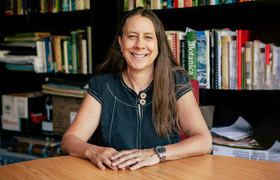
The University of Cape Town’s (UCT) Distinguished Teacher Award (DTA) is the highest accolade awarded to teaching staff at all levels within the university and recognises and celebrates excellent and transformed teaching practice. This year, senior lecturer in the Faculty of Science Dr Juana Sánchez-Ortega received the award for her outstanding pedagogical track record.
Nominees are assessed against a rigorous set of criteria – from their teaching philosophy and inclusive pedagogical approach to their contributions to curriculum renewal, innovation and student development beyond the classroom.
Dr Sánchez-Ortega was selected as one of the recipients of the 2024 DTA as a result of her exceptional, research-informed pedagogy, her deep responsiveness to students’ needs and her transformative impact on mathematics teaching at UCT.
In the decade that she has been a lecturer at the institution, Sánchez-Ortega has deliberately worked to reduce students’ anxiety around mathematics, create inclusive learning spaces and design effective teaching materials that work for students from diverse backgrounds.
She has contributed to the evolution of the mathematics curriculum, consistently achieving outstanding pass rates and evaluation scores. She has also mentored many students outside of the classroom, propelling them along successful academic paths.
A lifelong calling
For Sánchez-Ortega, the DTA is about more than how effective she is in the classroom. The accolade represents a life dedicated to teaching and making an impact on learners by helping them understand mathematics.
“I belong to a family of teachers. My dad was a teacher, and seeing the impact that he, as a skilled and passionate teacher, could have on people – not just in how they performed at school but in how they see the world – I always knew that I wanted to be a teacher,” she said.
“When I was around six years old and we started playing with numbers, I found it so interesting. It was almost like play for me. The equations were just puzzles that I enjoyed solving, but I realised lots of my classmates were struggling to understand. That’s when I decided I wanted to teach high school maths.”
“It was a desire to help people, and to probably make a change, with something that people struggle with.”
Sánchez--Ortega’s path was cemented in her second year at university when she began to tutor her sister, who was at high school and hoping to study medicine.
“After the tragic passing of a relative, my sister’s performance started dropping and her maths lecturer said that she should quit maths and do something else. I was quite upset by the fact that instead of trying to engage with this student who was good before just told her to give up,” she recalled.
Despite having completely opposite schedules, Sánchez-Ortega found a way to support her sister, setting her homework assignments that she could complete during the day and marking them at night.
“My sister went from getting poor test scores to achieving excellent marks. That’s what made me realise I wanted to lecture maths. It was a desire to help people, and to probably make a change, with something that people struggle with.”
Reimagining mathematics
From the outset, Sánchez-Ortega felt right at home at UCT. While the challenges involved in lecturing here were very different from those she had encountered teaching elsewhere in the world, her ability to create pedagogical clarity through careful design meant these weren’t too difficult to overcome.
“The nature of the environment that we teach in means that we have many students from different backgrounds and different cultures, many of whom don’t speak English as a first language,” she explained.
Knowing that this can be a tricky and potentially dry topic for some, Sánchez-Ortega has developed a set of lecture notes that are designed to be visually inviting, using colour coding, highlights and accessible explanations that make the abstract ideas feel less intimidating.
“What you have to do is teach students that mathematics is just another language.”
“Teaching abstract algebra also has its own challenges, because it has nothing to do with the algebra taught at the schools. It becomes very abstract. Students need to prove the existence of objects that you cannot touch. What you have to do is teach students that mathematics is just another language,” she said.
“It’s logical and there are building blocks. Once a student understands one concept and can remember how it works, they can easily build on that. It’s like increasing your vocabulary when you’re learning a new language.
“Maths textbooks are usually printed in black and white, which your brain doesn’t get very excited about. So, I started developing notes that had colours and highlights and notes that made them more inviting to read and engage with.”
A truly distinguished teacher
For Sánchez-Ortega, creating a space where she can reduce student anxiety and build confidence starts with meeting students where they are and showing them that you’re on their team.
“Recognising where your students are and helping them to progress, understanding that they may have had a bad experience with maths before but they’re still showing up is very important.
“I think of teaching as a team sport. There’s a coach and there are players, and they have to work together if you want to be successful.”
“You can’t assume they know everything they need to in order to excel, so I always welcome questions. I think of teaching as a team sport. There’s a coach and there are players, and they have to work together if you want to be successful.”
Much of her success has come from this ability to create a classroom environment where questions, mistakes and exploration are openly welcomed, and learning is framed as a shared intellectual journey rather than a solo performance.
Even on difficult days, Sánchez-Ortega draws energy from her students, seeing teaching as a shared human commitment rather than a top-down exchange. That humility, paired with her belief in dialogue, care and genuine connection, is what makes her impact feel both profound and deeply personal.
 This work is licensed under a Creative Commons Attribution-NoDerivatives 4.0 International License.
Please view the republishing articles page for more information.