

Wamkelekile, Welkom
UCT marks milestone in South Africa–Italy astronomy partnership
18 November 2025 | Story Lyndon Julius. Photos Nasief Manie. Read time 8 min.
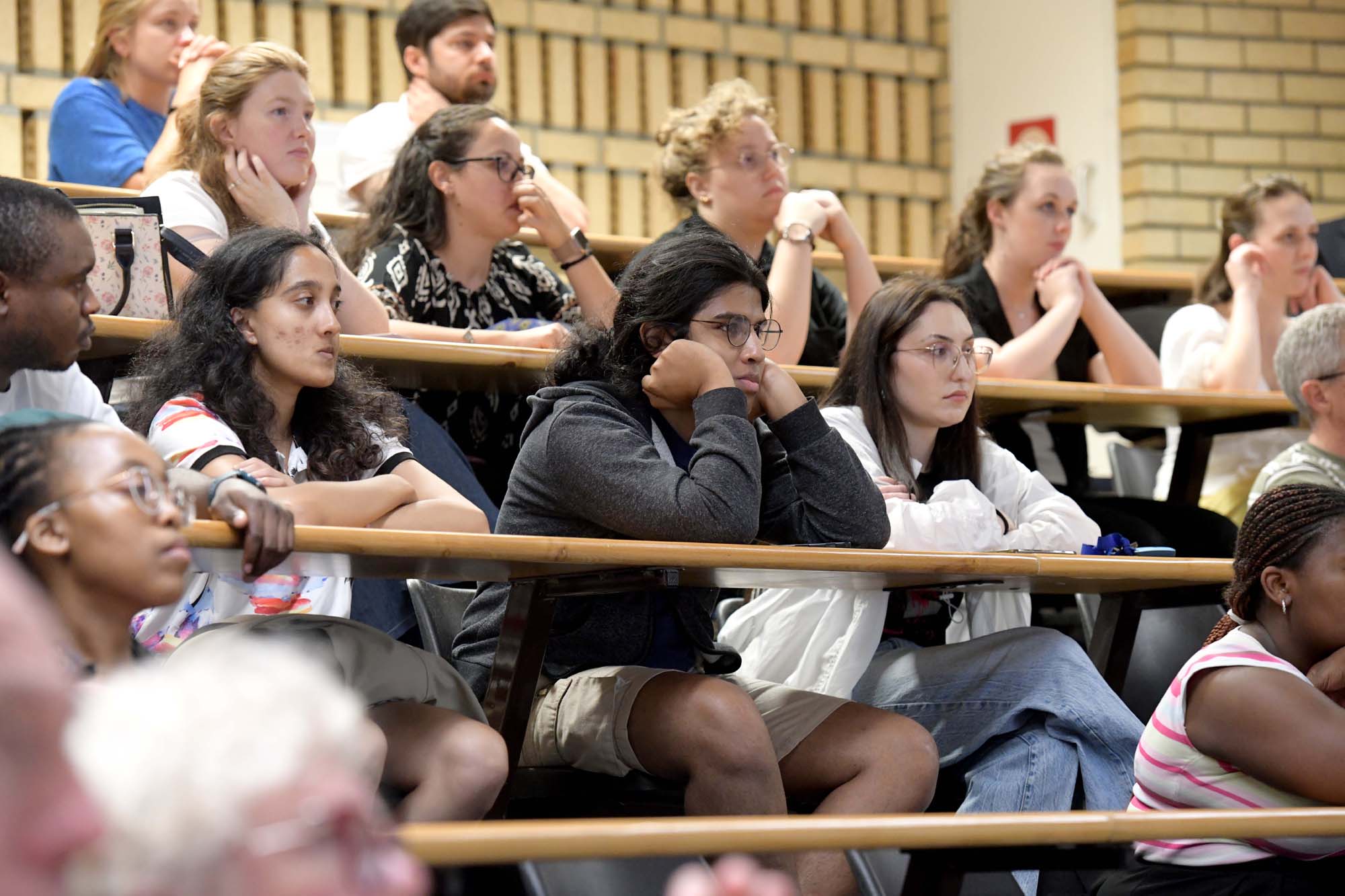
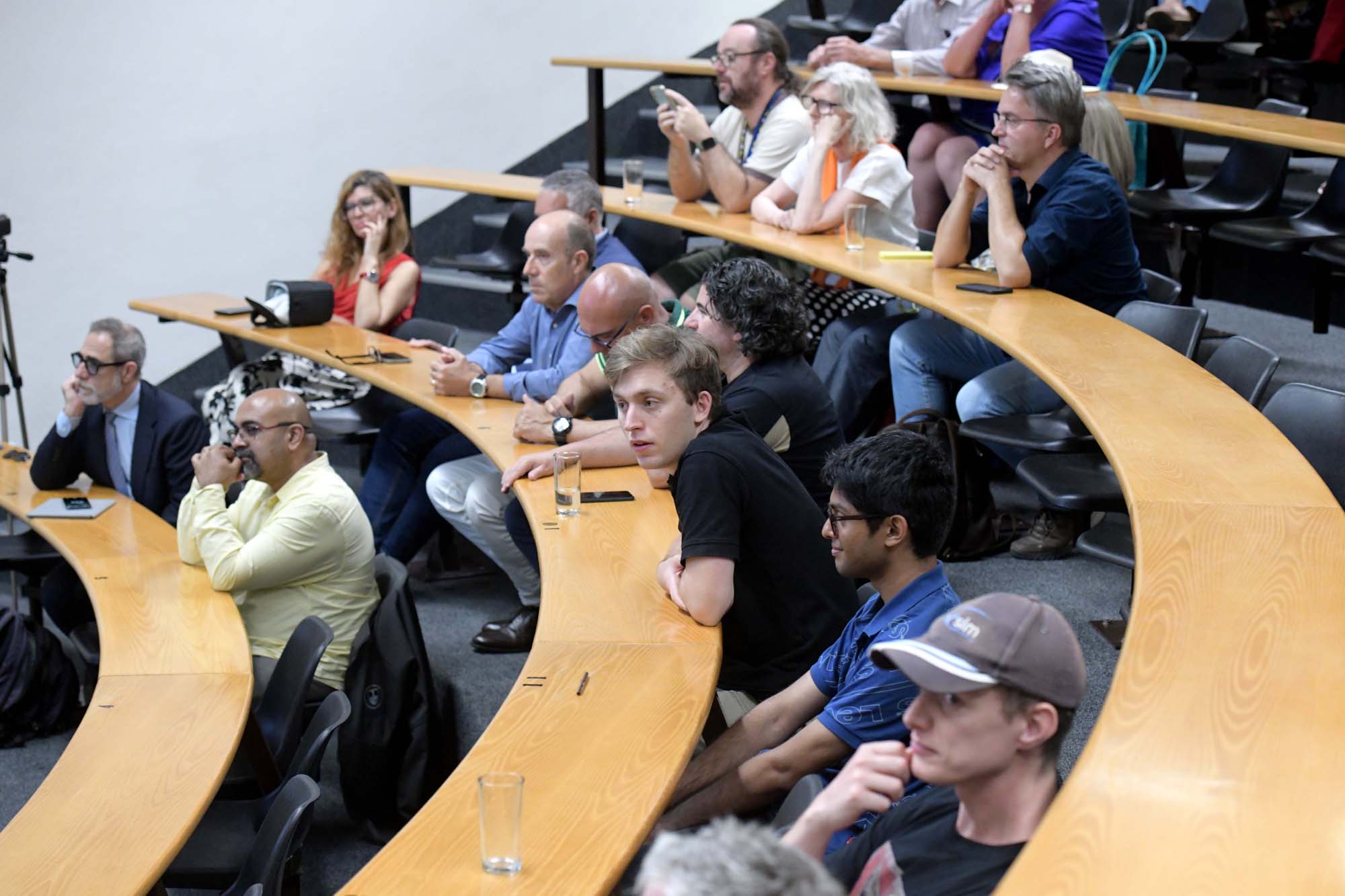
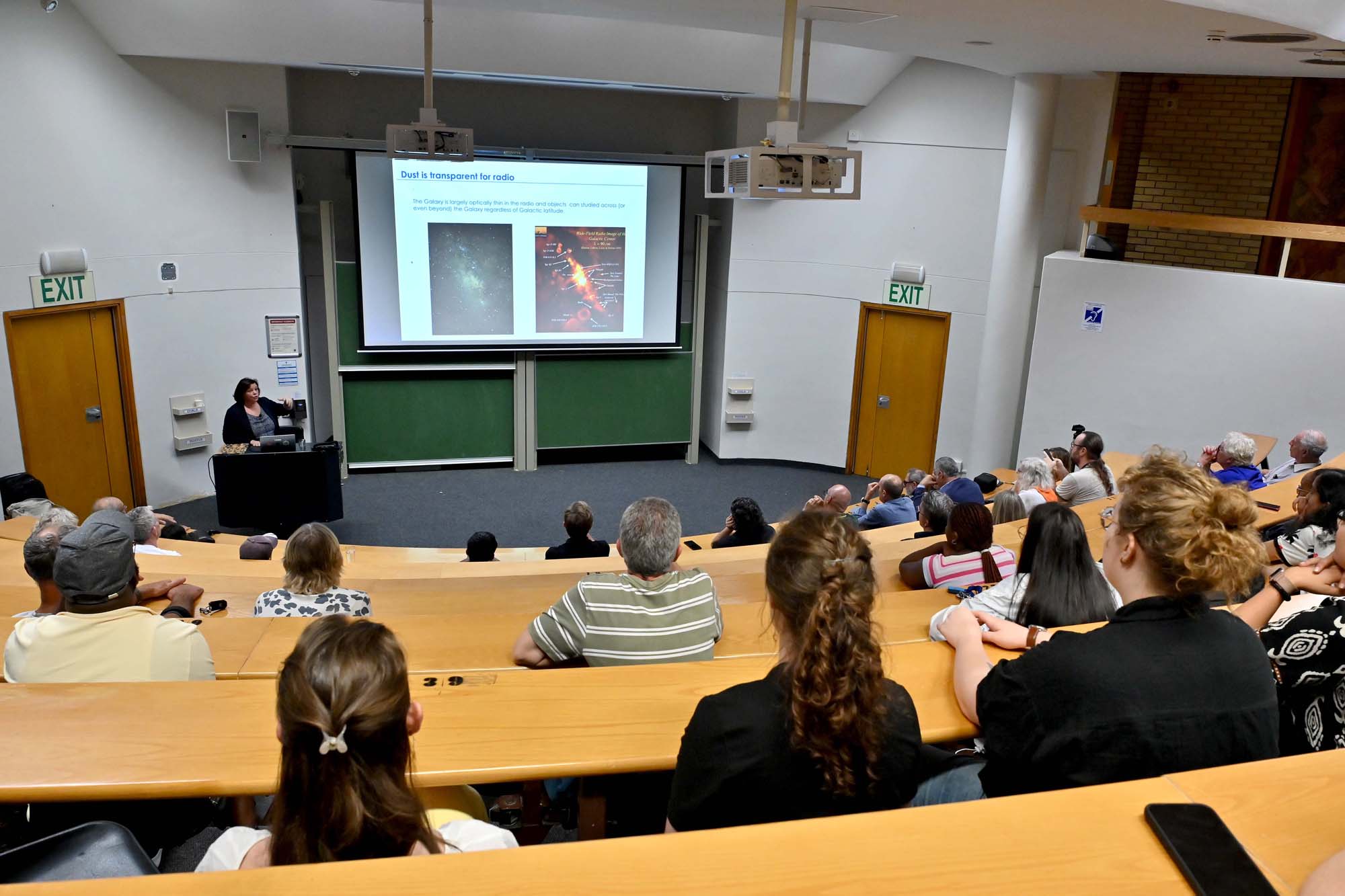
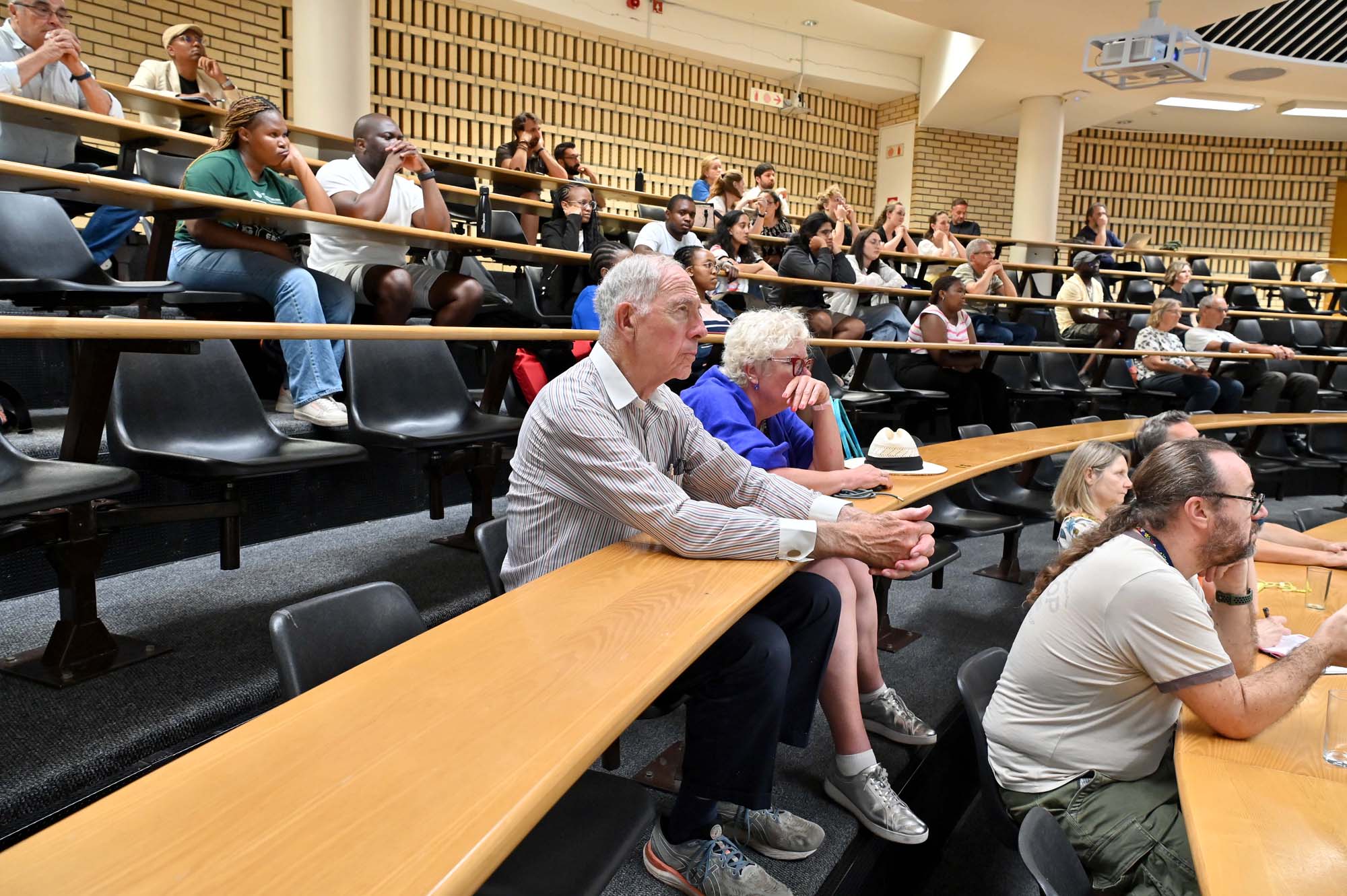
The University of Cape Town (UCT) has marked the successful conclusion of the RADIOMAP programme, a three-year exchange initiative between South Africa and Italy that has advanced research and training in radio astronomy. The milestone was celebrated with a public lecture by Dr Grazia Umana, of Italy’s National Institute for Astrophysics (INAF), highlighting the growing partnership between the two countries through the MeerKAT and Square Kilometre Array (SKA) projects.
Opening the evening, Dr Lucia Marchetti, senior lecturer in UCT’s Department of Astronomy and co-leader of the RADIOMAP programme, reflected on the collaboration’s achievements.
“We are celebrating the end of a successful three-year exchange programme between South Africa and Italy around MeerKAT and the SKA,” she said. “We are celebrating with the public. Thank you for joining the celebration with us.”
Professor Hussein Suleman, UCT’s dean of the Faculty of Science, spoke about the importance of international partnerships in reshaping education, research and society.
“The world is not the place it used to be. The distance between countries is no longer what it used to be,” he said. “These collaborations bring us closer together for science, and in South Africa, we understand that by doing science, we create a different way of thinking in society.”
Professor Suleman added that having colleagues from around the world at UCT reflects the increasingly interconnected nature of research.
Investing in young scientists
Taking the stage, Dr Umana, the principal Italian investigator for RADIOMAP, highlighted one of the programme’s most valuable outcomes: the training and mentorship of young researchers.
“The training, for us is very important,” she said. “This international collaboration strengthens our partnership with other SKA members.”
“This international collaboration strengthens our partnership with other SKA members.”
Her lecture focused on MeerKAT, South Africa’s flagship radio telescope in the Karoo, which has become a global leader in radio astronomy. While many South Africans recognise its striking images, fewer are aware of the international engineering and scientific collaboration behind them.
In 2020, Italy joined the MeerKAT Extension project, also known as MeerKAT Plus, contributing both financial support and technical expertise. “Italy contributed financially, but also with in-kind support from our engineers,” Umana explained. “This gives INAF [National Institute for Astrophysics] the opportunity to work on the scientific programme and to have a chair on the MeerKAT Science Committee.”
The MeerKAT Plus project will add 14 new SKA-compliant antennas to the 64-dish array. These additions will expand the telescope’s collecting area, improve resolution and enable the detection of weaker and more distant radio signals.
“If you add more antennas, you increase the capability of the instrument because you [extend the] collecting area, and you also improve the resolution,” Umana said. “Engineering work is proceeding well, and technical completion is expected in 2026.”
A lasting legacy
At the heart of this progress is RADIOMAP, jointly funded by Italy’s Ministry of Foreign Affairs and South Africa’s National Research Foundation (NRF). The programme has demonstrated how diplomacy, science and education can combine to produce lasting results.
“The ministry and the NRF fund RADIOMAP. This is a very important programme to push our collaboration further,” Umana said. “The relationships built through RADIOMAP led directly to the MeerKAT Plus concept gaining traction in Europe and being recognised as a research infrastructure.”
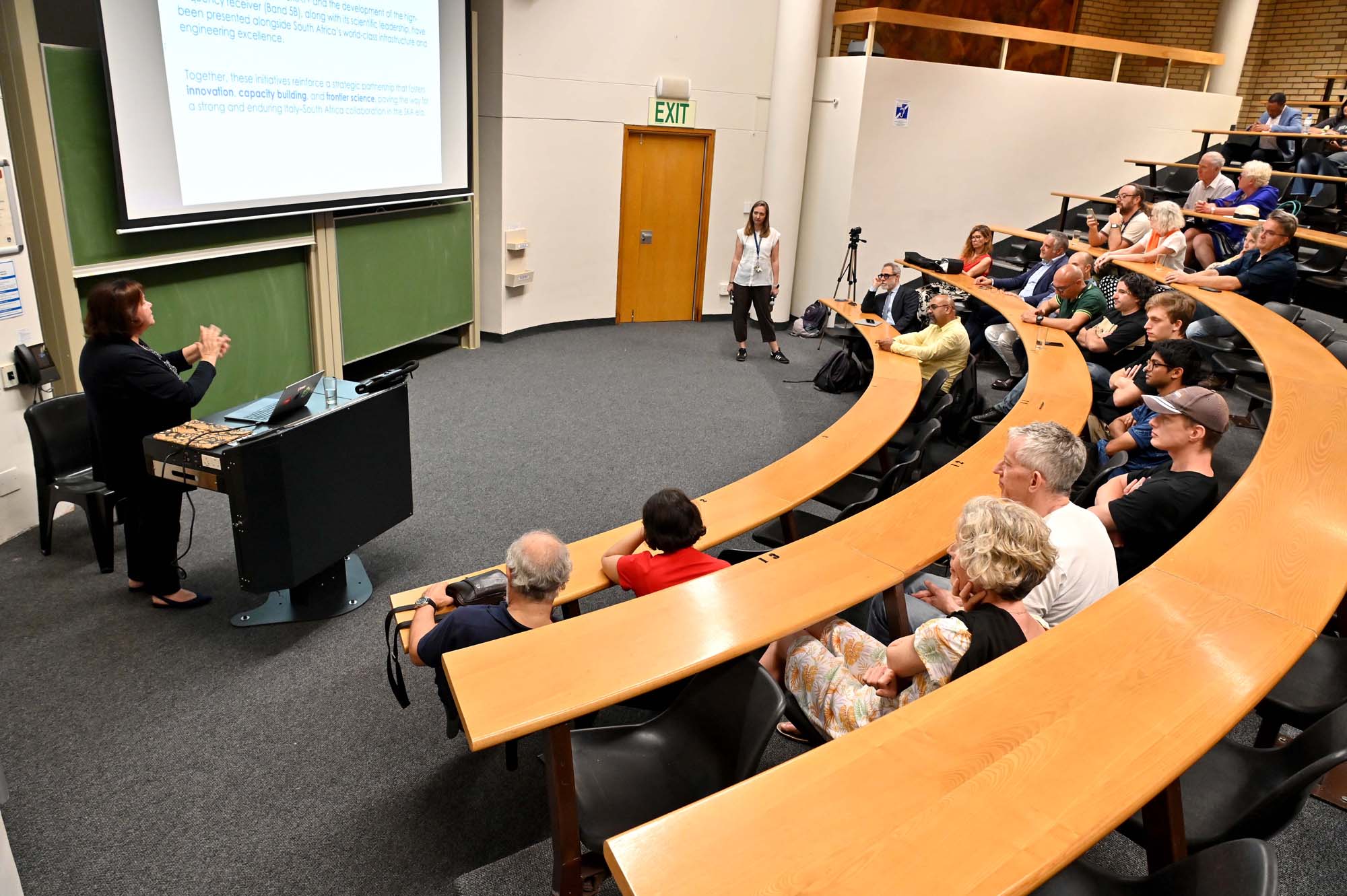
Umana also discussed the upcoming Band 5 upgrade for MeerKAT, which will extend its frequency capability up to 15 GHz, and make it the most sensitive high-frequency centimetre telescope in the southern hemisphere.
Part of a wider European programme known as STILES, the upgrade will enable astronomers to study galaxies and cosmic phenomena with unprecedented precision.
“After the Band 5 upgrade, MeerKAT will be the most sensitive high-frequency centimetre facility in the southern sky,” she said. The project is advancing through two phases, with all receivers and digitisers procured and the first scientific commissioning expected in 2027.
Dedicated engineers, scientists
Umana emphasised that technology alone does not advance science – people do. She acknowledged the dedication of the engineers, scientists and project teams from the South African Radio Astronomy Observatory (SARAO) and INAF who have driven the collaboration forward.
“I want to thank the wonderful team between SARAO and INAF. We are at this point because of their dedication,” she said.
“The stars above the Karoo are being mapped with increasing clarity.”
With MeerKAT’s improved resolution, astronomers will be able to distinguish individual stars in dense clusters, study how galaxies evolve and trace the life cycles of stars. The extensive surveys planned under the upgrade will create a legacy dataset for future generations of scientists.
As Umana concluded, the stars above the Karoo are being mapped with increasing clarity, and in doing so, they are bringing two nations closer together.
“This is a unique legacy survey,” she said. “It will produce information at a frequency that SKA itself will not cover.”
 This work is licensed under a Creative Commons Attribution-NoDerivatives 4.0 International License.
Please view the republishing articles page for more information.