
Wamkelekile, Welkom
The earth remembers
20 March 2026 | Story Elske Joubert. Photos Je’nine May. Voice Cwenga Koyana. Read time 8 min.
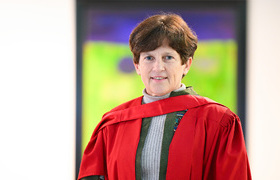
Beneath the streets of the Mother City, where traffic hums and pedestrians pass, lies a quieter story: one written in bones, soil and memory. The Prestwich Street Burial Grounds rest silently, holding fragments of the city’s colonial history; a buried history, reshaping how the past is studied and remembered. For University of Cape Town (UCT) PhD graduand Robyn Humphreys, the Prestwich Street Burial Grounds bring that history into sharp focus, raising questions about memory, power and the treatment of human remains.
Here, in the early years of the Cape colony, the unnamed and overlooked were hastily and informally buried, some with shackles or slave hawkers’ tags: indigenous peoples, labourers – lives that passed without monuments but not without meaning.
When the earth was opened in 2003 during the construction of a planned luxury development in Green Point, the past rose abruptly to the surface. More than 2 500 human remains were uncovered, each a whisper from a life once lived beneath the shadow of Table Mountain: an infant buried in a tiny coffin – small and fragile – whose soft, melodic coos ended with its last breath. Nearby, fully intact adult skeletons stacked upon each other … a mother, father, sister or brother.
What had been buried in silence for centuries suddenly demanded to be heard – and remembered.
Final resting place
Robyn, who will graduate with her PhD in archaeology on 2 April, initially set out to conduct DNA research on the ancestral remains but reconsidered this approach as her work progressed.
“The Prestwich Street Burial Grounds are the last resting place of enslaved ancestors. I wanted to learn more about the history of slavery through my research,” she explained. “However, as I started engaging with various groups, especially those who had intervened in attempts to conduct research on the ancestors, I began to question whether it was appropriate.”
“The Prestwich Street Burial Grounds are the last resting place of enslaved ancestors.”
Instead, her research turned to the systems that shaped how sites like Prestwich Street have been managed.
“Contract archaeology developed in the late 1980s, when the City of Cape Town was finding new strategies to facilitate development, prevent urban flight and attract private investors to the city,” she noted. “For example, the city sold the docklands, which was state-owned land, to a private entity that went on to develop the [V&A] Waterfront.”
As Cape Town expanded into a major tourist destination, redevelopment created new opportunities for archaeologists. “It provided an alternative source of income, allowing archaeologists to contract their services to developers,” Robyn said.
In practice, contract archaeologists worked alongside heritage authorities and developers to determine how best to manage archaeological sites affected by construction. Depending on the site’s significance, excavations would take place before development proceeded, ensuring that some record of the site’s history was preserved.

“If a site is deemed significant enough that building cannot occur over it, archaeologists and heritage agencies would work with developers to redesign plans and incorporate an archaeological site,” she explained.
Yet these processes often excluded the communities connected to those sites. “The primary stakeholders were the contract archaeologists, heritage agencies and developers. Communities were not consulted about the value of the site, or whether development was appropriate.”
Robyn pointed to the Cobern Street burial ground discovered in Green Point in 1994, where ancestral remains were removed and placed in a research facility, leaving no visible trace of who or what once lay there.
Colonial power structures
Her research suggests that these approaches, established during colonialism and the apartheid era, continue to position archaeologists as the primary authorities in decisions about how sites are interpreted and managed.
“In the case of Prestwich Street, its location in Green Point, which is now an affluent area, is significant,” she noted. “It created an opportunity to acknowledge erased histories of slavery, forced removals and labour that are often absent from dominant narratives of the area.”
At the same time, artefacts recovered during excavations are often stored in museums and repositories that remain inaccessible to the communities whose histories they represent.
“Archaeologists still hold substantial power … when it comes to producing knowledge about certain histories.”
“The discipline has come a long way in trying to integrate communities into research processes,” she said. “However, archaeologists still hold substantial power and are viewed as experts when it comes to producing knowledge about certain histories.”
Community responses to the Prestwich Street discovery took a different form.
“The Prestwich Place Committee challenged the exhumation process and attempts to conduct research on the human remains,” Robyn said. “Through their activism, they ensured that there is a memorial in Green Point. Even though it is imperfect, the ancestral remains were not stored in a museum and objectified through research.”
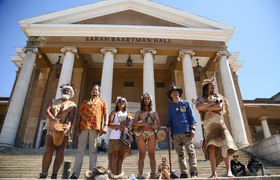
She added that the broader context, including debates around the repatriation of Sarah Baartman’s remains in 2002, and scholarship on the trade in human remains, shaped public engagement with the site.
Lessons learned
Her research highlights that archaeological sites carry different meanings for different stakeholders.
“To work effectively with communities, we need to create space for knowledge exchange, and to use our expertise and positions of power to explore how archaeology can work in service of community goals,” she argued, explaining that the Prestwich Street communities viewed archaeological and biological anthropological research methods as invasive and disrespectful of the dead.
“There isn’t a one-size-fits-all approach to working with communities. Archaeologists need to take a self-reflective approach and determine how our methods can support how communities want to engage with the past.”
 This work is licensed under a Creative Commons Attribution-NoDerivatives 4.0 International License.
Please view the republishing articles page for more information.