
Wamkelekile, Welkom
UCT scholar earns international honour for ethics work
30 January 2026 | Story Myolisi Gophe. Read time 7 min.
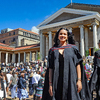
For nearly three decades, Dr Marianne Camerer has been asking some of South Africa’s most difficult questions: How is power used or abused? Why does corruption persist? What does ethical leadership look like in practice? In December 2025, her sustained contribution to anti-corruption research and education was recognised on the global stage when she received the International Anti-Corruption Excellence (ACE) Award in Doha, Qatar.
Dr Camerer, a senior lecturer at the Nelson Mandela School of Public Governance at the University of Cape Town (UCT), was honoured in the Academic Research and Education category, sharing the award with Professor Nikos Passas. The ACE Awards, under the patronage of the Amir of Qatar, His Highness Sheikh Tamim Bin Hamad Al Thani, is organised and delivered by the Rule of Law and Anti-Corruption Centre (ROLACC) in partnership with the United Nations Office on Drugs and Crime (UNODC), to shine a light on individuals and institutions making exceptional contributions to fighting corruption at the local, regional or international level.
“It felt incredibly humbling,” Camerer said. “You realise that you are part of a global community of people who refuse to give up – even in contexts where corruption feels overwhelming.”
A deep interest in public power has shaped Camerer’s academic journey: how it is exercised, misused and, crucially, restrained. “Corruption is often defined as an abuse of entrusted power for personal gain,” she explained. “It is inherently an ethical issue, and it has profound consequences for development outcomes and state legitimacy.”
With an MA in Political Philosophy from Stellenbosch University and an MPhil in Comparative Social Research from the University of Oxford, her professional career began as an applied policy researcher at the Institute for Security Studies, working on crime, policing and justice policy in the early years of South Africa’s democracy. Focusing on white-collar crime and corruption, she completed her PhD in 2009 under the supervision of Professor Tom Lodge at the University of the Witwatersrand (Wits). Her dissertation was titled “Corruption and reform in democratic South Africa”, with the Arms Deal as a case study.
Before joining UCT in 2014, Camerer co-founded Global Integrity, an international NGO that worked with local academics and investigative journalists around the world to assess how and whether countries’ anti-corruption systems worked – and whether citizens could access them.
“Our research asked uncomfortable questions,” she said. “Not just whether laws exist on paper, but whether they are actually effective in addressing abuses of power and are accessible to citizens.”
Teaching ethics to those who govern
At UCT, Camerer found an institutional home strongly aligned with her interests. The Nelson Mandela School of Public Governance – previously called the Graduate School of Development Policy and Practice – was founded with a focus on strategic leadership and public governance.

Referencing the late Emeritus Professor Francis Wilson, Camerer strongly believes that the quality of leadership and the choices made by those in power directly impacts development outcomes.
She currently co-convenes the school’s professional master’s in development, policy and practice, a mid-career programme that attracts public servants, policy makers and practitioners facing complex development problems. She has taught ethical leadership and public accountability at UCT for almost a decade.
“My focus is education,” she said. “These are leaders working under immense pressure. If we can give them conceptual tools and ethical frameworks, it helps them navigate often very difficult ethical dilemmas.”
Rethinking how corruption is understood
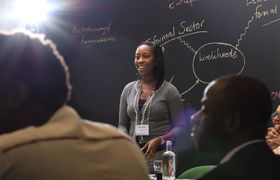
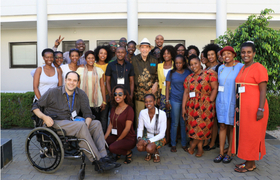
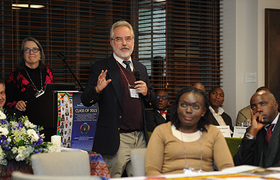
Last week, Camerer co-hosted (with Wits School of Governance) a two-day Public Ethics Network South Africa (PENZA) workshop at UCT, bringing together academics, practitioners, whistleblowers and civil society actors from across South Africa and abroad.
The workshop explored how language matters – particularly in the wake of the Zondo Commission – when discussing concepts such as “accountability”, “whistleblowing” and “state capture”. Participants included representatives from universities, the Ethics Institute and key individuals who blew the whistle on state capture, namely Cynthia Stimpel and Themba Maseko.
The discussions reflected a growing shift in how corruption is being understood and framed. “We often end up focusing on scandal and blame,” Camerer explained. “But if we focus on building institutions, leadership integrity and public ethics, we open up spaces for intervention and reform.”
One of Camerer’s own research interests focuses on public trust, an issue she describes as central to democratic survival. “If people believe that corruption goes unpunished, that impunity is normal, then trust collapses – and democracy is under threat,” she said.
“If we focus on building institutions, leadership integrity and public ethics, we open up spaces for intervention and reform.”
Recent data is sobering. The National Anti-Corruption Advisory Council’s 2025 report cites data from the Human Sciences Research Council’s South African Social Attitudes Survey that only 22% of South Africans trust the police, a figure recorded even before the establishment of the Madlanga Commission of Inquiry into Criminality, Political Interference and Corruption in the Criminal Justice System.
Despite the bleak statistics, Camerer resists despair. During a recent sabbatical at Oxford, she encountered research that reframed hope not as naïve optimism, but as action.
“Hope is a disciplined moral commitment to resist despair and work for a better future,” she said. “We can’t give up. We have to channel our energy into building something better.”
She sees grounds for cautious optimism: growing awareness of the importance of identifying and disclosing conflicts of interest in the public sector and the potential of new technologies, using artificial intelligence, to strengthen accountability systems.
“If we engage these technologies with our eyes open, they can potentially improve efficiency and detection,” she said, pointing to institutions using data analytics to combat illicit financial flows.
Recognition beyond borders
For Camerer, the ACE Award was not only a personal honour, but a reminder that South Africa’s challenges are shared globally. “We often think we are exceptional,” she said. “But corruption exists everywhere. What matters is how societies respond.”
Standing alongside this year’s awardees from Afghanistan, Nigeria, South Africa, Zimbabwe, The Gambia, Greece, Slovenia and Spain reinforced the importance of international solidarity. “You see people working behind the scenes, often at great personal cost, and you realise you’re not alone.”
“You see people working behind the scenes, often at great personal cost, and you realise you’re not alone.”
In partnership with the United Nations Office on Drugs and Crime, the award encourages mentorship and youth engagement, something Camerer believes is vital for long-term change. “We need to support the next generation of researchers, activists and public servants who are committed to integrity.”
Looking ahead, she returns to the classroom, preparing to welcome a new cohort of master’s students. While international recognition has been affirming, she remains grounded in what she sees as the university’s core responsibility.
“A key role of universities is to be convening spaces for critical thinking,” she said. “We bring people together, we create shared understanding, and we undertake research to support evidence-based reform.”
Her work, she emphasised, is about impact rather than abstraction. “Research has to matter in the real world. It has to influence policy, practice and leadership choices.”
Watch a short clip of Dr Marianne Camerer.
 This work is licensed under a Creative Commons Attribution-NoDerivatives 4.0 International License.
Please view the republishing articles page for more information.