
Wamkelekile, Welkom
UCT launches Mathieu Rouault Research Centre for ocean science
25 February 2026 | Story Thami Nkwanyane. Photos Leila Nefdt. Read time 4 min.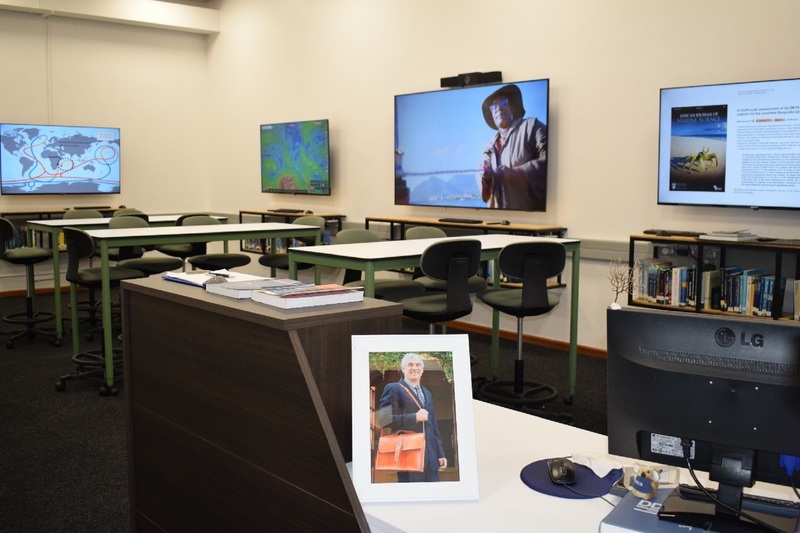
The University of Cape Town’s (UCT) Mathieu Rouault Research Centre (MRRC) – which celebrates the life and legacy of the late Mathieu Rouault, whose work transformed how scientists understand the oceans around southern Africa – has opened its doors.
Marking a meaningful moment for ocean and climate science at UCT, the launch of the centre is more than a memorial – it’s a dynamic space designed to inspire collaboration, innovation and learning for future generations.
Established within UCT’s Department of Oceanography, the MRRC transforms a former library into a hybrid teaching, learning and research hub. The launch event brought together staff, students, collaborators and friends to celebrate a scientist whose work on the Agulhas and Benguela currents revealed how ocean circulation shapes climate, ecosystems and livelihoods.
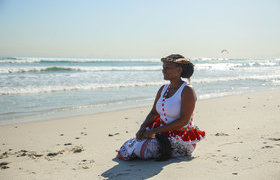
The programme included a tour of the resource centre and showcased a short documentary produced by Head South Productions and featuring Dr Moagabo Ragoasha, physical oceanographer and lecturer in the Department of Oceanography.
Reflections
Reflecting on the importance of the MRRC, Professor Marcello Vichi, the head of department in the Department of Oceanography and director of Marine and Antarctic Research Centre for Innovation and Sustainability (MARiS), noted that ocean science has evolved from a largely descriptive field into a predictive and interdisciplinary one. He emphasised that observations are now merged with data science, machine learning and numerical modelling to build new theories about the ocean–atmosphere system and its role in climate.
“This shift symbolises how institutions can honour the past while equipping the next generation of scientists.”
Professor Vichi explained that scientific spaces must evolve in parallel. Once a specialised library, the room had gradually darkened and lost its central role. Inspired by Rouault’s interdisciplinary legacy, it has been reimagined as a luminous, flexible environment that supports multitasking and interaction rather than one-directional lecturing. In this new format, printed books and digital knowledge coexist, encouraging students and researchers to move fluidly between discussion, analysis and discovery.
This shift symbolises how institutions can honour the past while equipping the next generation of scientists.
Nadia Jabaar, a resource centre officer, views the transformation as both professional and personal. She describes the renovation as a renewed commitment to connection, accessibility and growth within the department while the upgraded technology has already changed how the space is used.
New and improved
Large screens and improved digital infrastructure make meetings, group discussions and presentations easier, while also showcasing departmental research. This visibility has increased foot traffic and engagement, turning the centre into a lively environment rather than a quiet storage area.
Jabaar noted that working in a modern, well-designed space validates the importance of her role and gives her pride in managing a centre that actively supports teaching and research.
Work that shaped a generation of scientists
Rouault’s influence extends far beyond his publications. His mentorship shaped a generation of scientists who continue to explore how oceans influence regional and global climate. By naming the centre after him, the department anchors his legacy in the daily life of students and researchers.
Just as the Agulhas and Benguela currents collide, mix and transform the ocean around Cape Town, the MRRC is designed as a meeting point for ideas, disciplines and people. It is a place where physical oceanography meets biogeochemistry, where modelling meets observation, and where teaching meets research.
 This work is licensed under a Creative Commons Attribution-NoDerivatives 4.0 International License.
Please view the republishing articles page for more information.