
Wamkelekile, Welkom
Two UCT students named Google PhD Fellows
03 December 2025 | Story Nicole Forrest. Read time 8 min.
The Google PhD Fellowship Program supports exceptional graduates who are conducting groundbreaking research in computer science and related fields. This year, two students based at the University of Cape Town (UCT) – Elizaveta Siurina and Justine Kojo – have been selected as part of the 2025 cohort.
Since 2009, Google has been recognising groups of promising young academics through its Google PhD Fellowship Program. For the tech company, these students represent the future of research in fields as wide ranging as quantum computing and health research.
The goal is to support the next generation of researchers who are focused on the critical foundational science that can open up new avenues for technological development.
According to Google: “These fellowships recognize outstanding graduate students who are conducting exceptional and innovative research in computer science and related fields, specifically focusing on candidates who seek to influence the future of technology.
“The program provides vital direct financial support for their PhD pursuits and connects each fellow with a dedicated Google Research Mentor, reinforcing our commitment to nurturing the academic community. We are excited to welcome this global cohort and look forward to partnering with them as they continue to become leaders in their respective areas.”
In 2025, Google is providing over US$10 million to fund 255 PhD students across 35 countries and 12 research areas to support researchers who have shown they understand that accelerating scientific discovery through technology is vital to solving the world’s toughest challenges.
Eliciting emotion
Siurina, a doctoral researcher in the Department of Computer Science, is one of these researchers. She has been awarded a fellowship for her exploration into human–computer interaction. Her inquiries focus specifically on emotional elicitation in virtual environments (VEs).
“This research is important not only because it contributes to domains like digital art or video gaming, where you might experience virtual reality, but also because it has therapeutic and learning applications,” she noted.

Her project focuses specifically on curiosity and anger, two emotions that have been comparatively overlooked in academic research.
“Curiosity and anger play a central role in how people explore, adapt and learn. Yet, despite their importance, academic virtual reality research has traditionally focused on a narrow range of emotional states, leaving these two underexplored,” she explained.
“We still lack a clear picture of how emotions arise in VEs and how different ways of structuring a single environment can shift that experience.”
Not just a niche
To figure out exactly what emotions VEs can make people feel, and how those emotions are triggered, Siurina is designing and developing controlled VE prototypes that allow her to test how these feelings can be elicited and what effect different modalities have on the emotion in question.
“It turns out that we don’t actually know what exactly triggers certain emotions. My aim is to test different modalities to figure this out.
“In my study, I compare three design patterns of the same VE – one built around narrative cues, one shaped by mood and atmospheric elements and one that combines both – to examine how they contribute to emotional responses such as curiosity and anger,” she explained.
“How we can intentionally elicit specific emotions in VEs is not just a niche interest, but it has potential impact on the development and understanding of interactive technologies in general.”
In addition to monitoring participants’ self-reported emotions, Liza will monitor various physiological signals, including heart rate and skin conductance. This data can provide a more precise understanding of emotional engagement than subjective reports alone, amplifying its significance in the broader field of human–computer interaction studies.
“How we can intentionally elicit specific emotions in VEs is not just a niche interest, but it has potential impact on the development and understanding of interactive technologies in general. I’m excited to be part of the Google PhD Fellowship Program and to be contributing to this field,” she said.
A road to resilient transport networks
Justine Kojo is also focused on how advanced technology can be used to improve our everyday experiences. The Ghanaian doctoral researcher, based in the Centre for Transport Studies within the Department of Civil Engineering in the Faculty of Engineering & the Built Environment at UCT, is looking into how we can build resilience into our growing transport networks.
“My research uses artificial intelligence [AI] and Earth Observation [EO] data to study how transport networks respond to climate stress, particularly flooding and heat waves, and to develop ways to make urban mobility systems more resilient,” he explained.
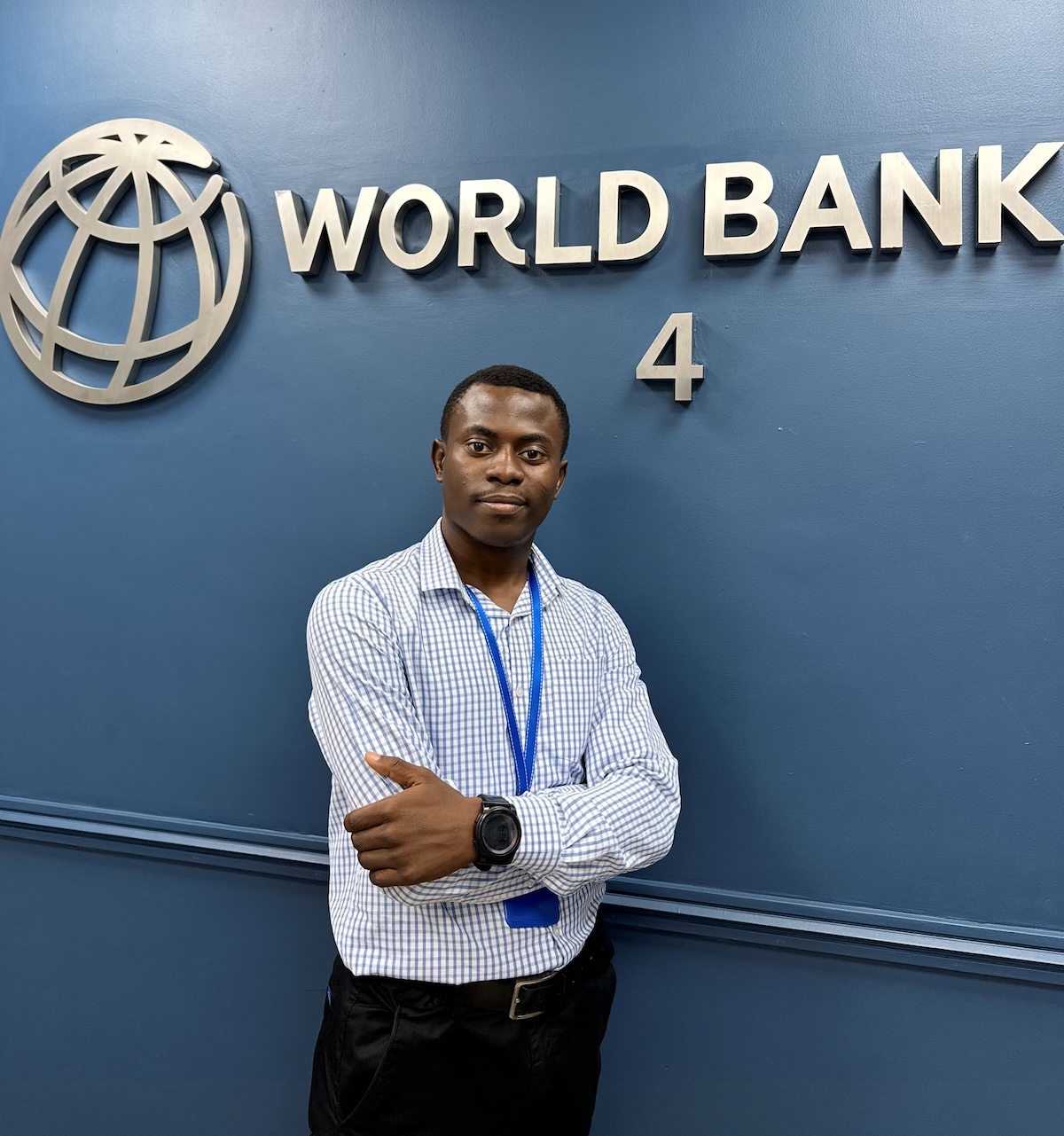
Kojo is interested in how the Anthropocene, a geological period defined by major planetary changes led by human impact on Earth’s systems, could impact urban planning and how we can use AI and satellite EO to overcome these challenges.
“We work with a large range of information, including satellite imagery, climate records, population data and data about the structure of transport networks. When these layers are combined with historical event information, the model begins to learn how environmental conditions, human movement and network design interact.
“This allows us to see the early signals that usually precede disruptions and to understand which parts of a city’s transport system are likely to struggle under climate or urban stress. This helps planners stress-test their networks, compare resilience across different cities and design mobility systems that adapt rather than collapse under pressure.
“The aim is to support long-term decision-making by identifying where vulnerabilities exist and how people would be affected if these disruptions repeat at a larger scale.”
African solutions to African problems
By passing this data through deep learning networks, Kojo hopes to build a model that can predict where transport systems might fail before disaster strikes – something that is particularly relevant in the African context where climate extremes and rapid urbanisation are reshaping our cities.
While this field of research opens up many opportunities for improvements in low-resource settings, there are also some important ethical considerations that need to be made.
“One of the things we need to make sure of is that we are not reinforcing inequality. We need to make sure that the model is fair enough to consider everybody who will be affected by its outputs. Just because the AI model can make accurate predictions doesn’t mean that it knows what is good for people,” he said.
“We have to design these systems to be fair and inclusive, ensuring that every group affected by their outcomes is considered.”
“We have to design these systems to be fair and inclusive, ensuring that every group affected by their outcomes is considered in decision-making, even those often overlooked in the data.”
In this light, Kojo is particularly excited about being named as a Google PhD Fellow in 2025. The engineer is keen to use this platform to cement the idea that African scientists are more than capable of finding solutions to African problems in ways that strengthen communities across the continent.
“Being selected as a Google PhD Fellow is both an honour and an opportunity. Beyond the mentorship, it’s a chance to amplify this research on the world stage and to demonstrate that groundbreaking, globally relevant innovation can come from African researchers working right here on the continent,” he said.
 This work is licensed under a Creative Commons Attribution-NoDerivatives 4.0 International License.
Please view the republishing articles page for more information.