
Wamkelekile, Welkom
‘Career highlight’ for VC’s award winner Sayed Hess
28 November 2025 | Story Lisa Templeton.Photo Robin Thuynsma. Read time 6 min.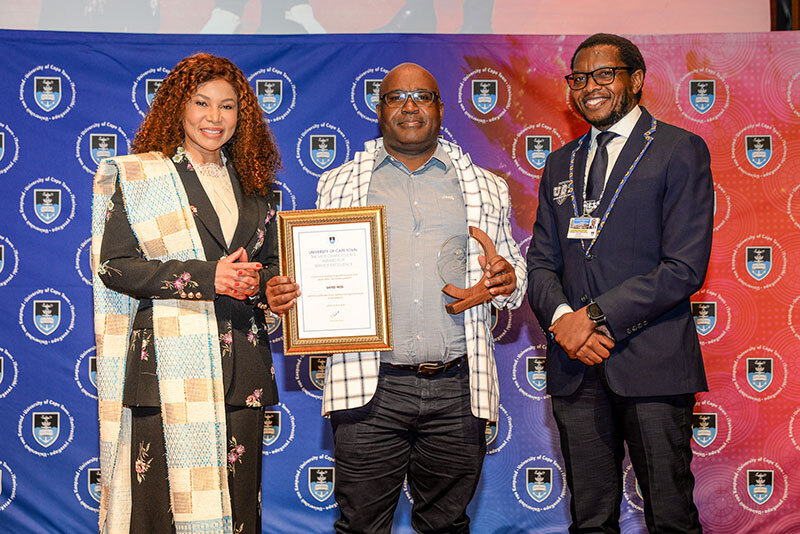
From his first days in 1997 as a campus protection officer at the University of Cape Town (UCT), Sayed Hess has spent 28 years quietly strengthening the Department of Environmental and Geographical Science (EGS). His dedication to operational excellence, safety and field-based research has now been recognised with a Vice-Chancellor’s Award for Service Excellence, a career milestone he describes as a true highlight.
Today, Hess’s portfolio spans the full operational life of the department: laboratory and venue safety, teaching support, building access, vehicle management, specialist technical assistance, and the coordination of scientific equipment and fieldwork. His work ensures that students and staff can learn, teach and conduct research in safe, well-run and fully supported environments.
Awarded by Vice-Chancellor Professor Mosa Moshabela at the UCT Staff Awards, Hess was acknowledged for his “exceptional commitment to operational integrity, safety and support”, and his “proactive leadership and dedication to excellence, which has significantly enhanced the working and learning environment for staff and students”.
“It is a career highlight to be recognised for my work,” he said. The award follows his recent naming as a Safety Champion by UCT’s Occupational Health, Safety and Environment (OHSE) unit.
Another personal milestone was when, after two years of planning, he travelled outside South Africa for the first time. “Passport in hand, through the three border posts of South Africa, Botswana and Zambia,” he said of the trip undertaken as apart of a collaborative research project with Nanjing University in China.
Outstanding contribution
The awards honour exceptional individuals who go beyond the call of duty to make a difference in the lives of others, and who make an outstanding contribution to the university’s mission and objectives of unleashing human potential towards a fair and just society.
“I always have envisaged UCT as my security net and a good employer,” Hess said. “I couldn't study here as I come from a poor family, but I was driven to become an Ikey. I got my big break when I saw the job ad in the Cape Times, applied, and here I am nearly three decades later.”
“But I was driven to become an Ikey.”
Hess admitted to being a “devil’s advocate when it comes to health and safety in the workplace”. “I take this very seriously – protecting our students, my fellow colleagues, visitors, our assets and the environment.”
Hess was recognised, in part, for his exceptional contribution and leadership in strengthening EGS health and safety systems. These include the safe removal of hazardous waste, developing standard operating procedures for laboratory work, and implementing comprehensive evacuation procedures.
“COVID-19 taught me to do things differently, and to be more proactive,” he said. “I’m very observant and an overthinker who likes to try new ideas. It’s all about ensuring compliance in the workplace, even if it sometimes feels like being a whistleblower.”
His accomplishments include the installation of a CCTV system after a break-in, and of an essential emergency shower in the laboratories. Where once the laboratories lacked a proper waste-management system or chemical registry inventory, he has now created an automated system. He also organised the removal and disposal of historical hazardous waste, and installed chemical storage cabinets.
Departmental first
The department was also one of the first at UCT to introduce motion-activated light sensors and no-touch door sensors. All evacuation marshals are now fully trained, and laboratory standards are monitored regularly.
Hess also oversees IT upgrades across the department.
“It is important for our students and staff to stay abreast of technological developments,” he said. “We are an independently-run department, but our spaces are used by many stakeholders. Teaching venues must be safe, functional and well equipped.
“Teaching venues must be safe, functional and well equipped.”
His daily responsibilities include coordinating access to buildings and teaching venues, managing departmental vehicles, and supporting the operation of laboratories and scientific equipment – ensuring that the department remains a reliable, responsive environment for both teaching and research.
Hess’s technical skill and logistical expertise have also made him an invaluable contributor to academic fieldwork and research.
“I like to learn more about our environment and physical spaces,” he said. “It gives me immense pleasure when I‘m called upon to be a research assistant, and to travel and explore the country.”
He has supported the RAIN Project with the German University of Jena, focusing on sedimentology in remote lakes, and research on estuarine systems and sediment dynamics in the Knysna Lagoon, in collaboration with East China Normal University.
One-man show
In June and July 2025, he travelled nearly 10 000 km in the EGS vehicle from UCT to Northern Zambia, where he assisted researchers from Nanjing University, as well as colleagues from France, and the Nelson Mandela University and the University of the Witwatersrand. The project involved limnological studies and sediment core retrieval from remote lakes.
“We travelled some very bad terrain and into crocodile-infested lakes to collect sediments,” he said. “I actively provided technical support to the team.”
“We travelled some very bad terrain and into crocodile-infested lakes.”
Hess is especially honoured when he is acknowledged in a publication after helping a student with a research project. He also values being able to solve unexpected technical problems, so that classes or research activities can continue safely and uninterrupted.
“The most important things are proper communication, making sure we have a safe building to work in, and being prepared for the day’s probabilities, because I’m mostly running a one-man show.”
Outside of work, he loves sport, especially rugby, and watching his son play. “Or I’ll go for a walk along the beach or play a game of squash,” he said.
 This work is licensed under a Creative Commons Attribution-NoDerivatives 4.0 International License.
Please view the republishing articles page for more information.