
Graduation 2026
‘Umuntu ngumuntu ngabantu’: How the community carried Nancia Mwaramba to graduation
23 March 2026 | Story Myolisi Gophe. Photo Supplied. Read time 8 min.
The dream began in a living room. In Grade 10, surrounded by family, Nancia Mwaramba watched matric results being announced on television. As South Africa’s top achievers celebrated, one name kept surfacing: the University of Cape Town (UCT).
It wasn’t just a university. It was a place where futures were forged.
“I knew that once I finished matric, that’s where I wanted to be,” she recalled.
Years later, after weeks of anxious waiting, the long-awaited email finally arrived: “Congratulations. You have been accepted.”
Next week, Nancia will join thousands of students celebrating the completion of their studies at UCT’s autumn graduation.
But her journey has been full of trials and tribulations that put her on the brink of dropping out of university.
Even in that moment after she had been accepted, a harsh reality lingered: there was no funding. Nancia chose to go anyway.
“A lot of things felt impossible. But somehow, something would always come through.”
As an international student – born in Botswana to Zimbabwean parents and raised in South Africa – securing financial support proved difficult for Nancia. Yet she moved forward with faith, trusting that a way would open.
“A lot of things felt impossible,” she said. “But somehow, something would always come through.”
For instance, to register, she needed R67 000 upfront. Family and friends raised R30 000 for tuition – but the remaining R37 000 for residence was out of reach.
With days to spare, she withdrew from residence.
At just 16, in a new country and city with no established support system, Nancia was suddenly facing homelessness.
Help came through a chain of kindness. A connection from the Diakonia Pathfinder Community Club in Durban linked her to a family in Cape Town who opened their home without hesitation.
“They became my family in Cape Town,” she recalled.
The experience reshaped her understanding of belonging.
“Home is no longer just one place. Wherever I go, I can find family.”
When plans fall apart and new paths emerge
Just as she began to find stability, another setback followed.
“I realised I hadn’t been accepted into actuarial science,” she said.
In the excitement of her acceptance, she had missed a crucial detail: she had been admitted to a mainstream commerce programme – not the competitive actuarial stream she had envisioned.
“When the truth finally sank in that I was not going to register for actuarial science, I was devastated. I had already declined offers from other universities. To find out that my dream university had not accepted me into the programme I wanted so badly felt crushing.”
With limited options, she enrolled in business science in analytics, hoping to transfer later. What initially felt like a compromise slowly became a discovery.
“Don’t box yourself into who you were in high school. We are all evolving.”
“I fell in love with analytics,” she said. “I realised I had interests beyond what I thought I wanted at 16.”
It was an early lesson in growth: “Don’t box yourself into who you were in high school. We are all evolving.”
The first year brought more than academic challenges.
Without funding, debt accumulated quickly. For the first time, her academic performance began to slip.
But the Seventh-day Adventist Student Movement (SDASM) became a refuge; a space where students studied together, supported one another, and shared the weight of expectation.
“In SDASM, I found people who understood,” she said. “People who knew what it means to carry your family’s dreams.”
The moment it almost ended
By the end of her first year, Nancia faced more than R76 000 in debt – an amount that threatened to end her studies. Still, she returned to campus, determined to try.
“I had about two weeks to find help.”
She knocked on doors, spoke to lecturers, reached out across campus – even standing outside the vice-chancellor’s office.
Most responses were sympathetic but offered no solution.
On the eve of the deadline, sitting in Sarah Baartman Hall, she prepared to let go.
“I thought this is it. I’ve tried my best.”
“I thought this is it. I’ve tried my best.”
Then came another email.
She had been selected as a beneficiary of the AFRI Fund – a Students’ Representative Council initiative dedicated to assisting African International students with debt clearance – which would clear her debt and allow her to continue.
“It was a second chance,” she said.
In her second year, Nancia came across a story on the UCT website that resonated deeply – that of Innocent Biringanine.
“I saw myself in his journey.”
When she reached out, she expected encouragement. Instead, she found advocacy.
“He went far beyond that.”
“Some days, helping others was the only reason I got out of bed. It wasn’t just about getting my degree anymore. It was about making a difference.”
He connected her with sponsors and opened doors that had previously felt closed.
“He played a huge role in my journey. You need people who’ve walked the path before you. They show you what’s possible.”
That support inspired her to give back.
Nancia began mentoring others – tutoring fellow students and supporting school learners through outreach initiatives.
“Some days, helping others was the only reason I got out of bed,” she admitted. “It wasn’t just about getting my degree anymore. It was about making a difference.”
Pushing through the final stretch
The challenges didn’t disappear.
“My study permit expired. What followed were months of back-and-forth with the Department of Home Affairs – delays, legal processes, and system backlogs entirely beyond my control. By the time third-year registration approached, my documents had still not been processed. Without those documents, I could not register and proceed. I felt helpless.
Biringanine, who had faced the same obstacles, advised her to approach UCT’s International Academic Programmes Office.
“[There], I received immense support throughout the process. The team understood that the delays were not my fault and worked with me to ensure I could continue navigating the administrative requirements while my documentation was being processed. The third year brought new pressures. For the first time in my life, I experienced intense stress, panic attacks, anxiety, and depression. I had reached my breaking point.”
Through UCT’s Student Wellness Services, she found coping tools – and the space to acknowledge her struggles.
“A person is a person through other people. I remember all of them – every lecturer, every student, every person who helped.”
“That helped me regain control.”
As she is about to graduate with a degree in computer science, statistics and data science, Nancia’s journey stands as a testament to resilience – and to the people who carried her through.
“Umuntu ngumuntu ngabantu,” she says. “A person is a person through other people. I remember all of them – every lecturer, every student, every person who helped.”
Her definition of success has also changed.
“It’s no longer just about being at the top,” she noted. “It’s about whether I made someone’s day better.”
For students facing uncertainty, her advice is simple:
“Join communities. That’s where you find support, opportunities, and people who will walk the journey with you. You are not alone. More people are rooting for you than you realise.”
 This work is licensed under a Creative Commons Attribution-NoDerivatives 4.0 International License.
Please view the republishing articles page for more information.



Autumn 2026 Graduation
The University of Cape Town (UCT) is hosting graduation ceremonies from Monday, 30 March until Friday, 2 April 2026. The ceremonies will be livestreamed on the website, and the video recordings will be made available on this feature page and UCT’s YouTube channel as soon as possible after the event.
Graduation programmes
The names of all of the autumn 2026 qualifiers are listed in the graduation ceremony programmes. Congratulations to everyone graduating.
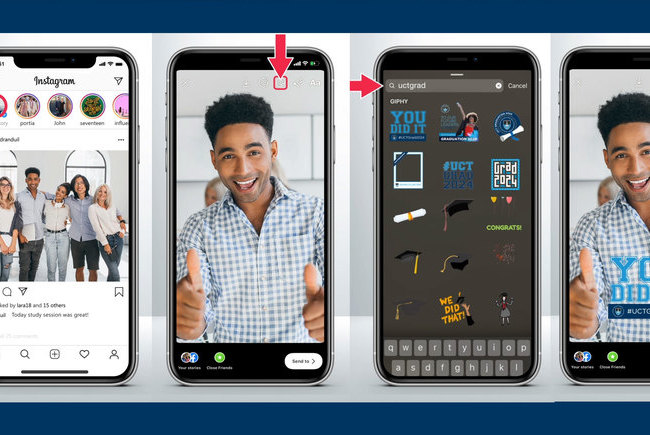
We are excited to see our UCT graduates unleash their potential for a fair and just society. Join the celebrations on social media by using the #UCTGrad2026 hashtag.
Inspirational graduates
Our stories: inspirational graduates
The UCT News team has profiled a cross-section of inspirational graduands whose stories have inspired us. To all those we haven’t been able to feature, we’d like to say: each one of you is an inspiration – to your university, your families and your communities. We wish you every success in the future.



Ceremony recordings
Graduation programmesGraduation programmes
The names of all of the autumn 2026 qualifiers are listed in the graduation ceremony programmes. Congratulations to everyone graduating.
We are excited to see our UCT graduates unleash their potential for a fair and just society. Join the celebrations on social media by using the #UCTGrad2026 hashtag.
#UCTGrad2026 – social media elements
Customised Facebook and Instagram stickers are available on our social media platforms. Watch the tutorial videos here to see how easily you can get your online presence ready.