
Wamkelekile, Welkom
East Africa Pre-Moot win for UCT Law students
26 March 2026 | Story Gaby Ritchie. Photo Supplied. Read time 5 min.
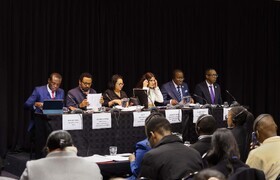
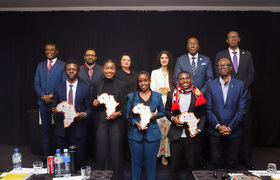
The University of Cape Town’s (UCT) Vis Moot team has returned from Nairobi with an impressive achievement, having been crowned winners of the East Africa Pre-Moot of the Willem C Vis International Commercial Arbitration Moot. The pre-moot brought together 18 teams from across the continent and offered a valuable combination of skills training and competitive oral rounds in preparation for the international competition.
Represented by Tayla Cooper and Benjamin Reid, and coached by Kerrin Baker, the UCT team demonstrated both technical excellence and composure throughout the competition. They began with strong performances in the general rounds against the University of Ghana and the University of Rwanda, before progressing to the semi-finals, where they faced the National University of Lesotho. The final round saw UCT go head-to-head with the University of Zimbabwe, ultimately securing a well-earned victory. Reid’s recognition as Runner-Up Best Oralist further highlighted the team’s strength in oral advocacy.
This success marks an important moment for UCT, which is now in its fourth year of participation in the Vis Moot programme. It is the first time the university has won the East Africa Pre-Moot, reflecting both the growing experience of its teams and the strength of its coaching and preparation. The team will now travel to Vienna to compete in the global rounds at the end of March, joining approximately 400 universities from around the world.
“Winning the Nairobi pre-moot was incredibly meaningful because of the level of competition and the standard it demanded from us. It reflects not just performance on the day, but months of sustained preparation, teamwork, and refinement,” Cooper said.
“It was a privilege to represent UCT in such a competitive space. Heading into Vienna, I’m most looking forward to testing our arguments against a truly global field.”
“More than the result, the experience reinforced the discipline and resilience that mooting requires and deepened my commitment to advocacy. It was a privilege to represent UCT in such a competitive space. Heading into Vienna, I’m most looking forward to testing our arguments against a truly global field and continuing to learn from some of the best teams in the world.”
Baker added: “The year 2026 marked a landmark year for the East-Africa pre-moot as 19 teams from various African countries participated. UCT emerged victorious in the final, something which we have never achieved before. This meant a great deal to me, as a participant who finished second last year, I really wanted to provide support for Ben and Tayla to thrive.
“I believe they acted as exceptional advocates for UCT, not only in terms of their performance but in terms of their general demeanour and willingness to make long lasting connections with other universities.”
In high regard
The Vis Moot is widely regarded as one of the most prestigious international mooting competitions. Its purpose is to promote the study of international commercial law and arbitration, while offering students practical training in resolving cross-border disputes. Each year, teams are presented with a fictional problem rooted in international trade, typically involving the sale of goods and governed by instruments such as the United Nations Convention on Contracts for the International Sale of Goods. The dispute is resolved through arbitration under a set of prescribed rules, reflecting the central role arbitration plays in modern international commerce.
What distinguishes the Vis Moot is the way in which it develops advocacy skills through two closely linked phases. The first is the drafting of written memoranda for both claimant and respondent, requiring students to engage deeply with legal authorities, structure arguments carefully, and write with precision and clarity. The second is the oral phase, where students present their arguments before panels of arbitrators composed of experienced practitioners and academics. These hearings are rigorous and interactive, demanding quick thinking and confidence under questioning.
Beyond technical legal knowledge, mooting fosters a range of professional skills that are essential for aspiring lawyers. It teaches students how to think critically, communicate persuasively, and respond constructively to challenges. It also builds resilience and professionalism, as students must refine their arguments through repeated practice and feedback. In the context of the Vis Moot, these skills are developed within an international environment that exposes students to different legal systems and approaches. Teams are deliberately matched across civil law and common law traditions, ensuring that participants learn not only how to argue their own case, but also how to engage with unfamiliar legal reasoning.
Invaluable opportunity
For the UCT team, the East Africa Pre-Moot provided an invaluable opportunity to test their arguments, learn from experienced arbitrators, and refine their advocacy ahead of the Vienna rounds. Their success in Nairobi reflects sustained preparation and a clear demonstration of the value of experiential learning in legal education.
Read more about the Vis Moot and its global programme.
 This work is licensed under a Creative Commons Attribution-NoDerivatives 4.0 International License.
Please view the republishing articles page for more information.