

Graduation 2026
Matthew Jordaan on his road to graduation: ‘Timing is everything’
20 March 2026 | Story Niémah Davids. Photo Je’nine May. Read time 10 min.
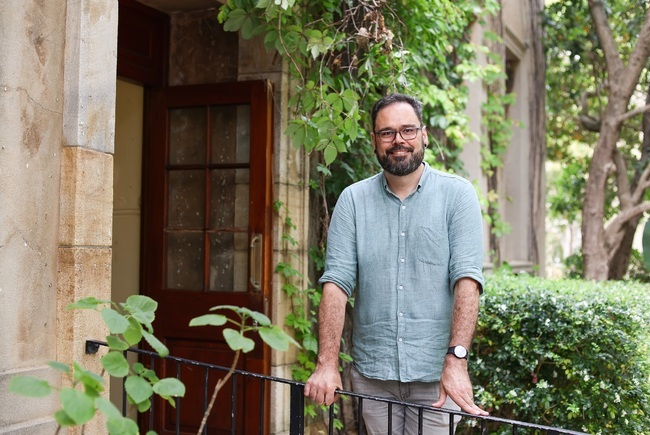
Matthew Jordaan’s journey with the University of Cape Town (UCT) came full circle when he entered the lecture theatre in 2025 – the year he turned 40 – to start his honours degree.
Years prior, in 2002, he was provisionally accepted to complete a Bachelor of Arts specialising in English and Film in UCT’s Faculty of Humanities, thanks to a stellar Grade 11 report card. Full acceptance was still dependent on his matric results. But the next year was not smooth sailing. Unlike others his age, home was anything but a safe space. With an abusive father, how could it be? By 14, Matthew had been diagnosed with clinical depression and anxiety disorder. Simple things like concentrating and studying for an exam were difficult in his home. When he reached matric, his mental health and grades took a dip – and just like that, the prospect of studying at UCT dwindled.
“I needed to find a way to become financially independent as quickly as possible to escape the abusive home environment. This led me to pursue my other passion: photography,” he said.
Matthew’s ultimate full-circle moment will arrive on Monday, 30 March, when he takes to the stage in UCT’s Sarah Baartman Hall, to receive his honours in media theory and practice from the Centre for Film and Media Studies (CFMS). And you bet he will make his younger self proud. It’s been a long haul, with a list of triumphs and defeats along the way. Over the years, two things have carried him: timing is everything and what’s meant for you will find you – eventually; and use every hurdle to deepen your understanding of empathy and to drive your desire to make a difference in the lives of those who have been marginalised and faced injustice. Matthew has – and this is his story.
Capturing moments
From a young age, Matthew loved taking photographs and captured different things using an old instant film camera “back in the day when film was easy to get and cheap to develop”. Determined to have a career in photography, he enrolled for an undergraduate degree in professional photography at City Varsity and specialised in photojournalism. It was the start of a fulfilling career, doing what he loved and getting paid for it – a win-win.
“I always wanted others’ stories and realities to be heard.”
“I always wanted others’ stories and realities to be heard. Photojournalism was the perfect avenue for this – to help people see life from different perspectives,” Matthew said.
His career started with a bang in 2006, and for the next couple of years he worked for leading media houses in Cape Town, including Media24 and several titles within the Independent Newspapers stable. Matthew thrived – winning several awards, including the Vodacom Journalist of the Year Award for Photography in 2010 and the coveted Standard Bank Sikuvile Journalism Award in 2012.
“What I loved most about this career was the power to positively impact lives and to change perceptions through my work,” he said.
Taking a chance
After spending the next two decades as a photojournalist in both permanent and freelance roles, Matthew realised that his dream of studying at UCT was stronger than ever. So, he took the plunge and applied for his honours via UCT’s recognition of prior learning process. To his delight, he was accepted and started his academic programme the same year he celebrated his 40th birthday.
“I’m not going to lie: it took some time to adjust. There were some funny generation gap moments. Like when a peer in my cohort told me: ‘You ate that’ [slang for complimenting someone for doing something well]. I had a total old man moment of having to google what it meant,” he said. “But besides things like that, I think I was much more aware of my age than my peers were. [To them] I was just another honours student finding their way through life.”
Matthew “ate” his honours degree. He scored a grade point average of 84.1%. And for his dissertation: “A not-so-foreign concept: An analysis of the framing of ‘foreign nationals’ in the South African tabloid, Daily Sun”, he scored an impressive 90%. As a result, he was selected to present his preliminary research findings at the South African Communications Association at Nelson Mandela University in September 2025.
Research snapshot
The A+ dissertation examined how the Daily Sun – a tabloid newspaper in South Africa – framed and represented African migrants. He used a qualitative and quantitative research methodology, as well as framing analysis, critical discourse analysis and exploratory interviews with Daily Sun news producers, to reach his conclusions.
His findings were startling. The research revealed a significant year-on-year increase in the use of dehumanising labels and discourses in news articles. One example is the use of aboMyFriend (plural) or uMyFriend (singular) when referring to migrants – an apartheid-era, anti-migrant slur. Alarmingly, the bulk of the articles surveyed framed migrants as suspects or perpetrators of criminal activity and presented them as a threat to the South African society.
“Naturally, there are no borders, but for some reason humankind has decided to demarcate land and declare who belongs in it and who doesn’t.”
“The topic of migration in South Africa has always been close to my heart. The idea of belonging and citizenship is also very interesting to me. Naturally, there are no borders, but for some reason humankind has decided to demarcate land and declare who belongs in it and who doesn’t,” he said.
Through this work, Matthew has earned a full scholarship from the National Research Foundation to complete his master’s as part of the Digital Media Sociology Lab in the CFMS at UCT. And while his research topic continues to develop, he has plans to explore how digital media provides a platform for marginalised voices to create counter-narratives, to do away with the dominant narratives that usually represent them.
Navigating CPTSD
Being in the lecture theatre was like a breath of fresh air. Matthew found his happy place. But his battle with complex post-traumatic stress disorder (CPTSD) – a diagnosis which came as a shock in 2022 – made it difficult in the beginning. Unlike PTSD, which is shaped by a single defining moment, CPTSD stems from being trapped in a traumatic situation, or being exposed to repeated trauma.
“Coming from a home where I repeatedly faced verbal, emotional and physical abuse, I was trapped in a traumatic situation.”
“Coming from a home where I repeatedly faced verbal, emotional and physical abuse, I was trapped in a traumatic situation [and it caused the CPTSD]. Living with it is difficult because your brain becomes wired for trauma. There are constant moments where your body is triggered. It sets in out of nowhere and results in panic attacks, flashbacks, heightened anxiety and overstimulation,” he said.
Navigating CPTSD and his academic programme was tough, so those early days on campus were challenging. But after a heart-to-heart with one of his lecturers, Dr Muya Koloko, he felt “seen and understood”, and was committed to keep going.
“In one of my electives I had the opportunity to conduct a multimodal exploration and autoethnography of the invisible pain I have felt from CPTSD, and to attempt to make that invisible and ungraspable pain visible and graspable. It was an incredibly liberating experience,” he said.
A support structure matters
Equipped with the right tools to manage his CPTSD, Matthew faced another hurdle: imposter syndrome. And once more, Dr Koloko provided the support and motivation he needed to carry on. During one of his lectures, Koloko stressed the importance of finding a support structure and a mentor to carry students through when the load becomes too heavy. Matthew did just that.
“I sought him [Koloko] out for a coffee. We spent a lot of time chatting throughout the year. I drew a lot of encouragement from him,” Matthew said.
There were others on campus who played an integral part in his journey. His supervisor, Associate Professor Martha Evans; and course convenor, Associate Professor Marion Walton, were constant pillars of support, and his peers inspired him too. At home, his partner, Yolande, was his biggest cheerleader; his voice of reason. She listened attentively and “never, ever complained”.
Pearls of wisdom
As he reflects on a hard, but equally rewarding year and prepares for the next step in his academic journey, Matthew said he is proud of his achievement, relieved to be at the finish line and grateful for the opportunity to keep gaining knowledge and contributing towards knowledge. He said he acknowledges his privilege to continue studying and takes nothing for granted.
“If you find yourself in the thick of it, feeling completely overwhelmed, take a moment to recognise how far you’ve come.”
His advice to students – those facing adversity and those who are not – is simple: embrace that beginner mindset. It helps ease the pressure of doing everything you think you should do.
“If you find yourself in the thick of it, feeling completely overwhelmed, take a moment to recognise how far you’ve come. You are not alone in your overwhelm or fears. And if you need help, seek help. There are networks on campus to support you. Don’t be afraid to be vulnerable,” Matthew said.
 This work is licensed under a Creative Commons Attribution-NoDerivatives 4.0 International License.
Please view the republishing articles page for more information.



Autumn 2026 Graduation
The University of Cape Town (UCT) is hosting graduation ceremonies from Monday, 30 March until Friday, 2 April 2026. The ceremonies will be livestreamed on the website, and the video recordings will be made available on this feature page and UCT’s YouTube channel as soon as possible after the event.
Graduation programmes
The names of all of the autumn 2026 qualifiers are listed in the graduation ceremony programmes. Congratulations to everyone graduating.
We are excited to see our UCT graduates unleash their potential for a fair and just society. Join the celebrations on social media by using the #UCTGrad2026 hashtag.
Inspirational graduates
Our stories: inspirational graduates
The UCT News team has profiled a cross-section of inspirational graduands whose stories have inspired us. To all those we haven’t been able to feature, we’d like to say: each one of you is an inspiration – to your university, your families and your communities. We wish you every success in the future.



Ceremony recordings
Graduation programmesGraduation programmes
The names of all of the autumn 2026 qualifiers are listed in the graduation ceremony programmes. Congratulations to everyone graduating.
We are excited to see our UCT graduates unleash their potential for a fair and just society. Join the celebrations on social media by using the #UCTGrad2026 hashtag.
#UCTGrad2026 – social media elements
Customised Facebook and Instagram stickers are available on our social media platforms. Watch the tutorial videos here to see how easily you can get your online presence ready.