
Wamkelekile, Welkom
New genus of sea snail discovered in the Great African Seaforest
06 February 2026 | Story and Photo Supplied. Read time 4 min.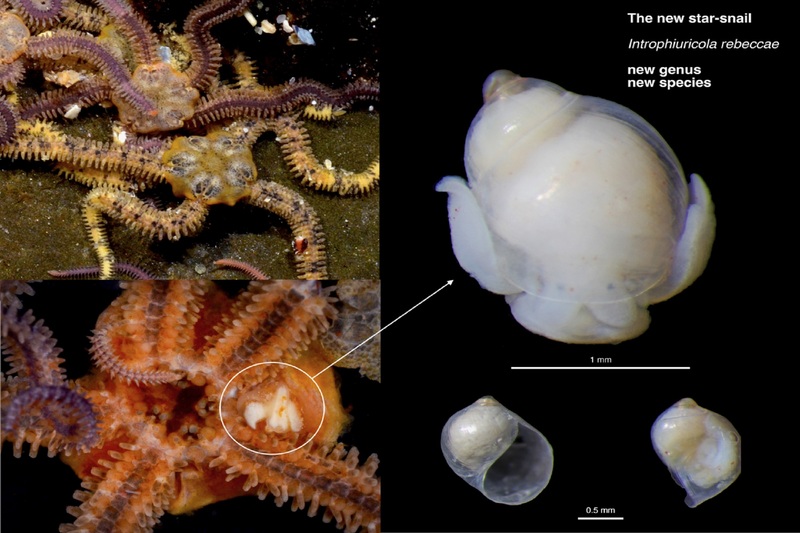
After nearly a decade of taxonomic puzzle-solving, scientists have unveiled a remarkable discovery: a parasitic sea snail that represents not only a new species, but an entirely new genus.
The snail was first observed in 2015 by Sea Change Project marine scientist Dr Jannes Landschoff and Rebecca MacKinnon, then an Honours student at the University of Cape Town (UCT), while studying the biology of the Equitailed brittle star Amphiura capensis. This marine echinoderm is related to starfish. However, unlike starfish, which use tube feet to glide, brittle stars crawl across the seafloor by whipping their highly flexible, serpent-like arms.
Dr Landschoff, who has carried out extensive research on brittle stars – particularly those that brood their young inside small chambers, like the Equitailed one – had launched a project on this species, together with Emeritus Professor Charles Griffiths, at the beginning of his research career. This project became MacKinnon’s Bachelor (Honours) thesis – and the catalyst for a fascinating discovery.
Several months into the study, MacKinnon and Landschoff discovered something peculiar: white, round globules about a millimetre in size nestled inside the brood chambers. After much sleuthing and studying, they realised these were parasitic snails belonging to the family Eulimidae, a group unfamiliar to the researchers. Tracking down experts who could shed light on the finding proved challenging. However, they were eventually pointed to Associate Professor Yasunori Kano and his student, Dr Tsuyoshi Takano, at the University of Tokyo, both experts on this highly specialised group of parasitic snails. The team sent the few specimens they had to Japan – and so began a long and meticulous taxonomic process, led by the Japanese collaborators.
Results
Nearly 10 years later, the results are in. The star-snail, now named Introphiuricola rebeccae n. gen. n. sp., in honour of MacKinnon, has been confirmed as both a new species and genus. Even more extraordinary, its biology – living as an internal parasite of brittle stars – is entirely new to Molluscan science.
The discovery highlights the many findings yet to be made in the Great African Seaforest, a richly biodiverse ecosystem, and contributes to the ongoing 1001 Seaforest Species project.
This science and storytelling project – a partnership between Sea Change Project and Save Our Seas Foundation – aims to scientifically document and chronicle the stories of the kelp forest’s distinctive species. The discovery of Introphiuricola rebeccae n. gen. n. sp., will be added to this repository and underscores the value of scientific collaboration.
Institutions that jointly undertook the research are the Sea Change Project; the Atmosphere and Ocean Research Institute, The University of Tokyo; the Department of Botany and Zoology, Stellenbosch University; and UCT’s Department of Biological Science.
The research can be found in the Journal of Molluscan Studies.
 This work is licensed under a Creative Commons Attribution-NoDerivatives 4.0 International License.
Please view the republishing articles page for more information.