
Wamkelekile, Welkom
UCT scientist honoured for advancing equitable cancer research
23 December 2025 | Story Sarah Marriott. Photo Supplied. Read time 5 min.
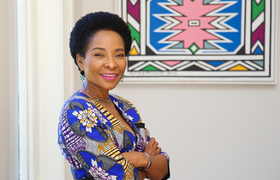
The University of Cape Town’s (UCT) Professor Sharon Prince, one of South Africa’s most accomplished and internationally recognised cancer scientists, was recently honoured with the 2025 A.G. Oettlé Memorial Award*.
A professor of Cell Biology and former deputy dean of research in the Faculty of Health Sciences, she was lauded by the Cancer Association of South Africa (CANSA) for her remarkable contributions to translational innovation, her leadership in advancing cancer control and her unwavering commitment to affordable therapeutics within the national context.
This prestigious award recognises her scientific excellence, visionary leadership, transformative mentorship and the extraordinary impact of her academic research on advancing equitable cancer research and care.
The CANSA Research Committee granted the award to two recipients this year, presented at a virtual ceremony during CANSA’s National Annual General Meeting on 31 October 2025. Professor Prince shares the honour with Dr Maureen Joffe of the University of the Witwatersrand.
Aligning scientific innovation with South Africa’s public health needs
Prince’s career spans more than two decades of addressing fundamental cancer research questions, illustrating her dual impact as a global scientific authority and a committed advocate for public engagement in cancer awareness. Her pioneering genetic research on the oncogenes, cancer-promoting genes, TBX2 and TBX3 transcription factors has transformed understanding of their role in aggressive cancers such as breast, cervical, melanoma, sarcoma and pancreatic cancers, which carry a high burden in the country.
“Recognition like this creates visibility, and visibility creates opportunity – not for me alone, but for the work and the people behind it.”
Alongside her laboratory discoveries, Prince was also recognised for developing affordable, locally relevant treatments, including repurposing accessible drugs and developing new agents from marine-derived and Platinum Group Metal compounds.
A community committed to curtailing cancer
Prince said that receiving the award was not just a professional acknowledgement, but a very personal one. “When I reflect on where I come from, the communities that shaped me and the obstacles along the way, this recognition feels both humbling and affirming.”
She noted that it comes at a time when scientific progress can feel challenging. “Recognition like this creates visibility, and visibility creates opportunity — not for me alone, but for the work and the people behind it,” Prince said. “It strengthens our ability to attract funders, collaborators and students committed to addressing the burden of cancer in South Africa and globally.”
The researcher sees the award as a nod to her persistence: “for choosing to stay in South Africa, to build science under difficult conditions, and to believe that rigorous, internationally competitive research can emerge from anywhere in the world.”
Prince hopes the award will also draw attention to translating fundamental cancer biology into accessible therapies for resource-limited settings. “We are facing many problems, especially funding and resource constraints, which create anxiety and uncertainty about the future of our research endeavours and training of young scientists,” she said.
“The award reinforces the value of staying committed to scientific research, even when progress feels slow.”
A pivotal moment in her research journey came during her postgraduate studies, when she developed a strong interest in understanding the mechanisms driving cancer initiation and progression. This sparked her enduring passion for cancer molecular and cell biology.
Prince acknowledged her collaborator Professor Colin Goding of the Ludwig Institute of Cancer at the University of Oxford, where she worked as a Wellcome Trust Postdoctoral Fellow. She spoke to his guidance, generosity and continued support as having a lasting influence on both her scientific approach and her career.
“My advice to early-career researchers has always been to read and remain curious, to conduct their research with integrity and to nurture collaborations. It is at the intersections of different fields that the most transformative advances emerge.”
“He taught me how to think critically about science, how to write compelling grants, and how to communicate research clearly and effectively,” she said.
Leadership in fostering the next generation of cancer researchers
Beyond her scientific discoveries and prolific output, of over 100 peer-reviewed papers, Prince’s dedicated mentorship of over 130 researchers was also celebrated. Her focus on diversity and female leadership has been invaluable in enabling inclusive academic growth. She proudly believes that this award also belongs to the many talented young scientists who trusted her with their training, reflecting their collective journey.
“My advice to early-career researchers has always been to read and remain curious, to conduct their research with integrity and to nurture collaborations,” she said. “It is at the intersections of different fields that the most transformative advances emerge.”
Prince also reminds young scientists that setbacks are part of the process. “Most importantly, I encourage them to ‘pay it forward’, because science advances when we lift others as we progress.”
*The AG Oettlé Memorial Award was created in remembrance of the late Dr George Oettlé, a cancer researcher and epidemiologist of outstanding achievement who worked at the South African National Health Laboratory Service.
 This work is licensed under a Creative Commons Attribution-NoDerivatives 4.0 International License.
Please view the republishing articles page for more information.