
Wamkelekile, Welkom
UCT students set the pace at Greenovate
18 December 2025 | Story Myolisi Gophe. Photo Supplied. Read time 5 min.
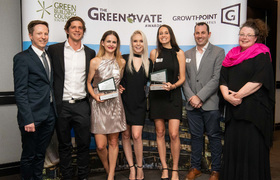
The University of Cape Town (UCT) has once again affirmed its position as a leader in sustainability-driven research and innovation, following its students’ outstanding performance at the 2025 Greenovate Awards. They secured multiple top honours across both the engineering and property streams.
Held in Johannesburg to mark the competition’s 10th anniversary, the Greenovate Awards bring together final-year and postgraduate students from universities across South Africa to present research-based solutions to some of the most pressing sustainability challenges facing the built environment. This year, 29 students from eight institutions took part, with UCT finalists standing out for both the quality of their research and its strong potential for real-world application.
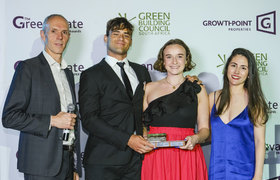
UCT students claimed first and third place in the property category; first place in engineering; and the International Finance Corporation’s Excellence in Design for Greater Efficiency (EDGE) award – underscoring the university’s continued strength in interdisciplinary, impact-oriented scholarship.
Leading the property and construction studies stream were Justine Braaf and Ben van Rhyn, who took first place for their research exploring the water cost savings and personal wealth creation potential of EDGE-certified homes compared with non-certified housing in the Western Cape. Their work not only impressed the judges of the Greenovate Awards for its rigour and relevance but also earned them the EDGE Award, highlighting the global significance of their findings.
A legacy of excellence in construction economics
Their supervisor, Dr Saul Nurick from UCT’s Department of Construction Economics and Management, said the success reflects a long tradition of excellence within the department.
“Since the inception of the Greenovate Awards in 2015, the Department of Construction Economics and Management has won the property stream eight times,” Dr Nurick said. “UCT students present research to real estate and sustainability industry professionals that strikes a chord for real-world application. The timing is ideal, as these students are about to enter the industry as new graduate professionals.”
UCT’s strong showing in the property stream continued with Aiden Pringle and Sam de Witt, who placed third for their innovative research on the capital expenditure and life-cycle costs of a unique green wall design. Their project went beyond conventional costing models by quantifying the often-intangible benefits of living walls, such as environmental performance and human well-being.
Supervisor, Dr Rolien Terblanche, praised the students’ commitment and courage. “I am extremely proud of our students. They put themselves out there – way out of their comfort zone. But wow, did they deliver,” she said.
“It’s a powerful example of how academic research can lead to high-impact solutions for South Africa’s water security.”
In the engineering category, UCT claimed top honours through Aqeelah Sharief, whose project analysed the feasibility of recycling urine on site at Cape Town Stadium using reverse osmosis technology to produce fertiliser and treated wastewater. The judges recognised the project for its bold thinking and practical potential, and the work will now be taken forward as a master’s research project, with implementation planned at the stadium.
Sharief was supervised by Professor Dyllon Randall, who also oversaw the work of Abdul Maliq Tofie, a UCT finalist in the same stream. Tofie’s research focused on optimising reverse osmosis processes and strengthening the business case for nutrient recovery systems in green buildings.
From academic research to national impact
“True innovation requires us to challenge the status quo of how we handle waste,” Professor Randall said. “By thinking outside the box, we can turn a major urban waste stream into fertiliser and reclaimed water. It’s a powerful example of how academic research can lead to high-impact solutions for South Africa’s water security.”
Collectively, the UCT projects reflected a strong alignment with national priorities around climate resilience, water scarcity and sustainable urban development, while also demonstrating the university’s commitment to producing graduates equipped to drive change beyond the classroom.
Manfred Braune, UCT’s director of Environmental Sustainability, who has been involved with the Greenovate competition since its inception, said UCT students continue to set the bar high.
“Every year I am blown away by the passion and innovation that our UCT students bring to the Greenovate competition.”
“Every year I am blown away by the passion and innovation that our UCT students bring to the Greenovate competition,” he said. “This year has been no different. These students have brought fresh perspectives on sustainability challenges – all with clear industry relevance.”
Established in 2015 by Growthpoint Properties in partnership with the Green Building Council South Africa (GBCSA), the Greenovate Awards were designed to bridge the gap between academia and industry. Over the past decade, the competition has grown into a nationally recognised platform for student-led sustainability solutions, with industry mentors, judges and funders playing a hands-on role in shaping projects for implementation.
This year’s awards introduced two new categories focused on implementation potential and alignment with global ESG goals, further reinforcing the programme’s emphasis on practical impact. Winners shared nearly R150 000 in prize money, along with access to professional accreditation courses, mentorship opportunities and platforms to present their work to industry leaders.
 This work is licensed under a Creative Commons Attribution-NoDerivatives 4.0 International License.
Please view the republishing articles page for more information.