
Wamkelekile, Welkom
UCT invested in nurturing the next generation of researchers
17 December 2025 | Story Ayanda Mthethwa. Photos Lerato Maduna. Read time 8 min.
This is the first of two articles by UCT News, which reflect on the research highlights and discussions of the Annual Research Celebration.
The University of Cape Town (UCT) has a range of capacity-building initiatives tailored to nurture and empower the next generation of researchers driving robust and innovative work. The impact of these programmes came to life during a panel discussion at the 2025 Annual Research Celebration, where beneficiaries shared how the support they’ve received throughout their early academic careers, shaped their ascent to becoming empowered researchers in a competitive ecosystem.
When the Deputy Dean of Research, Internationalisation and Social Responsiveness in the Faculty of Commerce, Associate Professor Nkosivile Madinga took his place as the panel facilitator, it was the unfolding of a notable moment. In the audience sat his former mentor, Dr Charles Masango, a research development co-ordinator at the Research Office (RO), who had supported him through the Emerging Researcher Programme (ERP). Years later one guided the discussion, the other observed from the audience – offering a quiet reflection on the generational impact of the sustained research development at UCT.

Contextualising the motivation behind convening the panel comprised of UCT researchers who have participated in RO-led programmes, acting Deputy Vice-Chancellor: Research and Internationalisation (DVC: R&I), Professor Jeff Murugan said the idea was prompted by a discussion during the presentation of the Annual Research Report (ARR), to one of the university committees earlier this year.
The report offers a comprehensive internal business intelligence review of the university’s research progress, achievements and strategic direction. Including metrics on UCT’s various research capacity-building initiatives for emerging researchers.
“Linked to this was a question about what becomes of those researchers,” Professor Murugan said. “There was a curiosity around how they have benefited from these initiatives and the value they have derived from them.”
Held on 2 December at the New Lecture Theatre on Upper Campus, the celebration provided an overview of the activities, challenges and achievements that characterised UCT’s research landscape in 2025. Hosted under the auspices of Professor Murugan and acting Executive Director: Research, Christina Pather, the event adopted the theme ‘Where do we grow from here?
“This theme reflects the importance of attracting, developing and retaining talent, while fostering a sense of belonging among emerging scholars,” Murugan said.
Researcher development initiatives, a lifeline for early-career researchers
For some of the panellists, UCT’s targeted support was vital at a time when establishing credibility remains a great hurdle.
“When you’re an early-career researcher, you don’t yet have a track record. What you have is a lot of ideas that have not been proven. No funder wants to touch you because your ideas could either work or not,” said Associate Professor Rachael Dangarembizi about her debut in academia.

Associate Professor Dangarembizi is based in the Faculty of Health Sciences’ (FHS) Department of Human Biology and the Neuroscience Institute. She acknowledged the support from the Building Research Active Academic Staff (BRAAS) programme as catalytic – providing critical early backing, enabling her to develop her research ideas into credible and therefore, fundable projects.
BRAAS was designed to help build research-active academic staff in the early years of their appointment to successfully graduate postgraduate students and build capacity in their specific research area. Dangarembizi was awarded a two-year grant amounting to R300 000 to support a master’s student. Having graduated them on time, she secured a R630 000 grant to support a PhD student over three-and-a-half years.
During this time and together with her team, they have managed to leverage this initial investment to secure research grants totalling a staggering R45 million.
“BRAAS came through for me as a lifeline. It was lifechanging, completely,” she said.
Dr Jacinta Delhaize from the Faculty of Science’s Department of Astronomy, described the ERP as the anchor that allowed her research career to take shape. She was supported with funding for three years after completing her postdoctoral fellowship, when she transitioned into becoming a member of staff at UCT – which she noted was her only source of funding during this time.
“Without that support, I wouldn’t have been able to attend conferences that opened opportunities for co-supervision with the University of Oxford and institutes in Australia.”
A journey not devoid of challenges
“Research is like growth; it’s very time dependent,” said Dr Cledwyn Mangunda, a participant in the Junior Research Fellowship (JRF) programme. He is based in the Minerals to Metals Initiative at the Faculty of Engineering & the Built Environment.
He described the challenge of reaching an “optimum level” of progress just as the programme concluded. “You’ve almost gotten to the point where you know how to ride this horse without falling off then you’re told it’s over.”
Also based at the FHS Department of Human Biology was panellist Dr Karabo Serala, a beneficiary of the Accelerated Transformation of the Academic Programme (ATAP). He emphasised the role of mentorship in academic development, saying that early-career researchers require better access to senior academics from whom they can learn research techniques and gain experience that supports long-term career progression.
Jointly implemented with the RO, ATAP is an initiative of the Deputy Vice-Chancellor for Transformation, Student Affairs and Social Responsiveness, Professor Elelwani Ramugondo.
“There’s a real understanding that relaxed environments enable growth, stimulate imagination and allow people across disciplines to engage with one another.”
“Most postgraduate students struggle to find good supervisors who can train them into becoming good academics in the future,” he said.
He lauded his supervisor, Professor Sharon Prince, who provided him opportunities to co-supervise early on while still completing his PhD: “I was already developing an important skill that I would need later in my academic career, even before completing the requirements to reach that level,” Dr Serala reflected.
From the Faculty of Humanities’ Centre for Theatre, Dance & Performance Studies, Associate Professor jackï job is a beneficiary of the Research Leadership Programme (RLP). This was introduced as a bespoke programme devised in response to the recognised need for support at the mid- to senior levels.

Pointing to the environment in which development occurs as critical, she said: “There’s a real understanding that relaxed environments enable growth, stimulate imagination and allow people across disciplines to engage with one another.”
Also a beneficiary of the ERP, job mentioned the value of the programme's writing retreats: “Those spaces were incredibly productive. I completed articles in days, largely because of the conversations and exchange that happened in a relaxed environment.”
Where do we grow from here?
While the university has invested millions of rands in developing its academic staff, some of whom have gone on to make significant contributions beyond UCT. Sustaining support for early-career researchers requires long-term, reliable resourcing models.
“The problems we must tackle are big and complex – and we need to pool our resources to achieve economies of scale.”
Speaking to these realities in his closing remarks, Vice-Chancellor Professor Mosa Moshabela acknowledged the complexity of researcher turnover at UCT, which has sector-wide impact.
“We have difficulty retaining all of the people we train,” he said. “But as our DVC: Transformation, Student Affairs and Social Responsiveness told me, we also have to think about the contribution we’re making to the sector as a whole – an instructive comment.”
Professor Moshabela cautioned that competitiveness within higher education has sometimes hindered collaboration: “Yes, we compete for resources, talent, students and funding. We can do a better job in working on sharing the talent and resources that exist.
“It has to be a time for collaboration over competition in our sector. The problems we must tackle are big and complex – and we need to pool our resources to achieve economies of scale.”
Moshabela concluded with a call for collective progress: “If you want to go fast, go alone. If you want to go far, go together.”
RO-led initiatives reaping seeds of success
Acting ED: Research, Christina Pather, acknowledged that: “These programmes were intentionally created and strengthened as incubation hubs – to build capacity, transform and diversify our academic pipeline, and ensure that the next chapter of UCT’s research excellence is inclusive, representative, sustainable and future-facing.”
Most of the programmes received a capital injection from donor or strategic grants. Specifically, JRF, BRAAS and the RLP which were driven by former DVC: R&I Professor Sue Harrison. Her strategic vision for growing research capacity led her to secure extensive strategic funding for researcher support.


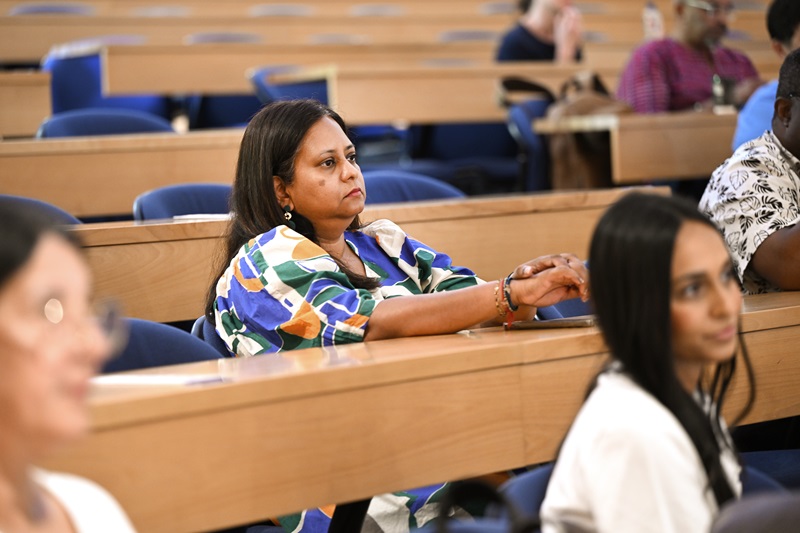


Building a diverse, inclusive and research-productive academic community remains a strategic priority for UCT. At the centre of this work is the RO, whose suite of capacity-building programmes –including those from which the panel members have graduated – continues to shape the next generation of research leaders. These efforts are strengthened by university-wide initiatives such as the New Academic Practitioners’ Programme (NAPP) and the Next Generation Professoriate (NGP), creating a layered ecosystem of support that enables emerging scholars to thrive.
*The second article in this two-part series is Reflecting on research milestones at the Annual Research Celebration.
To learn more about the Research Office’s support services, visit the Research Support Hub services directory.
 This work is licensed under a Creative Commons Attribution-NoDerivatives 4.0 International License.
Please view the republishing articles page for more information.