
Wamkelekile, Welkom
Programme sprouts new idea at UCT’s Neuroscience Institute
05 December 2025 | Story Niémah Davids. Photos Lerato Maduna. Read time 6 min.
“Art isn’t just about solving practical problems. It also intervenes in social spaces to help make social issues more visible, expose power and helps shape how we see the world, how we perceive power, how we feel – and alters our understanding of the world accordingly.”
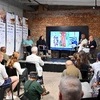
With these remarks, Dr Anye Nyamnjoh, a senior research officer at the EthicsLab located in the University of Cape Town’s (UCT) Neuroscience Institute, welcomed guests to a lunchtime lecture presented by artist, curator and activist Dr Ralph Borland. The lecture, held on Tuesday, 2 December, placed a spotlight on Dr Borland’s work over the years and his recent two-month art residency stint at the EthicsLab.
Background
As he set the tone for the afternoon’s discussion, Dr Nyamnjoh started by connecting Borland’s residency to the EthicsLab’s broad research vision. He reminded the audience that the lab works at the intersection of the humanities, ethics and emerging technologies. Ethics bind researchers’ work and they leverage the African humanities to think critically about ethical questions, especially posed by new and emerging health technologies. To support this vision, the lab hosts various activities like webinars and residencies like Borland’s.

“Interestingly, that’s actually the context in which Ralph’s stint at the EthicsLab was particularly attractive. It came at a moment where we were looking to explore conversations at the intersection of artificial intelligence [AI] and the imagination,” he said.
Currently, the lab is collaborating with the Department of English Literary Studies to explore how AI forms conceptual disruption with regard to authenticity, authorship and originality, as well as how it formats ethical disruption. The objective is to trace how creatives and literary scholars are not only engaged in creative production but, in their capacity as storytellers, also function as ethicists.
“Ralph has helped us immensely to think about some of that, both in terms of the scholarship [and] in terms of this artistic production.”
“Ralph has helped us immensely to think about some of that, both in terms of the scholarship [and] in terms of this artistic production that sits comfortably within,” Nyamnjoh said.
Early journey with art
Borland kicked off his lecture by reflecting on some of his most impressive art projects over the years. This included his first piece of art – a drawing on a cardboard box that showcased several elements, including where he lived (Mowbray) and his love for birds. He also highlighted the work he produced for his undergraduate degree in sculpture in UCT’s Michaelis School of Fine Art, and his master’s in interactive telecommunications at New York University.
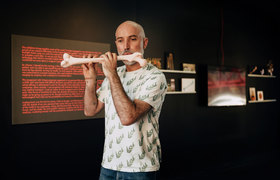
But it was a local project involving Dr Rudolph Venter, an orthopaedic surgeon at Tygerberg Hospital, that was most fascinating. The result was a flute crafted from a 3D replica of Borland’s very own thighbone. He produced this work during a research stint at UCT’s Institute for Humanities in Africa between 2021 and 2023.
“I was interested in imagery of skeletons playing their own bones as instruments.”
“Our remit was to look at emerging technologies in healthcare in Africa. What I was interested in doing with Rudolph was making my own artwork. I was interested in imagery of skeletons playing their own bones as instruments,” Borland said.
Dr Venter works in a 3D orthopaedic laboratory and develops low-cost methods for 3D printing patients’ bones so that surgeons can practice complex procedures beforehand. His work presented a unique opportunity for Borland to explore an idea for an artwork using a replica of his own femur. Once his femur was 3D printed, holes were carved into the creation, using the same tools and processes Venter uses for his surgical simulations on 3D prints. Once the bone had been digitally printed, musician Alessandro Gigli advised on the precise places the embouchure (place for the mouth) and other holes should be drilled and tested the instrument for pitch and sound.
Intro to the Neuroscience Institute
Borland’s intro to the Neuroscience Institute was unplanned. He said when he visited a friend who worked there, he was immediately impressed by the building, its architecture and its potential to be a space for artwork.
“I bet you a dichroic mobile would look great in this space.”
“I was like, wow! This atrium is an amazing space. It’s got light coming in from those high windows. I bet you a dichroic mobile would look great in this space,” he said.
In no time, Borland had met a few people with links to the EthicsLab. He shared some of his thinking and his passion for art, and this subsequently led to a formal introduction and a series of talks with researchers in the lab. They discussed the idea of him joining the space, designing a sculpture and while doing so engaging with colleagues to understand their work and build relationships. However, when he joined the lab, he realised that installing a dichroic mobile in the atrium space would be tricky due to its current lighting setup. So, he used a lightwell next to the lab’s offices and installed a range of dichroic lenses there instead. These discs varied in size to mirror the way each disc reflects off each other, and the way they cast light on the wall.

“Something that I think is amazing about this space is that it’s an awesome sculptural space because it’s visible from directly underneath; it’s visible from all the way up and from the sides. It’s got maximum visibility,” Borland said.
Spearheading a programme
As he wraps up his residency, Borland said his focus now is on developing an artist-in-residency programme at the Neuroscience Institute, which he has called the Creative Residency Programme. The idea, he added, is to “bring in more people like me and more people different to me” to work at the institute, and to build relationships with scholars and to produce unforgettable artwork.
What’s needed to get the programme off the ground? Borland said interdisciplinary engagement is key to recruit individuals from different disciplines, to work across the university, as well as across other institutions. The idea, he added, is to put people together in unexpected ways.
“How can we create welcoming structures for artists? They could be musicians, poets, dancers, visual artists and they could have a range of ways of engaging with the work here,” Borland said.
 This work is licensed under a Creative Commons Attribution-NoDerivatives 4.0 International License.
Please view the republishing articles page for more information.