
Wamkelekile, Welkom
Persistence, not perfection
26 January 2026 | Story Kamva Somdyala. Photo Lerato Maduna Read time 4 min.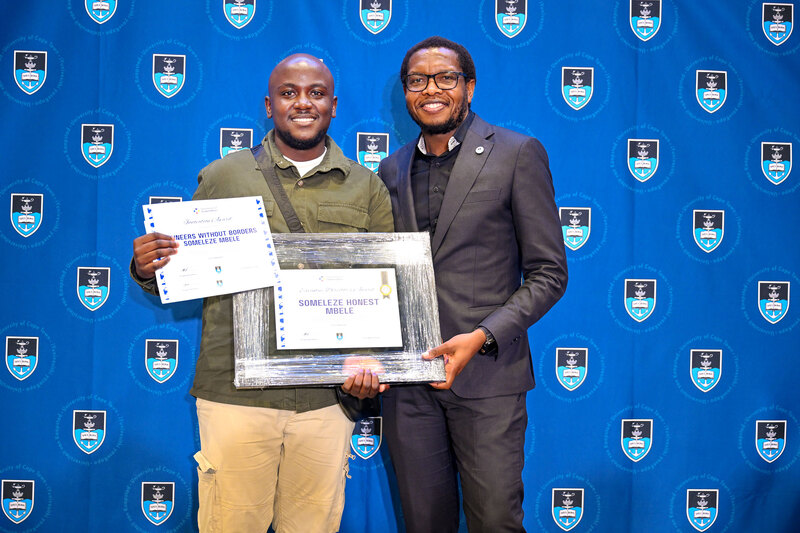
The University of Cape Town’s (UCT) Engineers Without Borders (EWB) chapter is a community rooted in dignity, empathy and sustainability. For former chairperson Someleze Honest Mbele, these values are not abstract ideals, but rather reflect his lived experience.
It is little surprise, then, that the student-led society emerged as one of the standout winners at UCT’s 2025 Student Leadership Awards, receiving both the Innovation Team Award and the Leadership Excellence Award. Mbele was also recognised individually, taking home the Executive Director’s Award and the Phoenix Award for Enduring Excellence.
“My journey with Engineers Without Borders began in 2021 through my involvement in the research and development of the Aquatecture Water Harvesting Pilot installation in Cape Town,” Mbele said. “I was drawn to EWB because it approached engineering not as an abstract technical exercise, but as a human-centred practice rooted in real social and environmental challenges.”
Multidisciplinary, ethical collaboration
Having grown up with an acute awareness of unequal access to basic services, and having personally experienced the impacts of the Cape Town drought, water security was never a theoretical concern for him. “EWB offered a space where multidisciplinary collaboration, ethical reflection and tangible impact could coexist,” he said. “That alignment of values is what made my involvement grow from participation into long-term leadership.”
“EWB offered a space where multidisciplinary collaboration, ethical reflection and tangible impact could coexist.”
At UCT, EWB positions itself as a bridge between the university, communities, industry partners and global networks. According to Mbele, this role encourages students to interrogate power, privilege and access, while equipping them with the practical tools needed to design responsibly.
“This positioning is what has allowed EWB UCT to consistently deliver innovative, socially grounded projects,” he said. “For the team, the awards were validation that ethical, people-centred engineering has a place, and a future, at UCT.”
One project that stands out is the Isondlo Garden Project (2022–2024). As part of the geomatics team, Mbele helped conduct a detailed topographic survey of the site. The team mapped elevation, slope, aspect and existing features to inform both the design and long-term sustainability of the garden.
“This project highlighted how spatial data and surveying underpin food security initiatives and community-based development,” he said.

Behind these achievements lies a more personal journey. One citation noted: “Through hospital stays, physical injury and battles with mental health, this student never allowed adversity to silence their impact. Instead, they transformed hardship into empathy and leadership, proving that resilience is not the absence of struggle, but the decision to keep serving despite it.”
Living with epilepsy
Mbele expanded on this experience: “I have lived with epilepsy and recurrent seizures, alongside depression that at one point led to my involuntary admission to a psychiatric hospital,” he said. “These experiences disrupted my academic life through hospital stays, physical injury, recovery periods and emotional strain.”
He credits UCT’s support systems, especially the Office for Inclusivity & Change and the Department of Student Affairs, with making it possible to continue. “I was provided academic accommodation, including transport assistance, access to suitable accommodation, extra time for assessments, secluded venues for tests and exams, and the hiring of a scribe when my physical condition made writing impossible as I had dislocated my collarbone during an epileptic seizure back in 2024,” he said.
“I made a conscious decision not to allow illness or circumstance to define or limit my contribution.”
Despite these challenges, Mbele remained actively involved in EWB, and continued progressing academically. “I made a conscious decision not to allow illness or circumstance to define or limit my contribution. Instead, I adapted, sought support and kept showing up where I could. That persistence became an act of resistance against being sidelined by adversity.
“Living through vulnerability deepened my empathy and reinforced my belief that inclusive systems are not optional – they are essential. While I have made significant progress academically and in leadership, financial pressure remains a reality. My story is not one of perfection, but of persistence,” he said.
 This work is licensed under a Creative Commons Attribution-NoDerivatives 4.0 International License.
Please view the republishing articles page for more information.