
Wamkelekile, Welkom
UCT and CAF celebrate football leadership graduates
04 February 2026 | Story Myolisi Gophe. Photos Nasief Manie. Voice Cwenga Koyana. Read time 5 min.
Thirty-five football executives from 20 African countries graduated from the Confederation of African Football (CAF) Management Executive Programme at the University of Cape Town’s (UCT) Graduate School of Business (GSB) – marking another milestone in a growing partnership aimed at professionalising football leadership on the continent.
The graduation on 30 January concluded a week-long programme hosted at the UCT GSB, bringing together senior administrators, legal practitioners, journalists and football development specialists from across Africa. Designed to strengthen governance, leadership and strategic capacity within CAF’s 54 member associations, the programme reflects a shared commitment by UCT and CAF to position education as a cornerstone of African football’s long-term success.
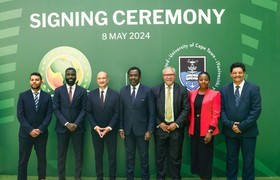
It forms part of a landmark memorandum of understanding (MoU) signed in May 2024 between UCT and CAF, which designated UCT as an Africa Centre of Education Excellence. Signed in Cairo, Egypt, by UCT’s then interim vice-chancellor, Emeritus Professor Daya Reddy; and CAF secretary general, Véron Mosengo-Omba, the agreement committed the two institutions to delivering bespoke executive education programmes for Africa’s football stakeholders.
Education as a catalyst for transformation
Welcoming graduates and guests at the ceremony, UCT Vice-Chancellor Professor Mosa Moshabela said the programme reflected the university’s responsibility to make its expertise available in shaping the future of football on the continent.
“Football plays a very important role in our society – globally, but particularly on the African continent,” Professor Moshabela said. “It brings people together across demographic and socioeconomic divides and represents hope and opportunity for young people. That is why we recognise the social and economic responsibility that comes with football, even for us as universities.”

He emphasised that graduates were not only gaining technical skills but were also shaping a legacy that would influence African football for generations to come. “Your decisions today are the decisions that will create a legacy for football on the continent that we will pass on to the next generation.”
The programme is led by Dr Quinton Johnson, the director of UCT’s International Office, and combines online learning with intensive, in-person modules at the UCT GSB. Its objectives include enhancing leadership expertise, building administrative capacity within member associations, driving innovation, and supporting the sustainability and global competitiveness of African football.
According to Moshabela, delivering a programme of this nature required UCT to move beyond its traditional academic offerings. “The needs that exist in developing football leadership have required us to become more agile and adaptive,” he said. “As a university recognised as one of the leading institutions on the continent, we feel both the pressure and the responsibility to make our resources and expertise available.”
Lessons from the world stage
Addressing the graduates, South African Football Association (SAFA) president, Dr Danny Jordaan, reflected on Africa’s journey in global football, linking administrative capacity to the continent’s ability to host and win major tournaments.
“One of the reasons Africa was doubted for so long is that football administration was not professionalised,” Dr Jordaan said. “Capacity building – the kind you have been exposed to here – is essential if African football is to be globally competitive, not only on the field, but off it as well.”
Drawing on lessons from the 2010 FIFA World Cup, Jordaan highlighted how education, planning and leadership had enabled South Africa to deliver one of the most successful tournaments in history. “We showed the world that Africa could deliver,” he said. “The next challenge is ensuring that African football administrators have the skills to apply what they have learned and to create a clear vision for the future of football on the continent.”

Graduates echoed these sentiments, describing the programme as both transformative and practical.
International sports lawyer and programme participant Shimaa El-Daly from Egypt said the exposure to management and finance had added significant value to her professional work. “This programme helped me understand the importance of management skills, even as a lawyer running my own firm,” she said. “The lecturers were highly experienced, and the networking opportunities were invaluable.”
South African participant Nkosinathi Innocent Mazibuko, managing director of the Weskus High Performance Football Centre, said the programme introduced a crucial business and commercial perspective to football administration. “African football can be competitive on the field, but the challenges have always been off the field – in leadership, management and commercialisation,” he said. “This programme is helping member associations move towards self-sustainability.”
For Nigerian sports journalist and executive participant Calister Enejele, the programme strengthened her leadership capabilities and broadened her understanding of African football ecosystems. “It has improved my learning, managerial and leadership skills, and connected me with people across the continent,” she said.
Moshabela encouraged graduates to see UCT as a long-term partner. “This is not just about the duration of the programme,” he said. “You now have a relationship with the University of Cape Town. If you ever need support, reach out. The university remains a resource for you.”
Congratulating the Class of 2025, he added: “Let this graduation be a milestone – and a commitment to lifelong learning – as you continue shaping the future of African football.”
 This work is licensed under a Creative Commons Attribution-NoDerivatives 4.0 International License.
Please view the republishing articles page for more information.