
Wamkelekile, Welkom
Money, accounting and banking
11 November 2025 | Story Kamva Somdyala. Photos Robyn Walker. Read time 4 min.
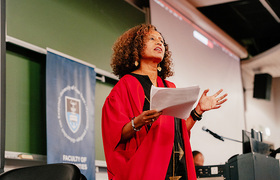
At the heart of modern finance is a question of trust. What happens when the systems built to uphold it begin to falter? The lecture by Professor Phillip de Jager in the Department of Finance and Tax at the University of Cape Town (UCT) explored this thought.
Professor De Jager used the example of the global financial crisis and how it provided a problem that combines accounting, banking and economics. The inaugural lecture was titled “The Numbers We Trust: Unintended Consequences of the Interconnectedness Between Money, Accounting, and Banking”.
“Accounting is not often named a direct cause of the crisis but is often called a contributory factor. One radical example of this viewpoint is the opinion held by Steve Forbes, chairman of Forbes Media, to the effect that mark-to-market accounting was the ‘principal reason’ that the financial system melted down in 2008. Thus, there seems to be a strong suspicion that fair value accounting is procyclical,” said De Jager.
There are of course common reasons for the 2008 crisis, such as loans to people who could not afford them, overleveraging, interest rates too low for too long, an over-strong belief in the ability of markets to regulate themselves, and greed.
“Accounting as money is powerful.”
“There are complaints that fair value accounting is procyclical. My idea is that fair value accounting amplifies the upswing, making banks fragile. To fully understand the argument, it is necessary to consider accounting’s role in money creation. Accounting in banks is important because money is important. But there is more. Accounting in banks is also critical in determining whether a bank is a safe bank.”
He added: “My idea is that fair value accounting amplifies the upswing. Accounting is not always neutral. In banking, accounting is money and bad capital drives out good capital. Accounting in banking has got effects on the real economy and might even contribute to bank crises. Accounting as money is powerful. Should that power be concentrated in a few decision makers or in more? More banks mean more credit officers that means more freedom and money created where it is needed.”
Money creation
If banks paying out dividends and bonuses from unrealised profits is a problem, then taxing these same unrealised profits might make the problem even worse. “Centralisation in banking is not positive for economic growth and innovation. Money creation needs to be as decentralised as possible. It has been established that accounting is money and determines bank safety. Fragility comes from bad capital driving out good capital. It is also banks reaching for yield and the inversion of the yield curve.”


He concluded: “Bank regulators did learn from the crisis in 2008 and tried to make the rules work better.”
 This work is licensed under a Creative Commons Attribution-NoDerivatives 4.0 International License.
Please view the republishing articles page for more information.