
Wamkelekile, Welkom
Protecting UCT’s urban forest from the polyphagous shot-hole borer
20 March 2026 | Story Megan Dick. Photos Grounds & Gardens and RVZ Consulting & Contracting Arborists. Read time 7 min.
As the global community marks International Day of Forests on 21 March, the importance of protecting tree ecosystems comes sharply into focus, including at the University of Cape Town (UCT), where the urban forest is facing a new and growing threat.
While from a distance UCT’s landscape appears to be making a slow but steady recovery from the devastating fire in 2021, its trees are increasingly under pressure from the polyphagous shot-hole borer (PSHB) (Euwallacea fornicatus).
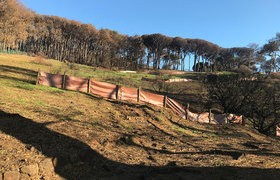
Following the 2021 wildfire that affected large areas of the mountain slopes above campus, protecting the remaining tree canopy and strengthening the resilience of new plantings has become an important priority for the university.
The invasive beetle carries a symbiotic fungus (Fusarium euwallaceae) that colonises a tree’s vascular tissue, disrupting the movement of water and nutrients from the roots to the canopy. As the fungus spreads, trees become increasingly stressed, leading to branch dieback, wilting leaves and a general decline in health. In severe cases, this can result in widespread canopy loss and eventual tree death.
With thousands of trees across upper, middle and lower campus, the urban forest forms a vital part of UCT’s landscape, providing shade, habitat for wildlife and essential green infrastructure that supports biodiversity and campus well-being.
For UCT’s Grounds and Gardens team within the Properties and Services Department, the priority is to protect the campus tree canopy wherever possible, while managing safety risks.
“Our trees are one of the defining features of the UCT campus,” said Noelene le Cordier, senior horticulturalist in the Grounds and Gardens division. “They provide shade, support biodiversity and form part of the character of this environment. Our approach is always to retain and protect trees wherever it is safe and feasible to do so.”
Monitoring and early detection
Regular monitoring has been central to UCT’s response strategy. Grounds and Gardens staff and specialist arborists carry out visual inspections across campus, supported by tree inventory and GIS-based systems that help identify vulnerable species and track changes in tree health over time. Reports from staff, students and visitors have also assisted with early detection.
These efforts have shown that some species are more vulnerable than others. Commonly affected trees on campus include plane trees, English oaks, box elders and coral trees, as well as some indigenous species. English oaks appear to react particularly poorly to PSHB infestations, with higher mortality rates observed in several areas of Cape Town, including nearby Campground Road in Rondebosch. Many of these species are recognised host trees and have shown high susceptibility elsewhere in South Africa.
Managing the threat
UCT’s response focuses on three main areas: prevention, strengthening tree health and careful management of infected trees, which forms part of an integrated urban forest management strategy. In priority areas, susceptible trees have been treated with neem-based products derived from the neem tree. These treatments act as natural deterrents and may help reduce beetle activity, while remaining environmentally responsible and safe for surrounding plants and wildlife. However, effectiveness depends on species, stage of infestation, and overall tree health. Early detection is critical. UCT’s approach is also aligned with broader City of Cape Town – as well as provincial and national – invasive pest guidance.
The Grounds and Gardens team is working to improve the resilience of existing trees through soil improvement programmes, irrigation adjustments and specialised arboricultural treatments, as healthier trees are generally better able to withstand pest pressure.
“Where there is a chance that a tree can recover or be managed safely, we prioritise treatment and monitoring.”
As infestations progress, trees can become structurally unstable. Dead or weakened branches may fail without warning, posing a risk to people, vehicles and nearby infrastructure. In more advanced cases, where the main stem or root system is compromised, entire trees may become unstable.
Management therefore focuses on both limiting the spread of the beetle and maintaining safety. Where infestations are detected early, targeted pruning and removal of heavily infested branches can help reduce breeding sites and slow population growth. All removed material is handled and disposed of according to strict protocols to prevent further spread. Tree removal is considered only when a tree becomes structurally unsafe or has suffered extensive decline. “Felling a tree is always a last resort,” said Le Cordier. “Where there is a chance that a tree can recover or be managed safely, we prioritise treatment and monitoring.”
Strengthening the campus landscape
While PSHB presents a significant challenge, infestation is not necessarily a death sentence for trees. Over time, ecosystems may reach a natural balance between host trees and beetle populations, although this process can take years and may result in the loss of highly susceptible species. Similar patterns have been observed in parts of Johannesburg and Somerset West.
UCT is also planning for the future. New plantings across campus increasingly focus on a diverse mix of indigenous species that are better adapted to local conditions and support biodiversity. “Diversifying the species we plant is one of the ways we build resilience into the campus landscape,” said Le Cordier.
“With awareness and support, we can protect the UCT urban forest for future generations.”
“Indigenous trees are often better suited to local conditions and help strengthen biodiversity while reducing vulnerability to future pests.”
RVZ Consulting & Contracting Arborists, who have been assisting the university with specialised assessments and management protocols, have also offered to donate replacement trees where losses occur. The first replacement plantings are expected during the winter planting season of 2026.
How the campus community can help
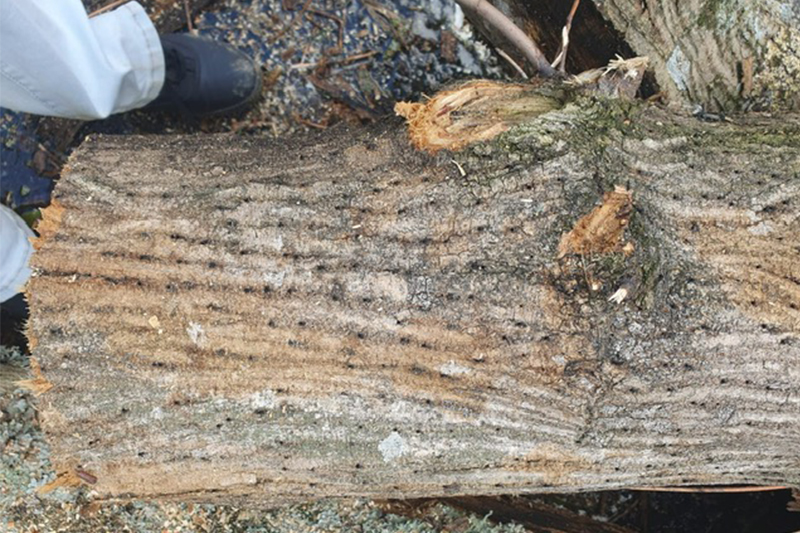
Grounds and Gardens emphasises that the campus community also has an important role to play. Staff and students are encouraged to report unusual tree symptoms to the Grounds and Gardens team. These include small round entry holes, saw-dust like material, staining on the bark, or branch die-back starting in parts of the canopy. Suspected infested wood should not be moved, pruned or disposed of informally, as this may contribute to further spread.
“UCT’s trees are part of a shared environment that benefits the entire community,” said Le Cordier. “With awareness and support, we can protect the UCT urban forest for future generations.”
 This work is licensed under a Creative Commons Attribution-NoDerivatives 4.0 International License.
Please view the republishing articles page for more information.