
Wamkelekile, Welkom
Calls for SA to enter global migration debate
18 March 2026 | Story Lisa Templeton. Photos Samuel Otieno. Read time 8 min.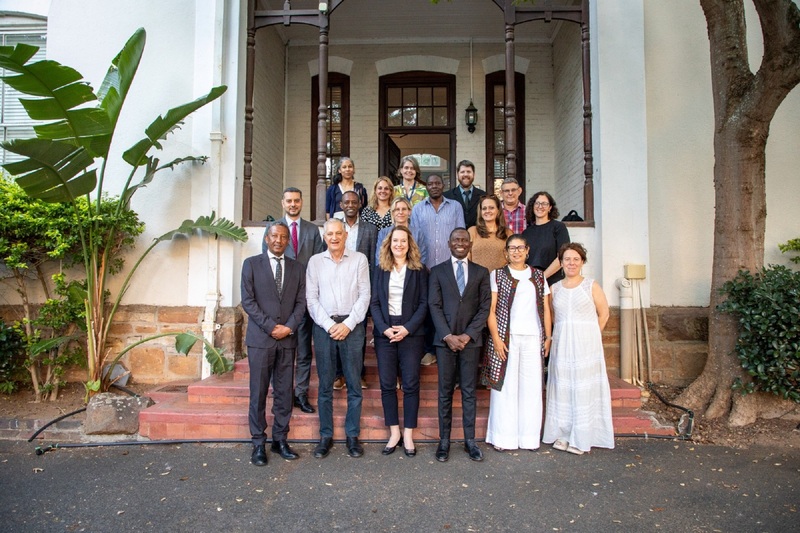
Visiting South Africa as the country advances its Draft Revised White Paper on Citizenship, Immigration and Refugee Protection, United Nations (UN) director general (DG) of the International Organization for Migration (IOM), Amy Pope, commended the country on its proactive approach, while emphasising the importance of data-driven migration reform.
At a time when migration – whether due to political turmoil, climate impact or economic need – is a global topic, South Africa’s reforms look to balance service delivery and economic development with national security and the mitigation of fraud and abuse.
“This is the moment for South Africa to enter this global debate,” said Pope, who was in the country to strengthen ties between the IOM and South African government, and meet with Minister of Home Affairs Leon Schreiber. “South Africa brings deep experience in managing complex mobility and regional dynamics and its leadership shapes how the entire region thinks about mobility. That responsibility matters.”
A priority for the IOM is to deepen cooperation with the South African government, notably the Departments of Home Affairs and of International Relations and Cooperation (DIRCO) around migration management, data systems, migrant protection and security. This builds on a 30-year relationship, which began post-apartheid in helping exiles return home.
The migration challenges facing South Africa are complex, and include digital identity, border management and labour pathways.
“The migration challenges here are real and often get overlooked. Climate change, urbanisation, youth unemployment … these are real pressures, but well-managed migration is part of the answer, not the problem. IOM is proud to be a partner in all of it.”
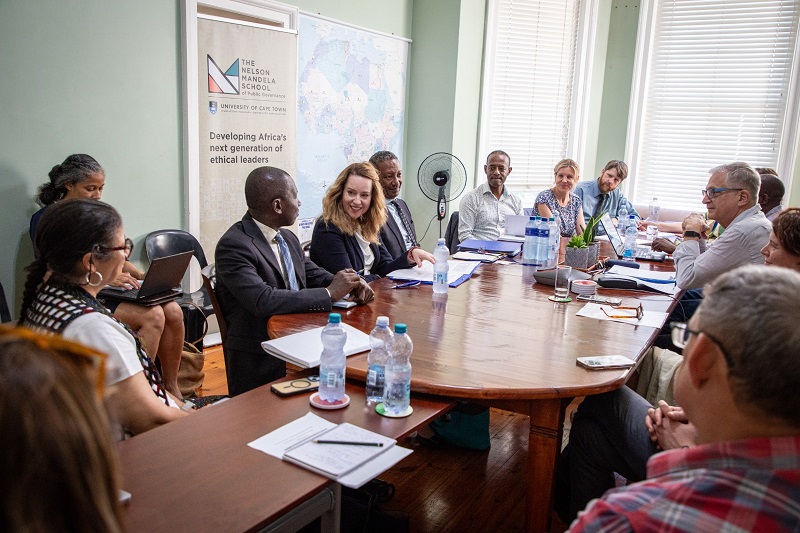
Pope was speaking from the grounds of UCT’s Nelson Mandela School of Public Governance at the close of a roundtable discussion that embraced academia as part of the migration conversation towards reform.
Importance of academic input in migration policy
“The purpose of meeting with academics is to link organisations and embrace broader stakeholders within the region to encourage better modalities for migration,” said Emeritus Professor Alan Hirsch, the head of the Migration Governance Reform in Africa Programme (MIGRA) at the New South Institute (NSI); and former founding director of the Nelson Mandela School. Emeritus Professor Hirsch convened the roundtable.
“It is hoped that this will result in cooperation between the various stakeholders going forwards.”
He added that this was an honour for UCT, the DG being one of the highest-ranking members of the UN system to visit South Africa in recent years. Pope is the first woman to hold the role of DG in the IOM’s 73-year history and served as Deputy Homeland Security Advisor to United States President Barack Obama and Senior Advisor on Migration to President Joe Biden.
Gathered around the table were UCT’s dean of Commerce, Professor Suki Goodman; the incoming director of the Nelson Mandela School, Professor Cheryl Hendricks, (currently executive director of the Institute for Justice and Reconciliation); scholars from UCT, the University of the Western Cape, and representatives of the Institute for Security Studies and the Scalabrini Institute.
“It is critical that we ground policy in what is happening in real life and take lessons from what is working and what’s not working.”
“One of the points made in today’s conversation is that while there are lots of good policy frameworks across Africa, you need solid implementation,” said Pope. “A starting point for so much of this is what is the evidence and data showing us? Migration policy can be driven by anecdote and feeling, and it is critical that we ground policy in what is happening in real life and take lessons from what is working and what’s not working.”
Academic study offers governments independent and rigorous analysis around complex mobility dynamics, policy outcomes, and future challenges. Not only that but universities and institutions create space for dialogue that includes researchers, communities, policy makers and the private sector, thereby facilitating diverse perspectives that shape national and regional debate.
“By elevating African research, policy innovation, and regional cooperation, countries across the continent can continue shaping global migration governance in meaningful and lasting ways.”
Just as South Africa carries weight in continental and international debates, so regional platforms such as the African Union and processes like MIDSA offer powerful avenues to influence global agendas on mobility, development, and integration. Active engagement in global frameworks such as the Global Compact for Migration reinforces this leadership, Pope emphasised.
The importance of data
“Number one is to know who is coming and what they need,” said Pope. “Humans have migrated since the beginning of time, and the total percentage of migrants today is not that different, but the drivers of migration are really interesting right now.
“This particularly applies to people who are migrating from extreme poverty; from countries with very little economic opportunity, looking for opportunity in more well-developed economies. This is what we are seeing: the disparity between where someone comes from and where they are searching to go to. And that is driving a lot of political debate.”
Pope commended the White Paper for charting a way forward that is sensible and fact-based. The question now is how it will be effectively implemented; migration can be better managed so that the issues around security, access to services, jobs and unemployment can be addressed as part of a broader conversation.
“The draft White Paper presents a significant opportunity to strengthen South Africa’s migration governance. IOM has provided technical inputs and stands ready to support its implementation. This includes work on digital border management tools, route‑based approaches, and enhanced migration data systems. Our focus is to help ensure that the reforms are grounded in evidence, reflect international good practice, and respond to the realities faced by people and institutions across the country.”
IOM message to young scholars, policy makers and researchers
Migration is one of the defining issues of this generation globally, notably in the big, developed economies of the world. Pope described a growing tension between the tolerance of communities to accepting migrants and the important economic, demographic roles assumed by migrants.
“Strong research, informed leadership, and public engagement are essential,” said Pope. “Young scholars have a critical role in shaping evidence‑based policy and advancing public understanding.”
“Governments, communities, private sector … together, that’s how we protect dignity and unlock opportunity.”
Work produced at institutions such as UCT is invaluable in guiding national debates and policy making. Pope encouraged students and researchers to pursue interdisciplinary approaches, engage with real‑world policy challenges, and remain active in shaping the future of migration governance. This year, the IOM will launch the World Migration Report, offering global data and analysis to support this important work.
“This week has been great,” Pope concluded. “I am a big fan of the country. This is a beautiful part of the world and it’s dynamic. Yes, there are real problems, but there are real solutions.
“As IOM marks 75 years globally and 30 years in South Africa, we’re as committed as ever. Governments, communities, private sector … together, that’s how we protect dignity and unlock opportunity.”
 This work is licensed under a Creative Commons Attribution-NoDerivatives 4.0 International License.
Please view the republishing articles page for more information.