
Wamkelekile, Welkom
BIOGRIP 2026 brings South Africa’s biogeochemistry community together
04 February 2026 | Story Stephen Langtry. Photos Lerato Maduna. Read time 6 min.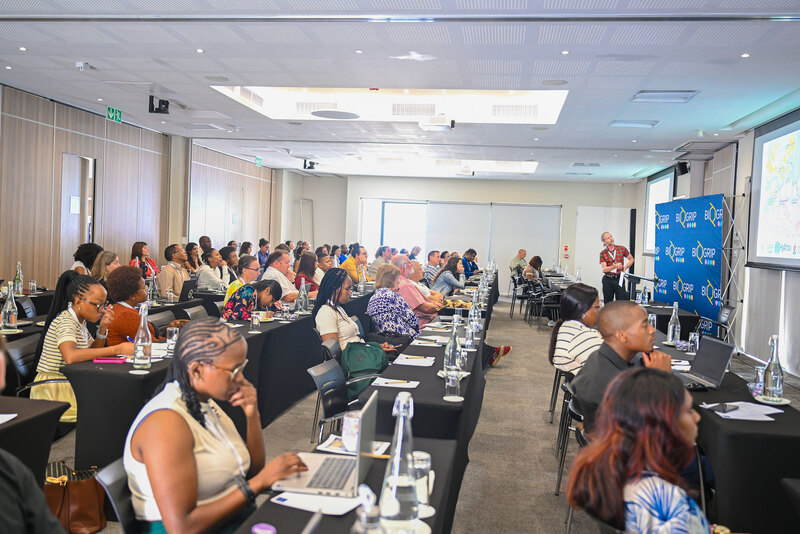
Close to a hundred researchers, students and partners gathered at the University of Cape Town (UCT) Graduate School of Business (GSB) at the V&A Waterfront from 28 to 30 January for the BIOGRIP 2026 Conference.
The conference provided a window into how shared scientific infrastructure is shaping South Africa’s response to some of its most pressing environmental challenges.
Hosted by the Biogeochemistry Research Infrastructure Platform (BIOGRIP), the conference brought together BIOGRIP-funded platforms across UCT, Stellenbosch University, the University of the Free State and North-West University, alongside collaborators from other universities and industry. Over two and a half days, delegates explored how biogeochemistry (the study of interactions between biological, chemical and physical processes) is helping to generate the data, tools and collaborations needed to understand environmental change.
At the heart of BIOGRIP’s work is a nationally distributed research infrastructure, coordinated through an administrative hub at UCT, with complementary nodes across the country. Each node brings a specific strength: isotope biogeochemistry at UCT; soil and water systems at Stellenbosch University; mineral–microbe interactions at the University of the Free State; and atmospheric biogeochemistry at North-West University.
“BIOGRIP was established to provide world-class analytical facilities, technical expertise and training, while generating long-term, comparable datasets that support environmental monitoring and decision-making.”
“BIOGRIP was established to provide world-class analytical facilities, technical expertise and training, while generating long-term, comparable datasets that support environmental monitoring and decision-making,” said Dr Aldwin Ndhlovu, project manager of BIOGRIP and organiser of the 2026 conference.
By coordinating infrastructure and expertise across institutions, BIOGRIP aims to ensure that advanced analytical tools are not siloed, but shared in ways that support national priorities such as water security, pollution monitoring and sustainable ecosystem management.
A moment for reflection and integration
According to Dr Ndhlovu, the timing of the 2026 conference was deliberate. Many BIOGRIP-funded platforms have now reached a stage where substantial datasets and research outputs are emerging, creating an opportunity to reflect on progress and strengthen integration across projects and institutions.
“The programme was designed to allow research to be viewed collectively rather than in isolation.”
Rather than organising sessions around individual platforms, the programme was structured around three broad thematic areas: Deep Past, Present-Day Natural Systems, and Human Impacts. This framing encouraged delegates to see connections across disciplines, methods and timescales, and to engage with research beyond their immediate specialisations.
“The programme was designed to allow research to be viewed collectively rather than in isolation,” Ndhlovu explained. “That approach reflects BIOGRIP’s broader objectives of inclusivity, capacity development and cross-platform collaboration.” The diversity of contributions, from postgraduate students to senior researchers, underscored BIOGRIP’s emphasis on building both infrastructure and people. Poster sessions and panel discussions complemented formal presentations, creating space for dialogue, mentoring and informal exchange.
Spotlight on present-day systems and human impacts
The afternoon session on 29 January, which focused on present-day natural systems and human impacts, offered a particularly vivid illustration of how biogeochemical research connects fundamental science with societal concerns.
Chaired by Ndhlovu, the session showcased research using high-sensitivity analytical techniques to trace nutrients, pollutants and environmental change across marine, atmospheric and terrestrial systems. Presentations ranged from studies of nitrogen stable isotopes as tools for Earth science research, to investigations of phytoplankton development in the Southern Ocean’s marginal ice zone, and fine-scale nutrient supply in the Cape Basin using ocean gliders.

Other talks examined the hydrogeochemical impacts of climate change on groundwater systems in South Africa’s Upper Karoo, as well as urban biogeochemical processes, such as the formation of mineral deposits beneath bridges in Athlone, Cape Town. Together, these studies highlighted the breadth of environments in which biogeochemistry is applied – from open oceans to urban infrastructure, and the relevance of these insights for sustainability and planning.
What united the session was a shared emphasis on process-based measurement: using isotopes, trace metals and advanced monitoring tools to trace sources, pathways and impacts that are often invisible to the naked eye.
“Biogeochemistry provides an integrative framework for understanding how physical, chemical and biological processes interact across land, water and atmosphere,” Ndhlovu explained. “These analytical platforms are essential for detecting environmental change and translating complex processes into actionable knowledge.”
Infrastructure as collaboration
Beyond the science itself, the conference foregrounded a central message that national research infrastructure delivers its greatest value when it is shared, coordinated and embedded in strong collaborative networks.
Delegates included researchers and students from multiple universities, as well as partners from industry and applied sectors. This breadth of participation reflects a broader shift in South African science towards collaborative, impact-driven research that bridges institutional and sectoral boundaries.
For BIOGRIP, such partnerships are integral. Shared infrastructure enables access to advanced facilities that would be difficult for individual institutions to sustain alone, while collaborative projects help ensure that research outputs speak to real-world needs.
“Training, student involvement and cross-institutional engagement are central to long-term impact.”
“The conference reinforced that BIOGRIP’s role is not only about infrastructure, but about developing people alongside that infrastructure,” Ndhlovu noted. “Training, student involvement and cross-institutional engagement are central to long-term impact.”
Panel discussions on science communication and quality control practices within laboratories further underscored the importance of shared standards, transparent processes and effective engagement beyond academia.
As BIOGRIP moves into its next phase, priorities include strengthening analytical platforms, supporting interdisciplinary research aligned with national challenges, and expanding capacity development across institutions. For UCT researchers and students, this means continued opportunities to access shared facilities, participate in collaborative projects and build advanced analytical skills.
By bringing together diverse expertise, career stages and institutions, the conference offered an example of how coordinated research infrastructure can help South Africa navigate an increasingly complex environmental future.
 This work is licensed under a Creative Commons Attribution-NoDerivatives 4.0 International License.
Please view the republishing articles page for more information.