
Wamkelekile, Welkom
Crime in the age of algorithms
22 January 2026 | Story Myolisi Gophe. Photos Lerato Maduna. Read time 9 min.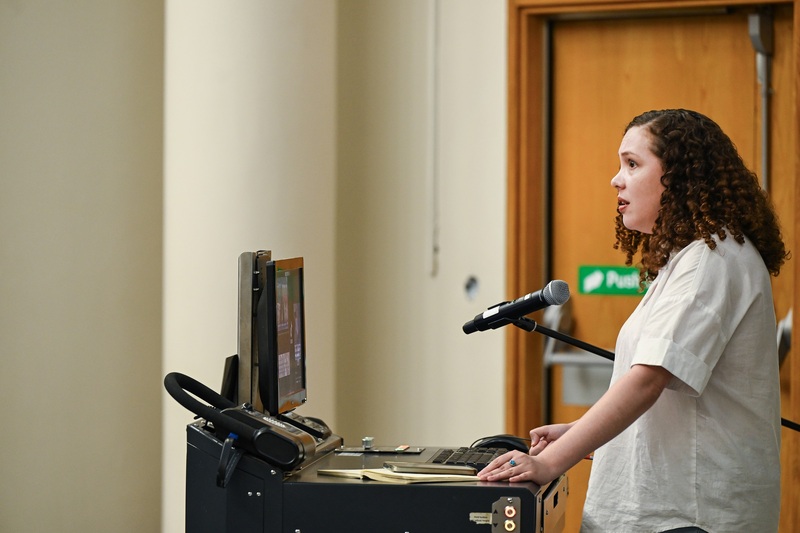
Crime in South Africa is no longer confined to dark alleys, back rooms or whispered phone calls. It scrolls past us on our phones, appears in our inboxes, speaks to us through artificial voices – and sometimes lies convincingly enough to pass for truth.
That unsettling reality formed the heart of an interactive, often emotional Summer School lecture delivered by award-winning author and journalist Caryn Dolley, who drew on decades of reporting to unpack how social media, artificial intelligence (AI) and misinformation are reshaping crime – and society’s relationship with it.
Blending sharp analysis with dark humour, personal reflection and moments of visible vulnerability, Dolley of the Dailly Maverick publication took her audience on a journey through a criminal landscape increasingly mediated by screens, algorithms and deception.
“What I’m talking about is happening in real time,” she said. “And it’s bizarre to watch it unfold as a journalist.”
The lecture, titled “The Crimes They are A-Changin’: Exploring South Africa’s evolving criminal landscape”, was Dolley’s third year at the popular Summer School, and one of her two lectures this year.
She recalled starting in a newsroom with no internet and a single landline – a far cry from today’s environment of encrypted messaging apps, instant global communication and anonymous online platforms.
“If you think about drug trafficking today … there are encrypted apps and platforms that allow instant communication.”
That shift, she argued, has made it easier for criminal networks to operate across borders, share intelligence and evade law enforcement.
“If you think about drug trafficking today … there are encrypted apps and platforms that allow instant communication,” she said. “It makes you wonder how much easier it is to organise crime now.”
Criminal groups, Dolley noted, often have access to equipment and resources that rival – and in some cases exceed – those of the state. From drones used in gang operations to sophisticated online scams, technology has become both a tool and a weapon.
“Basically, if we look at what the police service has and what the gangs have, probably I would go so far as to say they have better equipment, they have more, I don’t want to say manpower, but power.”
TikTok, gangs and the performance of crime
Social media platforms – particularly TikTok and Instagram – featured prominently in the lecture. Dolley described how gangs increasingly use these platforms to project power, promote a distorted sense of status, and normalise violence.
“Anyone can get onto TikTok and post almost anything,” she said, adding that with minimal word disguising, criminal content can circulate widely before it is flagged.
While social media can be used for good – particularly in locating missing persons – it also accelerates the spread of misinformation. The same platforms that help find missing children can just as quickly mislead the public, contaminate crime scenes, or derail investigations.
A striking example was the Joshlin Smith case, in which TikTok videos went viral during the search for the missing six-year-old. Videos showing possible “clues” prompted people to trample potential evidence, while police were forced to divert resources to counter online speculation.
In an unprecedented moment, a TikTok influencer was later called as a witness in court.
“That’s when you realise how much online behaviour is bleeding into real-world justice,” Dolley said.
“In a country battling gender-based violence, this kind of abuse is not just distasteful – it’s dangerous.”
Perhaps the most unsettling section of the lecture focused on deepfakes – digitally manipulated videos or images that convincingly portray people saying or doing things they never did.
Dolley shared a personal encounter with a deepfake video created using the likeness of a former police officer, which was used in an investment scam.
“I knew it was fake only because I’d spoken to him so many times,” she said. “Most people wouldn’t be able to tell.”
Deepfakes, she warned, are increasingly targeting prominent figures, exploiting existing trust to deceive the public and extract money. But the danger goes far beyond fraud.
On platforms such as X (formerly Twitter), AI tools are being used to generate non-consensual sexual images – overwhelmingly targeting women. The impact, she stressed, is humiliating, degrading and deeply traumatic.
“In a country battling gender-based violence, this kind of abuse is not just distasteful – it’s dangerous,” she said.
When misinformation becomes a weapon
The lecture also examined how misinformation campaigns intersect with power, politics and policing.
In the months leading up to South Africa’s explosive law enforcement scandal in July 2025 exposed by KwaZulu-Natal provincial commissioner General Nhlanhla Mkhwanazi, Dolley tracked a pattern of social media attacks, fake news and online smears aimed at senior figures within Crime Intelligence.
What initially appeared to be isolated online narratives later aligned with arrests, public accusations and allegations of cartel infiltration within the criminal justice system.
“When you look back, the signs were there,” she said. “Social media didn’t just report the crisis – it became part of it.”

The speed and scale of online smear campaigns, she warned, far exceed anything seen during earlier periods of state capture. “You can destroy a reputation in minutes.”
While organised crime is often associated with drugs, guns and money laundering, the lecture expanded the definition to include environmental and wildlife crime – areas increasingly linked to transnational criminal networks.
From abalone and rhino horn trafficking to the illicit trade in succulents and even ants, criminal exploitation now reaches deep into ecosystems.
In one case cited, traffickers were sentenced for attempting to smuggle thousands of ants out of Kenya – a crime with devastating long-term consequences.
“Without ants, soil quality declines,” the speaker explained. “That affects ecosystems, agriculture and future generations. These crimes may seem small, but their impact is enormous.”
A recurring question throughout the lecture was whether crime itself is increasing or whether society is simply more exposed to it.
“With videos, livestreams and instant uploads, we’re hyper-aware,” Dolley said. “We see shootings, arrests, corruption – often before authorities even respond.”
This exposure, she suggested, can distort public perception, heighten fear and erode trust, even as it reveals truths that might otherwise remain hidden.
A call for caution
Dolley concluded with a warning from police: posting crimes on social media can endanger lives, contaminate evidence and trigger vigilante violence. Families may learn of deaths through viral videos rather than official channels.
“Social media is not the police,” she reminded the audience. “And it’s not there to stop crime.”
Yet she was careful not to condemn technology outright. The problem, she argued, lies not in the tools themselves, but in how they are used.
“Crime is evolving with technology – but the intent behind it hasn’t changed,” she said. “Greed, power and exploitation have always been there.”
During the question-and-answer session, audience members asked about Dolley’s methods, safety and emotional toll, among others.

On how she verifies information in an era of rampant misinformation, she was unequivocal: go back to basics.
“I always go to the source,” she said. “If it’s a document, I want the original document. If it’s a human, I want the source human.”
More troubling, she added, are moments when misinformation appears to originate from within the state itself.
“That’s what makes me the most concerned,” she said. “When harmful narratives are intentionally pushed using official-looking documents.”
Asked whether AI will make journalism easier in the next decade, Dolley was sceptical.
“I can’t trust what the machine is telling me,” she said. “I don’t know who put that information into it.”
While AI may be useful for quickly scanning crime statistics, she argued that it strips reporting of nuance, language and intent.
“I’d rather take five hours to verify facts than rely on a machine that could lie to me,” she said – before lightening the mood by confessing her enthusiasm for robot vacuum cleaners.
 This work is licensed under a Creative Commons Attribution-NoDerivatives 4.0 International License.
Please view the republishing articles page for more information.