
Wamkelekile, Welkom
George Hull on winning a 2025 National University Teaching Award
22 December 2025 | Story Lisa Templeton. Photo Supplied. Read time 6 min.
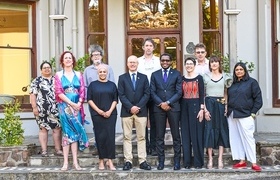
Selected for a 2025 National University Teaching Award (NUTA) as a “highly committed and influential teacher”, Associate Professor George Hull adds this honour to his 2023 UCT Distinguished Teacher Award. His work spans business ethics, the philosophy of race and political philosophy, underpinned by an approach to teaching that blends “discomfort and empowerment” to help students tackle complex ideas with confidence.
Recognised for innovation in both teaching and curriculum design, Associate Professor Hull’s nomination impressed the distinguished NUTA panel and took him to Emperor’s Palace in Johannesburg for the gala awards ceremony in November.
Professor Clever Ndebele, the chair of SA University Teachers, praised Hull’s “creative, thought-provoking and inclusive” methods, noting that his teaching portfolio “contains sufficient evidence to demonstrate that your teaching methods are effective and appreciated by your students”.
Lisa Templeton (LT): How was the awards evening, and was there anything notably inspiring about winning this award?
George Hull (GH): The evening was fun. Between the edifying speeches there was stand-up comedy and some great saxophone playing. It was inspiring to hear about the work lecturers are doing at other universities.
LT: What does this national award mean to you?
GH: It’s an honour, and in a way, it’s reassuring. I’m lucky to be in a department where colleagues all get on very well and give each other constructive input. Teaching is a standing agenda item in our meetings. Even so, you wonder whether the way you frame things will land with students, or how your courses compare with those at other universities. This recognition encourages me to try to do even better. I’m grateful to those who nominated me.
“This recognition encourages me to try to do even better.”
LT: Was there a lecturer that stood out for you as a student, and why?
GH: Definitely [German philosopher] Ernst Tugendhat, whose seminar I took during an undergraduate exchange year in Tübingen. He showed us what close reading of a text meant. Unlike some of his colleagues, he was genuinely interested in what students had to say, rushing over with a hand cupped to his ear when his hearing aid wasn’t amplifying sufficiently. He approached philosophical problems as urgent matters, on whose resolution a lot was hanging. At least for the two hours of the seminar, we tried to be as committed as he was.
LT: What makes a good philosophy lecturer?
GH: For me, it’s a mix of discomfort and empowerment. Discomfort because there’s no easy orthodoxy. In many important philosophical debates, there are several well-argued but incompatible positions. A lecturer should be able to show why each has its appeal, and why they can’t all be right. There’s no avoiding controversy.
Empowerment because the lecturer shouldn’t just be giving an exposition of theories. They should also be equipping students with the tools of conceptual analysis and evaluation of arguments, so that they can articulate and defend their own views.
LT: What role can philosophy play in the modern world?
GH: It’s a discipline with a lot of potential. People may assume philosophy is about impenetrable treatises and gnomic utterances – and we do love those – but it has a role to play as an ancillary discipline, as well as a core discipline. When I started at UCT, I taught a lot of biomedical ethics. I used to accompany a senior colleague when he ran ethics discussion groups for medical students who were taking on some responsibility for patient care. It was striking to see how training them to use some of philosophy’s tools, of conceptual analysis and evaluation of arguments, made a real-time difference in enabling them to think for themselves, systematically, about the dilemmas they were coming face to face with in the wards. Philosophy at UCT has a long-standing and positive relationship with the Faculty of Health Sciences via the Bioethics Centre, and with the Faculty of Commerce through our Business Ethics course.
LT: Is there something about the South African student body that stands out as challenging or rewarding?
GH: Philosophy isn’t generally taught in schools here. That means students don’t make a fully informed choice about taking it at university – so there’s a need for outreach. My colleague Gabriele Teal-James’s Foundations in Philosophy programme is a model for how to do this. But there’s only so much one department can do with limited resources. Many of the pressing questions about consciousness, personhood and ethical guardrails, which the advent of artificial intelligence now raises, are classic philosophical questions. Some of the philosophical ‘thought experiments’ that were ridiculed as unrealistic hypotheticals not so long ago, might be on the verge of becoming real-life choices. The challenge is helping students discover that this is what philosophy covers.
“Some of the philosophical ‘thought experiments’ that were ridiculed … not so long ago might be on the verge of becoming real-world choices.”
LT: You’ve been cited for innovation in the classroom. Is there something you’re particularly proud of?
GH: In my Philosophy of Race course, I’ve followed up the idea that a lot of the debates among colonial and apartheid-era Southern African liberation movement intellectuals like Ben Kies, Neville Alexander and Robert Sobukwe, pre-empted contemporary scholarly debates about identity and racial justice, and sometimes advanced them. I invited living intellectuals from the Unity Movement, Black Consciousness Movement and Congress Movement to put the writings in context for the class. The most impressive guest lecturer was Ben Turok. Totally on the ball at the age of 90, he spoke off the cuff about the thinking of the Communist Party/ANC around identity in the 1960s, and related it illuminatingly to campus debates from 2015 to 2017. In 2023, I aligned two weeks of the PHI2045S curriculum with Professor Mariam Konaté’s related course at Western Michigan University in the United States, and we merged our classrooms via video link.
LT: What do you do to relax when you are not winning awards or on campus?
GH: I like swimming, taking part in fiction book clubs, and doing nothing.
 This work is licensed under a Creative Commons Attribution-NoDerivatives 4.0 International License.
Please view the republishing articles page for more information.