
Wamkelekile, Welkom
‘Teaching is an act of hope’
08 December 2025 | Story Niémah Davids. Photo Je'nine May. Read time 10 min.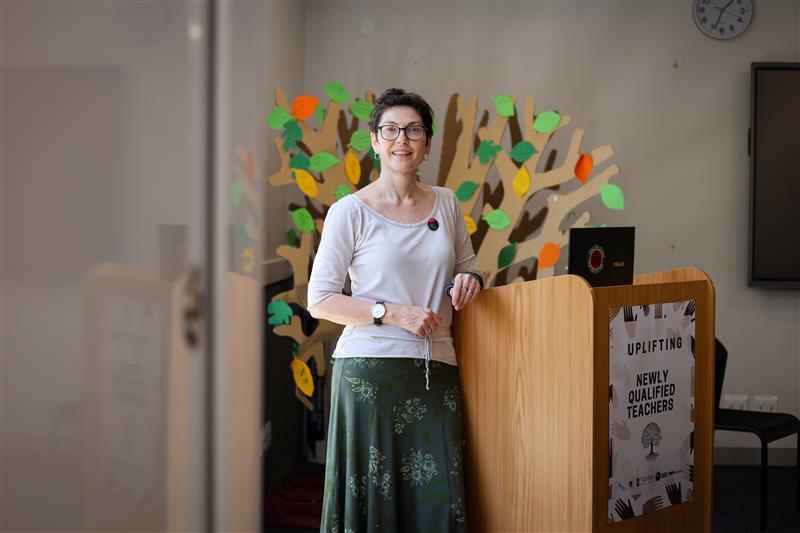
Dr Kate Angier first entered the classroom by chance to teach history in the mid-1990s. It was during the early days of South Africa’s constitutional democracy: she was young, unemployed, eyeballs deep in her PhD and had recently relocated to Cape Town from the United Kingdom (UK). A job as a history teacher was brimming with possibility.
For Dr Angier, the job and career held the promise of an identity and a community, and the thought of having a classroom of her own was exciting. The role was meant to be temporary, while she found her feet. But instead of moving on, she “put down roots and grew”. Almost three decades later and she’s still at the “chalk board” teaching. The only difference is she’s traded the high school classroom for a University of Cape Town (UCT) School of Education (SoE) lecture hall. So, same, same – but different.
Angier described her teaching style as critical and disciplined, forever evolving and deeply reflexive. In the classroom, she ensures her students feel seen and heard and makes every effort get to know them, to build knowledge and trust. For her novel approach to teaching and for her commitment to her students, Angier was named one of four recipients of UCT’s 2024 Distinguished Teacher Award (DTA) – the university’s highest teaching accolade. She shares the award with Dr Chivaugn Gordon from the Department of Obstetrics and Gynaecology; Associate Professor Jameelah Omar from the Department of Public Law; and Dr Juana Sánchez-Ortega from the Department of Mathematics and Applied Mathematics.
“I like to believe that my classes are an invitation to be curious, critical, to take risks, and to dare to question established norms.”
“For me, teaching is an act of hope. It is also an act of love. I like to believe that my classes are an invitation to be curious, critical, to take risks, and to dare to question established norms. On a personal level, teaching is deeply fulfilling work and brings me great joy,” Angier said.
High praise for an ‘extraordinary’ colleague
Receiving this recognition is no mean feat. The university calls on colleagues and students to nominate their preferred teacher and, in doing so, to submit a detailed nomination that ticks a list of boxes. As part of the stringent criteria, nominees must demonstrate excellence and leadership in teaching philosophy and must influence colleagues’ teaching practices through mentorship, collaboration and leadership.
In their nomination, the SoE’s Professor Carolyn McKinney, Dr Xolisa Guzula and Dr Soraya Adbulatief, supported by Emerita Associate Professor Rochelle Kapp, described Angier as an extraordinary teacher who is innovative and deeply committed to her students’ learning and well-being, and determined to nurture critically conscious, compassionate young minds.
“We have witnessed firsthand the immense impact she has had on her students and colleagues … we have experienced Dr Angier as an exceptionally inspiring, creative and responsive teacher,” an extract from the nomination read.
On the back of her award announcement, Angier said she is deeply honoured to have her name included among the phenomenal teachers who have been named DTAs in the past. UCT News sat down with her for more on what it means.
Niémah Davids (ND): How and when did you get into teaching? Was it by choice or chance?
Kate Angier (KA): It was by chance. In the mid-1990s, I was offered a job at an elite Cape Town high school after their matric class history teacher had left at short notice. I had only intended to teach for one year, but I stayed for 15 years. My first year of teaching was one of the hardest things I’ve ever done in my life. I survived that year only through the support of remarkable and experienced colleagues who mentored me, and staffroom friendships with other teachers, forged through the triumphs and tears of learning to teach.
ND: Where did you move to next and when did you arrive at UCT?
“I wanted the opportunity to work with teachers at the start of their careers.”
KA: When I left the school, I went to work as a senior curriculum planner for history at the Western Cape Education Department. I moved to UCT in 2015 because I wanted to spend more time teaching and particularly because I wanted the opportunity to work with teachers at the start of their careers.
ND: What do you teach now and to whom?
KA: I teach history methods to Postgraduate Certificate in Education (PGCE) students, that means I teach trainee high school teachers to teach history. I also teach honours courses in history education and supervise honours, master’s and PhD students.
ND: How would you describe your teaching style?
KA: It’s permanently evolving because there is always a new group of students, a new context and new information that comes to light. As I learn, I share new ideas and practices with my students, and I try to always respond to feedback with purposeful amendments to my courses. This idea of teaching as a process, as perpetual motion, is at the heart of my practice. As is self-doubt and the knowledge that I never live up to my own expectations of the teacher I would like to be. And so next year, I try again.
ND: What do you love most (and least) about working with students?
KA: Teaching is relational. So, getting to know the students as the complex people they are, and learning with and from them every year is one of the greatest joys of teaching. What I like least is having no easy solution to the hardships so many of our students face. The PGCE is no longer funded by the National Student Financial Aid Scheme (NSFAS), the Funza Lushaka Bursary Scheme or UCT Financial Aid. This means many students are struggling with accommodation, food, transport and professional clothing for their teaching practice placements. This has a knock-on effect on their physical and mental well-being during a very demanding year.
ND: What are some of your highlights of your time at the SoE thus far?
KA: Because teaching is a collaborative endeavour, being a part of the PGCE team, who work tirelessly to support and strengthen teacher education at UCT, is inspiring. Then I’d say the personal learning that I have experienced during periods of collective activism on campus like the Rhodes Must Fall and Fees Must Fall movements, campaigns against gender-based violence, and, more recently, teacher job cuts and the Palestinian genocide. I am proud to work alongside and be kept accountable by fearless colleagues whose work is profoundly ethical and centres social justice. And then I’d definitely say that chairing the Newly Qualified Teachers Project (NQTP) is another highlight. The NQTP is a soft-funded programme which supports first-year teachers through mentoring, reflections, workshops and an annual winter school to nurture their professional development.
ND: What are the challenges of teaching in an age of artificial intelligence (AI)?
KA: The speed with which it is evolving. This year I’d say that the greatest challenge has been how to balance the possibilities of working with a new technology while not allowing it to take away agency or prevent students from developing their own voice. I am open to working with different forms of AI in my teaching, but I do remain critical and concerned about who controls this new means of production.
ND: What stumbling blocks have shaped you as a teacher?
KA: Most of my career path has been smoothed by the privileges of my race and class, of my English mother tongue and my own access to free tertiary education in the UK and I am hugely grateful for the many opportunities afforded to me. But these are also stumbling blocks and blind spots that require ongoing, reflexivity, and self-work to disrupt. This process continues to shape my teaching and learning.
ND: Tell us about any meaningful projects you are currently involved in in the school classroom.
KA: I have been teaching history in a local low-fee high school for the past six months as part of a research project initiated by Professor Jonathan Jansen (a professor in education at Stellenbosch University). Highly critical of initial teacher education programmes, he challenged teacher educators to go back to school, to see if we could practice in school what we teach our students on campus. This experience has been eye-opening, humbling, exhausting and hugely rewarding work that will inform my planning for the PGCE in 2026. I’m also a member of the Ministerial Task Team re-writing the school history curriculum from an African-centred perspective – this is an essential, nationally meaningful project I am really grateful to be involved with it.
ND: How significant is this DTA recognition to you?
“This award is also an important recognition of the value of our teacher education programme at UCT.”
KA: On a personal level, it is an absolute honour. I was overwhelmed by the generous words of my colleagues and students who nominated me, which I will treasure forever. But this award is also an important recognition of the value of our teacher education programme at UCT.
ND: Last but certainly not least – who’s been your biggest cheerleader throughout your career?
KA: My family. My husband, Lance; and our three children Phoebe, Tom and Maddy. In receiving this award, having been in the field of education for over 30 years, I want to acknowledge their support and encouragement as I’ve juggled multiple projects and positions in the field of education.
 This work is licensed under a Creative Commons Attribution-NoDerivatives 4.0 International License.
Please view the republishing articles page for more information.