
Wamkelekile, Welkom
Science translation top of mind at research day
22 December 2025 | Story Fezile Khumalo. Photos Melvin Lawrence. Read time 5 min.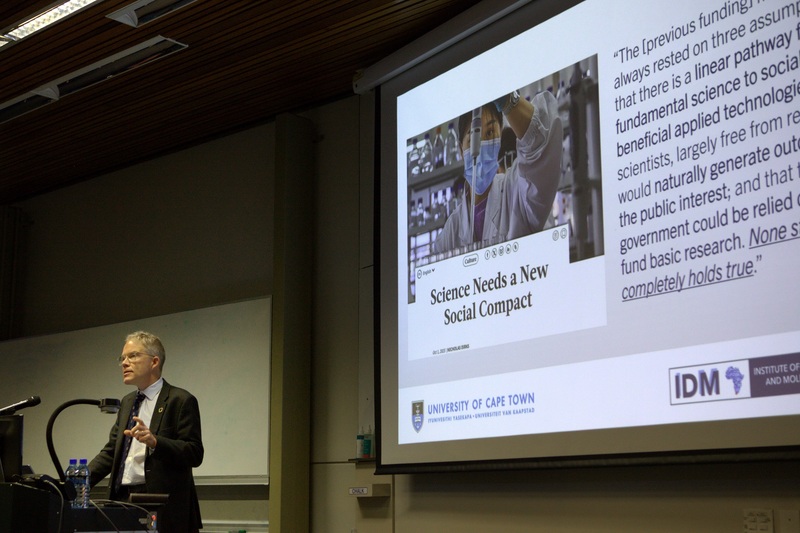
The bi-annual H.i.P research day co-hosted by the University of Cape Town’s (UCT) departments of Human Biology, Integrative Biomedical Science (iBMS) and Pathology was recently held at the Institute of Infectious Disease and Molecular Medicine (IDM). The event has been attended by over 1 000 postgraduate students, postdoctoral fellows and emerging researchers to showcase their ground-breaking research.
The theme "From Bench to Impact: Designing Discovery with Translation in Mind" was conceptualised to reflect the growing need for researchers to purposefully design their work with societal impact and benefit in mind. At its heart lies a call-to-action to members of the academic and research community to conscientise around the role we play in developing real-world solutions to pressing challenges. The event was hosted on 30 October 2025.
Speaking on the science
Through this platform, over 200 registered attendees engaged in a dynamic day of presentations, discussions and networking focused on innovation in health sciences.
Abstracts submitted for both oral and poster presentations underwent rigorous peer-review by the scientific committee, chaired by iBMS senior lecturer, Dr Lungile Sitole.
In a bid to innovate the conference experience, every poster presentation followed the format of a three-minute thesis, encouraging concise communication and fostering dynamic engagement with the audience. This shift also prompted the organising committee to invest in strengthening communication skills within our research community.
To facilitate this upskilling process, Dr Natashia Munia from the UCT Writing Lab was invited to host a workshop on effective scientific communication, ensuring students were equipped to present their work with clarity and confidence.

Keynote speakers included the late Professor Keo Motaung, the Female Academic Leaders Fellowship-Financial Research and Entrepreneurship Foundation- Nelson Mandela University (FALF-FREF-NMU) Research Chair in Entrepreneurship and Financial Inclusion and founder and CEO of Global Health Biotech (PTY) Ltd as well as Professor Collen Masimerembwa, the founding president and CEO of the African Institute of Biomedical Science and Technology (AiBST) in Zimbabwe. Between them they brought distinct perspectives while sharing a united message that: academic research must drive impact.
Professor Masimerembwa set the theme for the day, exploring contextual innovation in the academic community and referencing engagement with the topic in everyday activities. They also spoke to redefining and broadening what impact looks like, so creating an environment that nurtures the necessary change in mindset.
While Professor Motaung reaffirmed the central role of African-led innovation in solving local and global challenges, emphasising that academic research must move beyond publication outputs to deliver tangible impact.
The speakers urged researchers to embrace contextual relevance, intellectual autonomy and translational thinking from the earliest stages of discovery. Their insights emphasised the abundant opportunities for African researchers to lead impactful science – where discovery meets unmet need.

The career expo, introduced this year, was co-created with the office of Research Contracts & Innovation (RC&I). A diverse panel of speakers showcased innovation beyond the bench including entrepreneurs Drs Genevieve Thompson and Sarah Carroll, patent attorney, Dr Joanne van Hermelen, finance specialist, Khumo Mokone and academic, Dr Munya Musvosvi.
Having introduced themselves the panellists reflected on their journeys, collaborative priorities and lessons learned. The discussion covered topics that resonated deeply with the audience including:
- considerations for intellectual property,
- challenges in taking lab research and its application to clinical settings,
- researchers’ engagement with different funding bodies,
- de-risking early-stage research so it becomes investible,
- the role of venture capital,
- what it takes to spinout a sustainable company.
The session powerfully illustrated the breadth of innovation pathways available to researchers. A moderated discussion by Dr Bruna Galväo from the HIV Diversity Group and Dr Bruce Maseko, RC&I followed.
Societal impact gets institutional support
IDM director, Professor Digby Warner and dean of Faculty of Health Sciences, Professor Lionel Green-Thompson offered institutional support for the research day.
Professor Warner gave the opening addresses, laying the foundation on the changing landscape of research and how the IDM is enabling impact within infectious disease research. In his closing remarks Professor Green-Thompson spoke to how the UCT Strategy 2030 is intentional in prioritising societal impact amongst its top six priorities:
- Maintaining and improving Academic Excellence in our teaching, learning and research
- Securing our Financial and Institutional Sustainability
- Investing in People, and improving our Culture and Societal impact
- Enhancing all Stakeholder experiences, Brand and Reputation Management and nurturing a culture of Ambassadorship
- Improving our Governance, Management and Leadership structures and systems
- Developing multilayered Strategic Partnerships in Africa and the World.
Together their messages underscored how aligned leadership and supportive ecosystems are key to driving translation and innovation in academia.
Collaborating for collective good
Prizes were awarded to the top three PhD and MSc oral presentations, as well as the top three posters across both sessions. In response to overwhelming engagement and excellence, the organising committee added additional poster prizes for each session.
Special recognition was also given to the Most Innovative Project, evaluated by an independent panel, as well as the Spirit of Engagement Prize for the most engaged audience member.
The sponsors who supported the H.i.P research day, together with the dedication of the student volunteers and the organising committee made for a successful event, facilitating the presentation of exceptional research.
The IDM, Faculty of Health Science deanery, the three host departments H.i.P, RC&I, Microsep, WhiteSci, inqba biotec® and Anatech also helped make this initiative possible. Volunteers came from the departments of Human Biology and iBMS as well as the IDM and the African Research Society.
Dr Khumalo is a Junior Research Fellow based in the Division of Medical Virology UCT’s Faculty of Health Sciences and is the co-chair of the H.i.P research day 2025.
 This work is licensed under a Creative Commons Attribution-NoDerivatives 4.0 International License.
Please view the republishing articles page for more information.