
Wamkelekile, Welkom
Embracing multilingualism for a transformed UCT
11 November 2025 | Story Nicole Forrest. Photo Lerato Maduna. Voice Cwenga Koyana. Read time 6 min.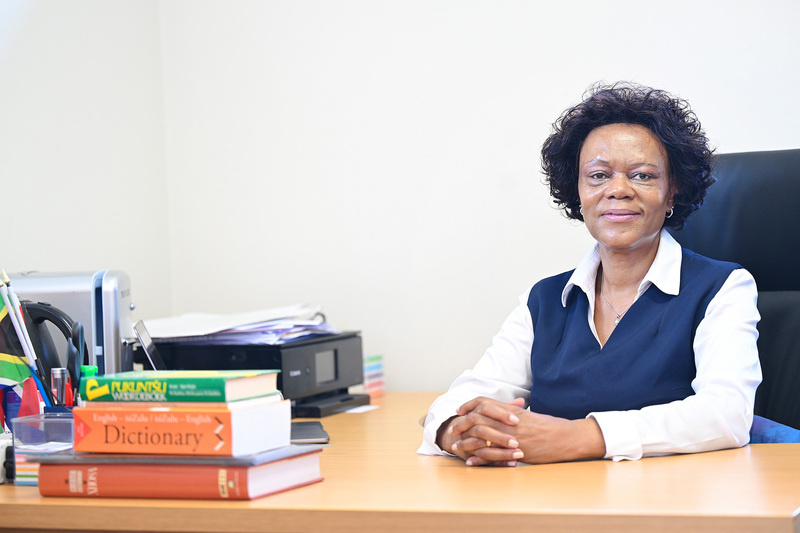
The University of Cape Town’s (UCT) Multilingual Education Project (MEP), Office for Inclusivity & Change (OIC), and Remember and Give (RAG) joined together to host the institution’s annual International Translation Day celebration and recognise Deaf Awareness Month.
The twofold theme for International Translation Day for 2025, “Translation, Shaping a Future You Can Trust” and “Indigenous Language Translation: Shaping a Future You Can Trust”, was chosen by the Federation of International Translators to highlight the importance of human translators in building trust, as well as the need for accuracy and cultural sensitivity in preserving indigenous languages.
With the occasion coinciding with Deaf Awareness Month, the MEP decided to celebrate both events under the theme “LOUD SILENCE: Language Access Through Translation and Deaf Inclusion”.
“We chose the theme for two main reasons. One being that, since the recognition of South African Sign Language (SASL) as an official language in 2023, we haven’t truly seen much promotion of it,” explained the director of the MEP, Associate Professor Lolie Makhubu-Badenhorst.
“We think of this as a loud silence – it’s something that is swelling and swelling, and that we need to address.”
“The second reason is that, in academia, the Deaf community doesn’t really have a voice. Only a few universities in South Africa take in Deaf and hard-of-hearing students because of challenges with resources and capacity, and the Deaf community suffers because of this.
“We think of this as a loud silence – it’s something that is swelling and swelling, and that we need to address. So, we wanted to show that we empathise with the frustrations of the Deaf community and help them make their voices heard.”
Building blocks of knowledge
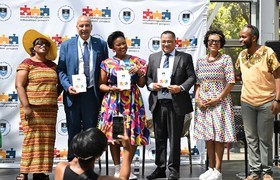
In addition to foregrounding the intersection of language, identity and access in higher education, the LOUD SILENCE event marked the official launch of UCT’s isiXhosa Glossaries for Economics and Statistics by Deputy Vice-Chancellor for Transformation, Student Affairs and Social Responsiveness Professor Elelwani Ramugondo.
The release of these language corpora, which were contributed to by Dr Xolisa Tshongolo of the Pan South African Language Board (PanSALB) and quality assured by the IsiXhosa National Language Body (XNLB), is not only an exciting milestone for the MEP, but also a major step towards the decolonisation of knowledge production in South Africa.
“As a country, we want to be able to offer education to people in their mother tongues. The terminology glossaries are one of the building blocks for offering students education in their native language,” Associate Professor Makhubu-Badenhorst said.
Providing instruction in a student’s mother tongue has a multitude of benefits, including improved academic performance and a stronger sense of identity. The approach has been proven to help students better understand important concepts and can make practising in a second language easier.
“This is the scaffolding that translators and interpreters can use to support social and academic transformation through inclusive language practices.”
However, there has traditionally been a lack of corpora that identify key terms and provide definitions and equivalents in African indigenous languages.
“When you are a translator or interpreter, you need words and concepts that you can put together to make sense of something for your audience. If those concepts only exist in foreign languages, you don’t have the actual vocabulary to convey meaning,” Makhubu-Badenhorst added.
“The International Translation Day event was an opportune moment for us to launch these glossaries, because this is the scaffolding that translators and interpreters can use to support social and academic transformation through inclusive language practices.”
A vision for transformation
The event saw UCT students, staff, and invited guests from peer institutions across the Western Cape engage with Deaf culture through interactive games, short SASL lessons, and a market featuring Deaf-owned businesses.
Representatives from the Cape Peninsula University of Technology (CPUT), University of the Western Cape (UWC) and Stellenbosch University (SU) were all invited to make presentations around their respective institutions’ pursuits in multilingualism.
These engagements, in combination with the release of the isiXhosa Glossaries, all aided in reaffirming UCT’s strategic vision of fostering a just, inclusive academic environment where all languages and identities are recognised and valued.
“Our Vision 2030 really speaks to the issues of access, success and redress. Our students don’t just need to access the university – they need to be successful while they’re here and after they leave.”
“Our Vision 2030 really speaks to the issues of access, success and redress. Our students don’t just need to access the university – they need to be successful while they’re here and after they leave. And learning in their mother tongue is a key way that we can give them full access and the best chances of success in the rest of their lives,” Makhubu-Badenhorst said.
“By embracing multilingualism in this way, not just putting a multilingual language policy in place but taking steps to recognise the languages identified in that policy, speaks to the issue of transformation. It helps us to move towards a more equitable learning environment where students can thrive.”
Future forward
Over the next five to 10 years, Makhubu-Badenhorst envisions UCT and other universities across South Africa establishing fully resourced language units that can share resources and best practices to promote multilingualism, Deaf inclusion, and equitable language access nationwide.
“If we can make an impact and an influence and share our learnings and our best practices with other institutions, that will be a breakthrough for me,” she explained.
“That will allow us to move forward at a much faster pace, because we will not need to reinvent – or just invent – the wheel. If a certain university is good at a particular aspect of glossary creation or multilingual policy implementation, we can learn from them instead of starting from scratch.”
 This work is licensed under a Creative Commons Attribution-NoDerivatives 4.0 International License.
Please view the republishing articles page for more information.