

Wamkelekile, Welkom
Environmental Sustainability
08 December 2025
“In 2024, the University of Cape Town (UCT) further ramped up its activity towards becoming a more environmentally sustainable campus, in support of the university’s Vision 2030 [strategy], directed by the Environmental Sustainability Strategy. This strategy ultimately aims to guide the university towards becoming a net-zero carbon, water and waste-to-landfill campus by, or before, 2050. While much has been achieved in 2024, the university will need to significantly increase its investment in sustainability initiatives in the coming years to achieve this ambitious goal.”
Manfred Braune, Director of Environmental Sustainability
The Green Campus Initiative (GCI) continued to provide leadership to the student community at UCT, hosting various engaging events on campus, led by their enthusiastic executive team.
UCT students win prizes for their green research projects
In 2024, UCT students won prizes in the top three places of both streams of the Greenovate competition (Engineering, and Property & Construction Management), which is a wonderful demonstration of students leading with their honours research projects on the topic of sustainability. Read about this.
UCT carbon footprint
UCT has remained a leader among South African universities in terms of public reporting on its carbon footprint, being only one of a handful of universities in the country to measure and report publicly on its annual carbon footprint. The report for 2023 was produced and published in 2024. The most important finding of the report is the 20% reduction in greenhouse gas emissions under scope 1 and 2 compared to the 2019 baseline. Substantial further investment in various initiatives over the next 15 to 20 years will be required for UCT to meet its long-term carbon footprint objectives.
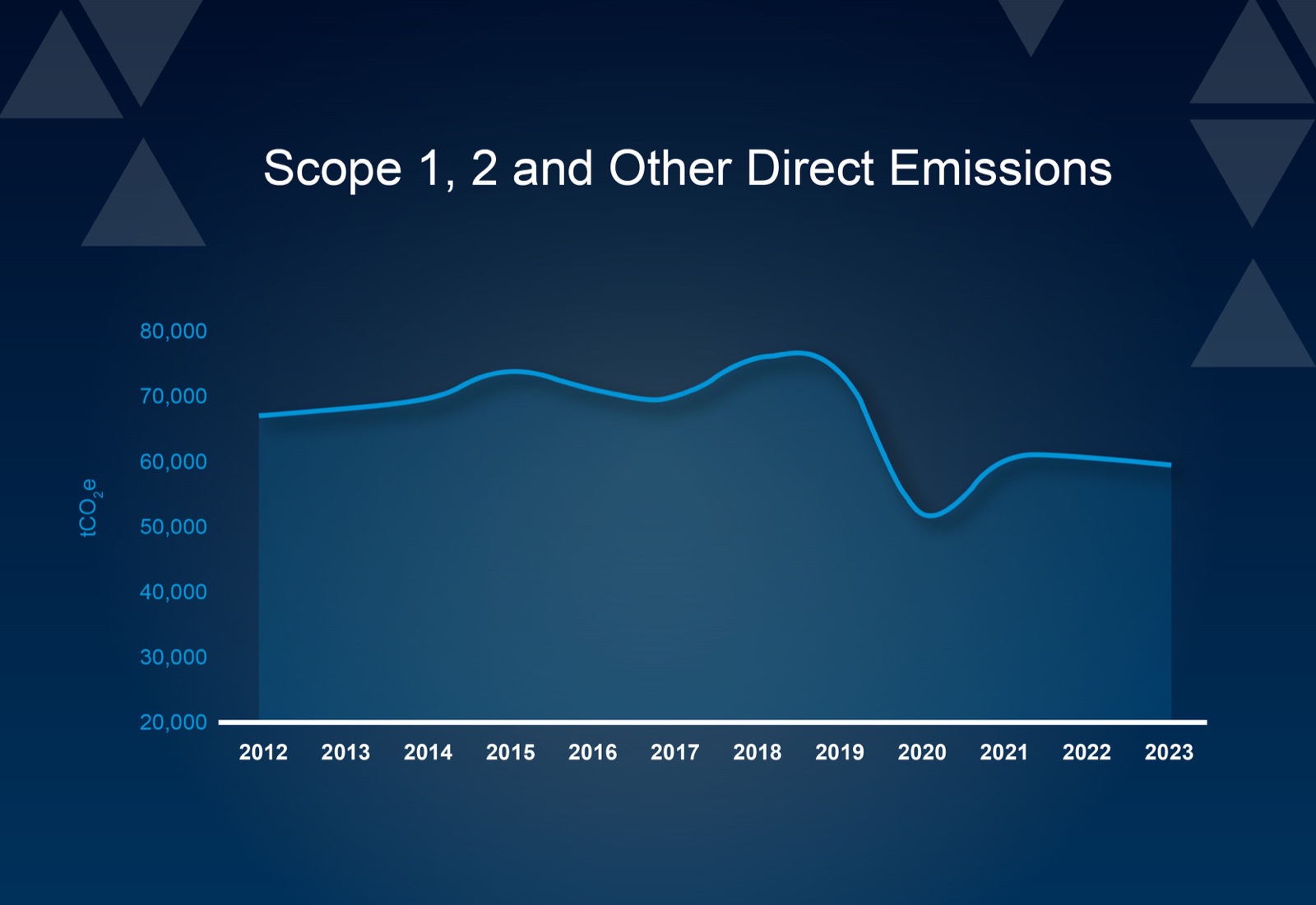
Reducing building energy consumption is essential
Buildings are responsible for one third of global greenhouse emissions due to their energy consumption, according to the World Green Building Council. At UCT about 50-60% of its carbon footprint is due to building energy consumption, mostly coming from dirty coal power. As such, UCT continues to replace older inefficient lights and equipment with more energy efficient equipment when it comes to their end of life. Students and staff are also encouraged to switch off any equipment or lights when not required.
Loadshedding and diesel generators
In 2024, UCT experienced much lower levels of loadshedding. Despite this, the institution continued to work on some of its large back-up power projects such as the large battery/solar/generator project at the Faculty of Health Sciences, for which a tender was awarded and contractor appointed. This project will provide back up to the entire health sciences campus through one central battery system, which will also include a diesel generator and solar power to support the battery system.
Harnessing the power of the sun
UCT in 2024 continued with its solar PV rooftop installation project, which saw the installation nearing completion at the Baxter Theatre, the Graduate School of Business and the Meulenhof administration building, totalling close to 300 kW peak. The health sciences solar PV system design was also started in 2024.
Wheeling renewable energy
In late 2024, UCT issued a tender that would source most of its energy supply for the main campus and health sciences campus from wind and solar energy farms around the country. The tender was expected to be adjudicated in early 2025 but the renewable energy is likely to be available in late 2026 or early 2027. Renewable energy wheeling is an important component of UCT’s environmental sustainability and financial sustainability strategy, as it will allow UCT to purchase electricity from independent power producers (IPPS) and thus reduce its operational spending on energy and reduce its carbon footprint substantially. This is particularly important when it is not possible to install sufficient renewable energy on campus.
Green buildings on campus
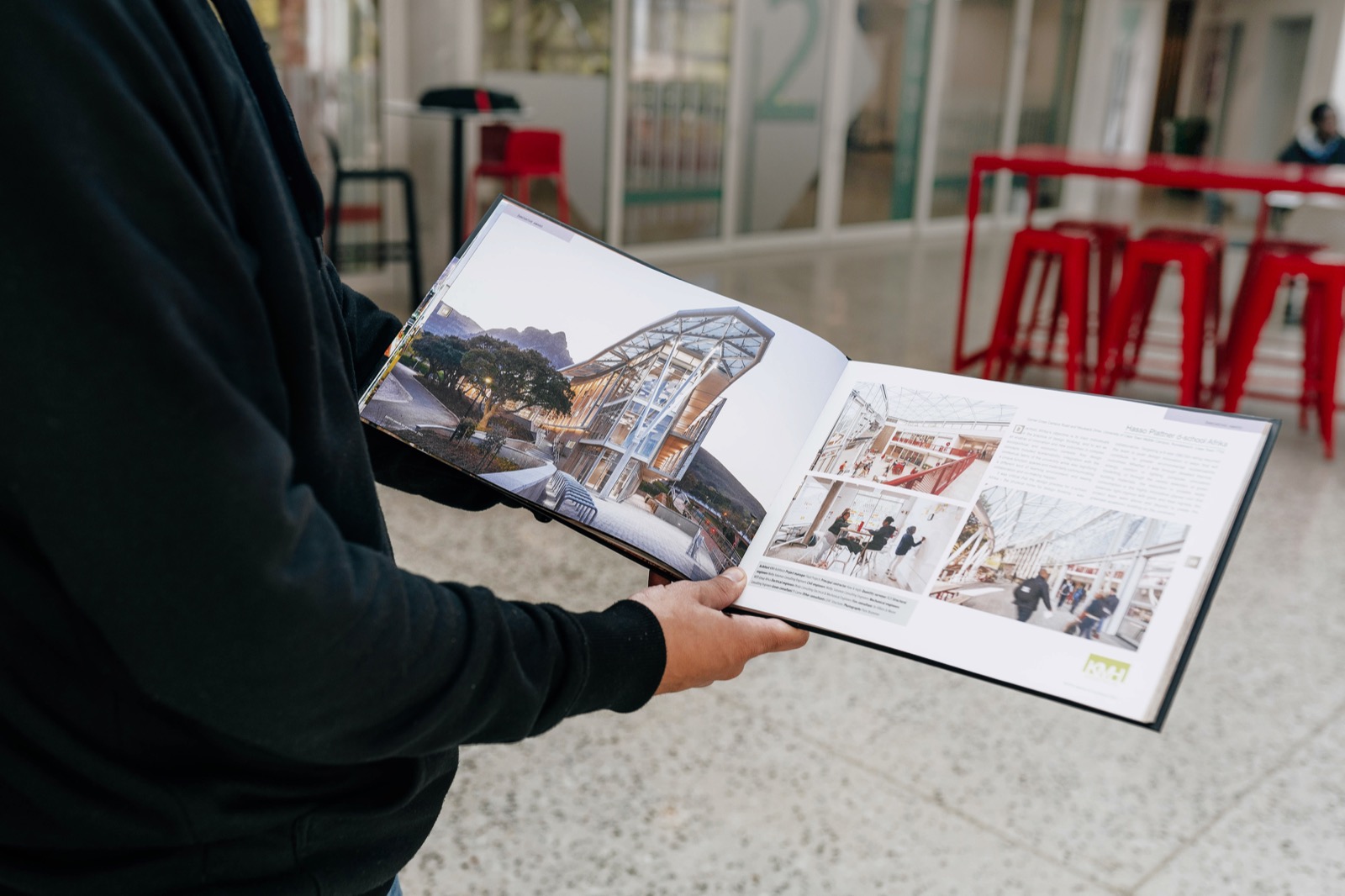
In late 2024, UCT’s Hasso Plattner School of Design Thinking Afrika (d-school Afrika) achieved its second 6 Star Green Star rating from the Green Building Council South Africa (GBCSA) – this time the 6 Star As Built rating – this is a first for any academic building on the continent. While no new buildings were built in 2024, there are several that are in their planning stages, all targeting green building certification, including the Nelson Mandela Memorial Centre and the School of Public Governance on upper campus, the Arise Building on the health sciences campus, the refurbished library and the Green Precinct Water Recycling Facility, which is targeting a 4 Star Green Star certification and several et zero ratings from the GBCSA.
Sustainable water management
The university’s Department of Higher Education and Training-funded Sustainable Water Management Strategy saw positive progress being made on the design of the on-site sewage water recycling facility on lower campus next to the Kopano residence. This will be combined with a Future Water learning centre surrounded by a beautifully landscaped area for student amenity, cultural practices and places of respite. It will be a first for any university in the country and a global leading example of combining sustainable water management with education and places for respite and amenity. This “green precinct” is earmarked for completion by end of 2025.
The Khusela Ikamva sustainable campus project gains momentum
The Khusela Ikamva Sustainable Campus project continued to make positive progress in 2024, with research continuing and various campus sustainability tours being hosted to help grow the UCT sustainability community of practice. One project was to create an online campus map of various UCT sustainability initiatives.
Environmental sustainability research and work shared in the UCT news
UCT students and academics continued to publish leading research papers and covered work on themes related to environmental sustainability. Here are a few examples of articles published on UCT news:
- UCT to host international biopharming conference.
- UCT jointly leads two Centres of Excellence on sustainability themes.
- UCT research on green fuels.
- UCT researchers release climate change synthesis report:
- UCT soars to within the top 100 universities globally in the THE Impact Ratings.
- UCT academic leads climate change research on oceans.
- UCT Catalysis institute shaping a sustainable future.
- UCT discovers a honey badger near campus with camera traps.
- Climate crisis is a health crisis.
- Launch of the Nelson Mandela Memorial Centre and School of Public Governance.
- Albie Sachs on thirty years of freedom: ‘It’s not personal; it’s Constitutional’.
- Dr Nodumo Zulu’s Algal innovations at UCT.
- Research that inspires and transforms lives.
- Noelene le Cordier blooming where she planted.
- Mixed reaction to alternative water use.
- IP Rights and the SDGs.
- Reforestation continues on Upper Campus.
- ACDI launches lab to support nature-based solutions research.
- Khusela Ikamva Sustainable food waste management.
- Khusela Ikamva reflective conversation on the reforestation of Upper Campus.
- d-school’s second 6 Star Green Star rating.
- University of the Future.
 This work is licensed under a Creative Commons Attribution-NoDerivatives 4.0 International License.
Please view the republishing articles page for more information.