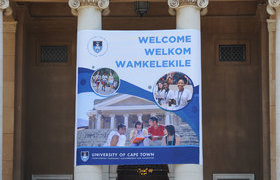

Wamkelekile, Welkom
Grandparents’ wisdom inspires UCT Rhodes Scholar’s pursuit of better healthcare
30 October 2026 | Story Myolisi Gophe. Photo Times Higher Education. Read time 6 min.
Long before Maboletso Letsoalo began asking how data could help address some of Africa’s toughest healthcare challenges, she was learning to ask questions about life, the human experience and the world around her from the people who raised her.
Raised by her grandparents in Mokopane, Limpopo, Letsoalo was immersed in a way of understanding the world that nurtured her curiosity – and that continues to shape her approach to science, leadership and public service. Today, as a 2027 Rhodes Scholar, she is preparing to take that curiosity to the University of Oxford, where she hopes to advance research that could help make quality healthcare more accessible across Africa.
“Being raised by grandparents is just truly something special,” she said, reflecting on an upbringing that introduced her to what she described as “an ancient and authentic way of knowing and being”.
Her upbringing was an important foundation for the questions that would eventually guide her academic journey; questions about the interconnectedness of the body, mind, spirit and environment, and why these produced different realities for different people.
“Grandparents aren’t always so imposing. [They] tend to pull you into things; pull you into a certain way of understanding; pull you into a conversation and sort of walk with you.”
As a child, she did not fully appreciate the significance of these experiences. In hindsight, however, she recognises how her grandparents’ conversations and perspectives encouraged her to question, explore and make sense of the world.
“Grandparents aren’t always so imposing. [They] tend to pull you into things; pull you into a certain way of understanding; pull you into a conversation and sort of walk with you,” she said.
That approach to learning helped set her on an interdisciplinary academic path that brought together human physiology, genetics and psychology. It also planted the seeds of a deeper interest in understanding human beings as people whose experiences of health and illness are shaped by a complex interplay of factors.
“And when it comes to how I got into healthcare data research, really, again, my grandparents are so vital to the story,” she said.
If her grandparents’ influence helped shape the questions she asked about life, the illness and passing of her grandfather gave those questions a more personal and urgent direction.
Grandfather’s illness changed her path
While in high school, her grandfather passed away due to cancer. This loss was devastating, she said, but it also prompted her to seek a deeper understanding of the disease, treatment options and why they worked in some circumstances but not others.
Her grandfather’s illness exposed her to the realities of disease while stimulating questions about biological causes and genetic, environmental and other contributing factors.
This tragedy strengthened her interest in healthcare and, ultimately, in the challenge of ensuring that people receive quality care.
After completing her undergraduate studies in human physiology, genetics and psychology, Letsoalo completed a Bachelor of Medical Science (Honours) in Bioinformatics before pursuing her master’s at UCT.
Today, as an MSc candidate specialising in Computational Health Informatics, she is investigating how data and technology could improve the diagnosis and prevention of disease.
Her academic trajectory reflects a growing interest in the intersection of biology, health, and data science – a field she believes holds considerable potential to address healthcare challenges across the continent.
Using data to tackle tuberculosis
Letsoalo’s current research focuses on tuberculosis (TB) diagnostics and risk stratification, with particular interest in whether information obtained from a patient’s urine sample can help researchers better understand lung disease and identify individuals at risk of developing active and/or recurrent TB infections.
South Africa’s high TB burden makes this work particularly crucial. Better ways to identify at-risk patients could help healthcare professionals intervene earlier and develop more targeted prevention and treatment approaches.
For Letsoalo, the research looks beyond the immediate diagnosis to understand the broader factors driving vulnerability to disease and repeated infections.
The work also reflects her broader ambition of ensuring scientific advances translate into tangible healthcare solutions.
“I find that technology … can really help us to deliver high-quality healthcare.”
Across many African health systems, constraints in infrastructure, resources and medical personnel make the delivery of quality healthcare particularly challenging. Letsoalo believes data science and technology can help address some of these barriers by supporting more accurate diagnostics, improving risk assessment, predicting and identifying disease trends and informing decisions about where healthcare resources are needed the most.
“I find that technology [and data analytics] can really help us to deliver high-quality healthcare, even in contexts where physical infrastructure is potentially a problem or where there is a scarcity of resources or medical personnel,” she said.
Her long-term ambition is to become a leading digital health researcher and policy advisor, contributing to technologically advanced and responsive healthcare systems.
Leadership shaped by empathy
Alongside her academic work, Letsoalo has developed a strong commitment to student advocacy and institutional transformation at UCT.
She has served on the university Council and is the outgoing vice-president of the Students’ Representative Council (SRC) and co-chair of the Institutional Forum.
These roles have brought her into contact with students from diverse backgrounds, which has broadened her understanding of the challenges students face – from academic pressures and mental health concerns to financial, social and psychosocial support needs.
“You learn to lead with empathy,” she said, reflecting on how engaging with students from different backgrounds had expanded her understanding of their needs.
One initiative she is particularly proud of is introducing free sanitary pads on campus.
“Your access to quality healthcare shouldn't be determined by your zip code.”
The initiative, she said, addressed a critical problem: period poverty, which presents a practical barrier to academic participation. The initiative sets to combat this while affirming students’ dignity.
She credits UCT with nurturing both her scientific interests and her commitment to public service.
“The academic rigour that one is exposed to at UCT nourished the scientist in me,” she said, adding that her advocacy experience had helped refine her sense of purpose.
Together, these experiences have cemented that impact, whether through research or leadership.
The Rhodes Scholarship represents an important next step in bringing these interests together.
Her selection as a 2027 SACS Rhodes Scholar will enable her to pursue a research degree in healthcare data science at the University of Oxford, where she hopes to deepen her expertise and contribute to more equitable and effective African health systems.
Letsoalo intends to develop the skills necessary to translate complex clinical data into insights that can inform improved healthcare practice and policy.
For her, access to healthcare means more than reaching a health facility. It must also mean receiving quality care. “Your access to quality healthcare shouldn't be determined by your zip code,” she said.
The Rhodes Scholarship is the world’s oldest global graduate scholarship programme, dating back to 1903. Each year, over 100 Rhodes Scholars are selected from across the world to study only at the University of Oxford. Of the 100 scholarships awarded each year, 10 are awarded to graduates from Southern Africa. Selection for the 2027 cohort is ongoing and is expected to be completed next month.
 This work is licensed under a Creative Commons Attribution-NoDerivatives 4.0 International License.
Please view the republishing articles page for more information.