
Wamkelekile, Welkom
How and why (or why not) palaeontologists communicate with the public
26 October 2026 | Story Supplied. Read time 3 min.
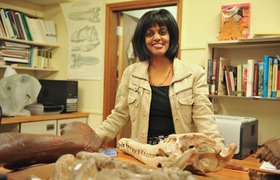
Two leading South African science communicators, Professor Anusuya Chinsamy-Turan of the University of Cape Town (UCT) and Professor Marina Joubert of Stellenbosch University (SU) are the driving forces behind a new comprehensive international survey exploring how researchers and practitioners communicate palaeontology with the public.
The first of its kind, the survey was launched in mid-October 2026, ahead of the 7th International Palaeontology Congress (IPC7) to be held in Cape Town from 30 November to 3 December 2026. It forms part of a mixed-methods study investigating how often and in which ways palaeontologists connect with the public about their research, and what incentivises or demotivates them to do so.
The research team is making use of the momentum being built around the first-ever IPC to be held in Africa to gather insights from across the world. Survey results will feed into the first field-specific, internationally comparative dataset on public engagement in palaeontology, and will build on and extend established science communication frameworks.
“While there have been global surveys examining the public communication activities of astronomers, comparable research remains scarce around palaeontology, a science discipline with which the public also regularly connects,” explained Professor Joubert, an associate professor in SU’s Centre for Research on Evaluation, Science and Technology (CREST).

“Through the use of fossils and reconstructions of past life, palaeontology provides compelling opportunities for education, outreach, and communication about evolution and life on Earth, including human pre-history. Such public communication and engagement strengthen relationships between science and society and ensure that scientific knowledge reaches diverse publics. Good practice also helps to counter misinformation and maintain public trust in science,” added IPC7 chair, Professor Chinsamy-Turan. She is a renowned palaeontologist who has authored both academic books and children’s books on African dinosaurs and other prehistoric life.
Engagement
Questions examine how frequently palaeontologists currently engage with the public through activities such as public talks, media interviews, popular science writing, social media, exhibitions and work with schools and communities. It explores researchers’ willingness to increase these activities over the next two years. They are asked about the audiences they prioritise, including young people, girls and women specifically, educators, local and Indigenous communities, museum visitors, journalists, policymakers and amateur fossil enthusiasts.

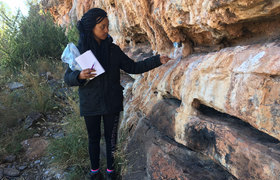
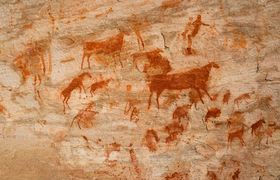
The study also investigates potential barriers, including concerns about being misunderstood or misrepresented, public criticism and backlash, and the possibility that publicity could increase fossil theft or damage to sensitive sites. It will also assess researchers’ confidence, communication training and access to institutional support and resources.
“In support of our study, we will also run a focus group [during IPC7] that will include representatives from diverse regions and institutions, including the Global South,” Joubert said.
Results will support actionable recommendations for future IPC programming, other palaeontological gatherings, institutional policy, and capacity-building initiatives.
The research is funded by the Palaeontological Scientific Trust, and the South African Department of Science, Technology and Innovation.
 This work is licensed under a Creative Commons Attribution-NoDerivatives 4.0 International License.
Please view the republishing articles page for more information.