
Wamkelekile, Welkom
Leadership Launch Pad programme shapes emerging student leaders
21 October 2026 | Story Nonkululeko Busisiwe Gwangqa. Photos UCT LEAD. Read time 4 min.
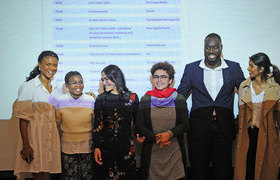
The University of Cape Town (UCT) Leadership Academy celebrated the 2026 cohort of Leadership Launch Pad participants with a programme closing ceremony held Thursday, 3 October.
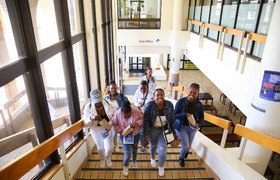
For a growing number of newly elected student leaders, the programme has played a significant role in preparing them for their leadership journeys. Drawing on workshops on design thinking, presented by the Hasso Plattner School of Design Thinking Afrika (d-school Afrika) and sessions on personal branding by UCT’s Careers Service, the programmes offered 50 first-year students opportunities for personal growth, self-reflection, and practical leadership development.
The 2026 cohort produced a significant number of participants that completed the programme who have since taken up leadership roles across residences, faculty structures, and student societies.
Impact
For Chuma Nondonga, a first-year Bachelor of Social Sciences student, one of the most important lessons learnt was understanding that effective leadership begins with self-care and self-awareness. He said that leaders cannot serve others effectively if they neglect their own well-being and values. “As a leader, you cannot forget where you come from, who you are and the people you intend to serve. Once you lose sight of this, you risk losing touch with the potential strength and impact of your leadership.” Nondonga was recently elected to both the Faculty of Humanities Council and the Clarinus Residence House Committee.
Joe Junior Lawack also completed the programme. He now serves in the Student Wellness portfolio on the Upper Campus Residence House Committee. “Leadership Launch Pad inspired my application into leadership roles,” Lawack said. Learning to view leadership holistically, he reflected: “A leader needs to be a holistic person. Academics are not the only aspect of your identity you should focus on; you need to be flexible in order to achieve multiple goals. The best leaders are the ones who do not give up. They stick it through regardless of circumstance.”

First-year medical student Nondumiso Ndlovu found value in the programme’s emphasis on leading oneself before leading others. Workshops on financial literacy, personal development, and leadership challenged her understanding of what leadership entails and highlighted the importance of mentorship and continuous learning. Looking ahead, she plans to continue growing through collaboration and shared learning, noting that she intends to continue developing her leadership capacities: “[I will do this] by building my network and leaning on my community to balance knowledge acquisition and implementation of skills acquired,” Ndlovu said.

Similarly, Tshepang Malete, who will serve in multiple leadership roles, including on the Upper Campus Residence House Committee as a mentor in the Faculty of Humanities; and as a project lead for Residence Activities and Institutional Engagement within the Green Campus Initiative Society, described how the programme deepened their understanding of leadership through the lens of ubuntu and social responsiveness. A workshop on Leadership and Social Responsiveness presented by Sibongile Rwayi, a programme administrator at TSIBA Business School, encouraged Malete to think critically about how leaders respond to the needs of others and ensure that people’s voices remain at the centre of decision-making. This human-centred approach continues to guide Malete’s commitment to creating positive change within student communities by making sustainability and environmental advocacy more accessible.

For Santé Mulusa, the programme transformed leadership from an abstract concept into a practical and personal journey. Lessons from the Design Thinking workshop reinforced the value of creativity, collaboration, and resourcefulness in addressing complex challenges. Reflecting on the programme during the closing ceremony, Mulusa echoed remarks shared by Phumza Qwaqwa, a student leadership and development assistant in the Department of Student Affairs: “Leadership Launch Pad is a launchpad, and it has sparked different ways of thinking about leadership and areas of leadership development.”
 This work is licensed under a Creative Commons Attribution-NoDerivatives 4.0 International License.
Please view the republishing articles page for more information.