
Wamkelekile, Welkom
Whips, laughter and ancestral echoes at Live Art Festival
16 October 2026 | Story Myolisi Gophe. Photos Ruairi Abrahams and Ntanga Ramugondo. Read time 6 min.
From the unsettling rhythm of a whip to the absurdities of survival and the healing power of isiXhosa sound, the University of Cape Town’s (UCT) Live Art Festival opened with performances that challenged, entertained, and invited audiences to listen differently.
The Cape Town evening was cold enough on 14 October, but on Hiddingh campus, bodies moved, laughter rippled through the audience, and unfamiliar sounds held the inside and outside stages in a different kind of warmth.
Three performances opened the festival’s evening programme, organised by the Institute for Creative Arts (ICA), turning a chilly night into an encounter with pain, precarity, resilience, and the possibilities of artistic expression.
Now in its eighth edition, the festival runs from 14 to 18 October, bringing around 30 free performances and installations to streets, gardens, galleries and public spaces across Cape Town, with a dedicated Sunday programme in Langa.
“Now is the time to make every effort through creative forms to activate and agitate in public space and also to forge the spaces of convergence.”
Curated by Themba Stewart and Luvuyo Equiano Nyawose, the festival features Vincent Mantsoe, Mandla Mbothwe, Mwenya Kabwe, Qondiswa James, Oupa Sibeko and Sbo Ndaba Dance; and continues across eight routes and multiple sites, including the Company’s Garden, St George’s Mall, the Castle and Guga S’thebe in Langa.
Established in 2011, the Live Art Festival builds on earlier initiatives that took audiences beyond traditional cultural venues, encouraging them to walk through the city and encounter places and communities they might otherwise overlook. The festival brings together dance, theatre, visual art, music, architecture and performance, encouraging audiences to encounter art beyond conventional theatres and galleries.
The invitation is simple but ambitious: encounter art beyond the familiar confines of theatres and galleries, and see the city, and one another, differently.
Bodies, sound and the politics of survival
On Wednesday, the evening began with Hard But Fragile, a performance by the Johannesburg-based Thulisile Binda that placed the body at the centre of an exploration of pain, power and resilience.
Using a series of whips and movement, Binda and her co-performer created a striking physical language in which the body became both an instrument of expression and a site of endurance. Emerging from the COVID-19 pandemic, the performance reflected on the possibility of finding strength through pain.
The mood shifted with Did4Luv, a tragicomic dance-theatre solo by Carro Sharkey, a transmasculine freelance artist and choreographer based in Berlin.
Part fever dream, part theatrical spiral, the work plunged audiences into the exhausting world of precarious labour, where performance becomes both a livelihood and a means of survival.
The piece brought together elements of sex work, drag, magic, clowning and pole dance, blending them with Western dance techniques to expose the friction between spectacle and survival.
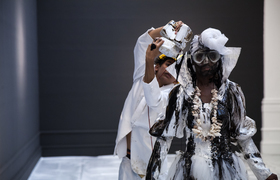
The evening closed with Kè, an immersive solo performance by Indwe, born Dineo Nomawethu Madikila, an acclaimed South African vocalist, composer and interdisciplinary artist known for preserving and reimagining isiXhosa musical traditions.
Rooted in isiXhosa storytelling, indigenous instrumentation and vocal experimentation, the work invited audiences into a more contemplative space.
Indwe’s work drew on indigenous knowledge systems as resources for healing and understanding, reminding audiences that artistic expression can carry histories and ways of knowing that extend beyond words.
The performances unfolded against a wider conversation about art’s role in a world where democratic freedoms and public spaces are increasingly under pressure.
“Artists are often the first critics and the first casualties of authoritarianism. They have always been among the strongest guardians of free expression.”
Art, free expression and imperfect solidarities
Opening the festival, ICA director, Professor Nomusa Makhubu, said creative interventions were essential to activating public spaces and bringing people together across Cape Town’s entrenched social and economic divides.
“Now is the time to make every effort through creative forms to activate and agitate in public spaces and also to forge the spaces of convergence,” she said.
The dean of the Faculty of Humanities, Professor Shose Kessi, echoed this call, describing artists as important defenders of free expression at a time of growing political polarisation and authoritarianism.
“Artists are often the first critics and the first casualties of authoritarianism,” she said. “They have always been among the strongest guardians of free expression.”
The festival’s keynote speaker, Canadian-born art critic and writer, Aruna D’Souza, who lives in the United States, added another dimension to the discussion by reflecting on solidarity. Drawing on her book, Imperfect Solidarities, she challenged the assumption that people must first understand or empathise fully with one another before acting against injustice.


D’Souza, whose writing explores contemporary art, intersectional feminisms and diasporic aesthetics, said empathy was increasingly presented as a solution to political polarisation, particularly in the United States. However, she argued that calls for people to understand one another could postpone meaningful action.
“When you say that we need to empathise with each other to be able to move forward politically, it can mean waiting for someone else to recognise another person’s humanity before granting them rights and recognition.”
Although empathy can foster connection, she explored how it can also become a limiting measure of whose pain is recognised and whose struggles are considered worthy of attention. When solidarity depends on whether audiences can identify with a person’s experience, it risks excluding those whose lives, politics or circumstances feel unfamiliar.
This question becomes particularly urgent in discussions about Gaza and the representation of Palestinians. D’Souza examined the idea of the “perfect victim” – the expectation that people experiencing violence must present their suffering in ways that make it acceptable, relatable or convincing to outside observers.
Every festival performance is free, letting audiences encounter work by choice or by chance as they move through the city.
 This work is licensed under a Creative Commons Attribution-NoDerivatives 4.0 International License.
Please view the republishing articles page for more information.