
Wamkelekile, Welkom
The soft vengeance of a freedom fighter
16 October 2026 | Story Nomfundo Xolo. Photos Fiona MacPherson. Read time 9 min.
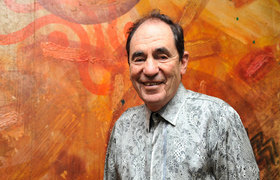
What does it take to build a life after political violence, and what does that life leave to the people closest to you? At the Baxter Theatre Centre, Albie Sachs: Fathers, Sons and Soft Vengeance brings us closer to the man behind one of South Africa’s most consequential political legacies: an anti-apartheid freedom fighter, a survivor of a devastating attack, a constitutional justice and a father.
Through the intertwined stories of injury, family, freedom and the pursuit of justice, the production explores how Albie Sachs chose to answer violence by helping shape a new South Africa, and what it means to live with the personal cost of that history.
The first time we meet Sachs on stage, he is dancing on a beach in Maputo, his hat resting in the sand as he jumps about with an unguarded joy. He is playful, absorbed in the moment and entirely at ease in his body, moving with a freedom that makes the violence to come almost impossible to imagine.
Then comes the bomb.
On 17 April 1988, while living in exile in Mozambique, Sachs was targeted by apartheid security operatives who planted a bomb in his car. The blast tore through his body, costing him his left arm and the sight in one eye. On stage, the transition is immediate and brutal: one moment, there is sunlight and movement; the next, sirens, darkness and agony. The beach vanishes, replaced by the wail of an ambulance carrying him towards an uncertain survival.
The hospital room
The audience is taken directly into a hospital room where Sachs lies bandaged and broken, beginning the excruciating process of clinical rebirth. It is here that Albie Sachs: Fathers, Sons and Soft Vengeance’s emotional weight comes into sharpest focus.
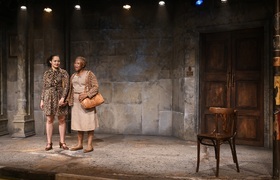
Written by Gail Louw, directed by Fiona Ramsay and performed by Graham Hopkins, the play moves beyond Sachs’s public legacy to examine the personal cost of political violence. It brings the audience close to the physical pain of his recovery, the psychological aftermath of the bombing and the vulnerability of a man so often remembered for his role in shaping South Africa’s democracy.
In the hospital, Sachs drifts in and out of consciousness, initially believing he has been kidnapped, struggling to make sense of his injuries and the fact that he has survived. The damage is extensive: four broken ribs, shrapnel embedded in his chest and the loss of his dominant arm. As a nurse changes his bandages, the audience witnesses his pain at close quarters, while the scene captures the disorientation of waking to a body permanently changed.


What emerges most strongly from the wreckage is not victimhood or despair. It is an extraordinary, almost incomprehensible optimism.
Faced with the loss of his limb, Sachs responds not with bitterness, but with a sharp, defiant humour. “That’s all they got,” he reflects, looking at his stump. “They were trying to take my life and all they got was my arm.” When nurses and doctors marvel at his survival, he turns to wit to anchor his humanity. In the play, humour becomes an assertion of selfhood, a psychological shield encapsulated in his playful adaptation of Cartesian philosophy: “I joke, therefore I am.”
Targeted to silence his pen, Sachs turned learning to write with one hand into an act of quiet defiance. “I write, therefore I am,” affirming that neither his voice nor his will had been broken.
Soft vengeance
This triumph over physical destruction forms the bedrock of Sachs’s famous philosophy of “soft vengeance”. For Sachs, true vengeance against a brutal regime was not to plant bombs or inflict equivalent suffering on his torturers. Instead, soft vengeance meant the total triumph of democratic ideals: building a constitutional order rooted in fundamental human rights, rule of law, and dignity for all South Africans.
Sachs’s commitment to justice was also reflected in his work within the liberation movement. As he put it, “The first and most important legal writing of my life was the code of conduct banning torture in the ANC liberation struggle.”
“They were trying to take my life and all they got was my arm.”
In the play, Sachs resists the idea that his contribution should be elevated above those of the comrades who fought alongside him. Re-enacting his acceptance speech for the international Albie Awards, established in his honour, he asks: “Why not a Nelson [Mandela]? Why not an Oliver Tambo? Why not a Braam [Fischer], or any of the hundreds of heroes? I was part of a movement. It was the movement that was special. And why me? It must be because I survived. Because I’m still here. And my trauma is visible.”
Louw drew on Sachs’s memoir, The Soft Vengeance of a Freedom Fighter, to shape the production. Accustomed to writing flawed characters, she found Sachs a different kind of challenge, particularly because he insisted on an honest portrayal of his life. “It’s really his words, all of it,” she said. What struck her was his refusal to present himself as an extraordinary man defined only by his achievements. “He does not approach his own story by declaring, ‘I’m such a genius and such a great man. Look what I’ve done. Look at all these amazing things I’ve done.’ Instead, he allows himself to be seen at his most vulnerable, finding humour even in his own humiliation – in his most demeaning and pitiful state, he shows himself and laughs at himself,” said Louw.
Fathers and sons
While Sachs’s public legacy as a Constitutional Court judge and freedom fighter belongs to the nation, the production anchors its emotional narrative in the quiet, complex terrain of fatherhood. Sachs was 71 years old when his youngest son, Oliver, was born.
The play exposes the delicate, often painful friction between a public icon and a growing child. Oliver, now a second-year social science student at the University of Cape Town (UCT), contributed directly to the character development in the production, bringing raw honesty to the portrayal of their relationship. Through a voice-over, we hear a young boy grappling with an elusive, world-famous father who was frequently away speaking or building a nation. Oliver speaks of the isolation of childhood, the embarrassment of having an older, disabled parent, and the heavy emotional weight of knowing his father might not live to see him reach adulthood.
Oliver Sachs is now 20, and he shares what felt like a burden in childhood has become an opportunity to understand the values that shaped his father’s life.
“We’ve kind of gotten over apartheid superficially but that healing is an ongoing process.”
For Ramsay, the play is an appeal from father to son, a conversation across generations about the cost of political commitment and what it means to grow up in the shadow of history.
She believes theatre demands more than passive observation. “You can’t escape it if you watch it,” she said. “But you really have to engage in the story. Each performance depends on the audience in front of it; the exchange changes from night to night – you’re acting with a different person every night.”
Ramsay also knows something of the long road back from physical injury. Badly injured at 18 months old, she has undergone 29 operations. What drew her to Sachs’s story was the psychological work of recovery and the difficult return to society that can begin long before healing is complete. She sees a parallel in South Africa’s own unfinished reckoning with apartheid. “We’ve kind of gotten over apartheid superficially but that healing is an ongoing process.”
Still dancing
At the end of the play, we return to the shore in Maputo. Sachs is once again jumping and dancing in the sunlight, his hat on, the same beach stretching around him. But he is no longer the man we met at the beginning. He has lost an arm, endured the violence intended to kill him and lived with its consequences. Still, he dances. The return does not erase what happened or suggest that survival comes without a cost. Instead, it brings the play’s idea of soft vengeance into view: Sachs’s answer to those who tried to silence him lies in the life he continued to live, the work he carried on and the future he helped make possible.
 This work is licensed under a Creative Commons Attribution-NoDerivatives 4.0 International License.
Please view the republishing articles page for more information.