
Wamkelekile, Welkom
UCT students bring coastal science to life at Zandvlei Estuary
13 October 2026 | Story Hishamodien Hoosain. Photo Megan van Zyl. Read time 4 min.
Visitors to Zandvlei Estuary can now discover the hidden importance of one of its most overlooked inhabitants through a series of educational signs developed by students and researchers from the University of Cape Town (UCT).
Installed along a popular footpath, the public-facing infographics highlight the ecological role of sandprawns and their contribution to healthy coastal ecosystems. The project also shows how students can turn scientific research into accessible knowledge that inspires environmental awareness.
The initiative began with a vision from Associate Professor Deena Pillay, a coastal ecologist whose research examines how human activities affect sandy shore and estuarine environments. Wanting to bridge the gap between scientists and society, Associate Professor Pillay set out to create a public resource that would make coastal science more accessible and raise awareness of the need to protect often-overlooked sandy shore ecosystems.
Sandprawns proved the ideal species through which to tell that story. While many local communities know them as bait organisms, they are also ecosystem engineers that play a critical role in maintaining estuarine and sandy shore habitats. By focusing on a familiar species, the team hoped to communicate broader messages about ecosystem health, human impacts and conservation.
Students driving public engagement
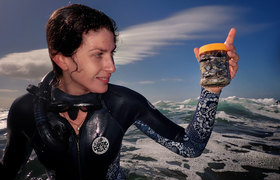
Students played a key role in the project. Master’s students Lieschen Shepard and Mila Truter developed the first draft of the signage, combining scientific knowledge with creative design ideas to explain the ecological importance of sandprawns. Later, Megan van Zyl refined the final design and helped develop a second infographic focused on sandprawn conservation and the role local communities can play in protecting coastal ecosystems.
For Van Zyl, the project offered a rare opportunity to combine science with creativity. “I wanted to make something that was accessible, but that also grabbed people’s attention,” she said. “Many people will walk past something that doesn’t catch their eye within three seconds, so finding that balance between being creative while still maintaining scientific accuracy was a fun challenge.”
Connecting science and society
The project also highlighted the value of collaboration beyond the university. The team worked with the City of Cape Town on the installation of the signage, while renowned marine biologists George Branch and Margo Branch provided guidance and support that strengthened the scientific content.
Now in place at Zandvlei, the signs invite visitors to look beyond the surface of the estuary and consider the relationships that sustain coastal life.
“I hope that people will think a little more carefully about who all plays a part in our world – not just humans, but animals and plants too,” said Van Zyl. “Sandprawns are silent ecosystem engineers that, although small, make a big impact on our coastal and estuarine environments.
“This project represents much more than educational signage. It shows how research can move beyond academic journals and into public spaces where it can inform and inspire.”
“We can easily get stuck in our own echo chamber of academia. What we learn and uncover also needs to be shared with the public. We do what we do to better understand the world we live in and how we influence it, and it’s up to us to actively take what we learn and use it to make the world a better place – for people and for nature.”
Pillay added: “This project represents much more than educational signage. It shows how research can move beyond academic journals and into public spaces where it can inform and inspire. We hope it encourages people to think differently about the ecosystems around them, while demonstrating the important role students can play in connecting science with society.”
 This work is licensed under a Creative Commons Attribution-NoDerivatives 4.0 International License.
Please view the republishing articles page for more information.