
Wamkelekile, Welkom
The premium on supporting recovery
12 October 2026 | Story Kamva Somdyala. Photos Nasief Manie. Read time 4 min.
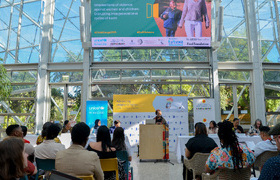
In the run-up to observing World Mental Health Day on 10 October, an important conversation happened around recovery. The University of Cape Town’s (UCT) Student Wellness Service (SWS) held a series of wellness initiatives with its partners.
In conjunction with Recovery Walk Cape Town, the programme kicked off on the Plaza on upper campus to raise awareness and help break the stigma around addiction and mental health illness; and to celebrate recovery. “You cannot do recovery alone; you need people to help you. Recovery is understanding that in order to get better, I have to think about what I do because it is not about what I think; not what I feel – it’s about what I am doing,” said Recovery Walk Cape Town’s Debbie Bub, an occupational therapist.
“If, for example, you feel your mind is confused, it is important to think about what you will do next to support yourself and help you get stronger. Recovery is [about] getting better by doing better. The other bit about recovery is that I must be able to say what it is that I am struggling with. People who cannot ask for help, cannot get better.” She added that stigma is something that makes a lot of people fearful of reaching out for help.
“When we do things that appear as addiction, sometimes these are attempts at self-medication.”
“Recovery never ends; it’s a practice every day in the little things we do. Those little things make a difference. The recovery walk makes hope visible,” said Bub. The initiative by SWS is in line with the People, Culture and Society leg of Strategy 2030, which looks at “enhancing engagement for well-being and flourishing, ensuring staff and student voices inform systemic approaches for work and study fulfilment and effective delivery and accessibility of wellness programmes”.
It further states that it aims to “strengthen UCT’s institutional culture rooted in shared values, trust, accountability, and compassion”. Lastly, “Central to Strategy 2030 is the recognition that UCT’s greatest asset is its people. We must create an institutional culture which fosters ubuntu, kindness, empathy and collaboration. Creating an enabling environment where talent is nurtured, psychological safety is prioritised, and diversity is celebrated is essential to our academic enterprise.”
The symptom
UCT’s deputy vice-chancellor for People, Culture and Society, Professor Elelwani Ramugondo, said: “The people who we write missions and visions for in documents must be well! The people must enjoy well-being and flourishing, and there is a lot of work we are doing in that regard.” She said the work being done behind the scenes will be revealed when the time is right.
“We have a history of colonialism and apartheid with lots of things that continue on the back of those legacies, and part of it results in us being wounded,” said Professor Ramugondo.


“We are a wounded society. When you hear of gender-based violence and femicide and all manner of violence, you must recognise that they stem from somewhere. When it comes to recovery, it is very easy to focus on addiction alone, but addiction is a symptom – a symptom of the woundedness I refer to. Many of us carry trauma that is intergenerational, and so when we do things that appear as addiction, sometimes these are attempts at self-medication.”
She added: “Because addiction comes in different forms, we need to attend to our woundedness so that addiction can be managed or begin to fall away.” Turning to Manfred Max-Neef’s fundamental human needs thought process, Ramugondo said rather than remembering the vast list, three things should stay uppermost in mind: “We all need love; we all need purpose, and, lastly, we all need rest.”
To conclude the wellness drive, SWS hosted a 5 km run/walk and fun day for World Mental Health Day on Saturday, 10 October. The event brought the UCT community together to raise awareness of mental health, promote well-being and show support for the community.
 This work is licensed under a Creative Commons Attribution-NoDerivatives 4.0 International License.
Please view the republishing articles page for more information.