
Wamkelekile, Welkom
Africa’s top university co-hosts first THE Summit on home soil
30 September 2026 | Story Niémah Davids. Read time 6 min.
“If you want to go fast, go alone. If you want to go far, go together.”
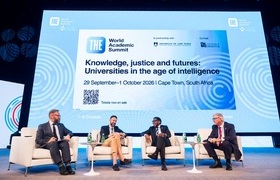
Professor Mosa Moshabela, the vice-chancellor of the University of Cape Town (UCT), referenced this African proverb to emphasise the importance of collaboration as he opened the 14th annual Times Higher Education (THE) World Academic Summit (WAS). The event, co-hosted by Africa’s top university and the University of Bristol, is first of its kind to be held on African soil.
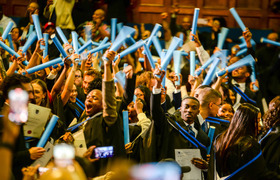
The summit joins leaders in higher education from around the globe under the banner: “Knowledge, justice and futures: Universities in the age of intelligence”. The three-day event, which kicked off at the Cape Town International Convention Centre on Tuesday, 29 September, explores how universities can harness intelligence to shape fairer, more sustainable and future-ready societies. The summit’s opening session was a vibrant affair and included an African musical performance by UCT’s South African College of Music.
“We [UCT] are very proud [to be co-hosting the summit]. I also want to express my gratitude to our partner, the University of Bristol. We have travelled this journey over many months to make this meeting happen, and we are finally here,” Professor Moshabela said.

“This is the first Times Higher Education World Academic Summit to be hosted on African soil, [and] we are very grateful that Times Higher Education has recognised the importance of bringing this meeting to the continent.”
The future of higher education
For Phil Baty, the chief global affairs officer of THE, where delegates gather for the summit matters as much as why they gather. And meeting in Cape Town is not a symbolic gesture. Instead, Baty said, the Mother City was chosen to host the summit because the future of higher education will not be written only in Oxford, Beijing and Bristol.
“It will be written here too. In the laboratories, in the libraries and lecture halls across the continent that by the middle of this century will be home to the largest young population on Earth,” Baty said. “No serious conversation about the future of global higher education can happen without Africa at its very centre.”

And considering the theme of the summit, Baty said, Cape Town is the right place to have these conversations. After all, he added, African universities are the shapers not just of their own futures, but of everyone’s future.
“When we talk about justice and about universities in the age of intelligence, we don’t just mean artificial intelligence. We mean the age in which the value of knowledge itself is being tested; tested by mistrust; tested by inequality of access,” he said. “Over the next few days, I hope that we can hold two things at once: ambition for research that changes lives and collaboration that keeps flowing north and south equally.”
Finding answers to challenges – together
Shedding light on the African proverb he referenced earlier, Moshabela said he considers it important in the summit’s context because of the kind of work delegates in the room need to execute together to advance the higher education sector globally.
“I say this because of the togetherness that it takes to bring a big meeting like to this together. I say this because of the geopolitics that we see in the world causing so much division, fragmentation and polarisation. I say this because of the very temptation to close down borders and keep others out. I say this because of the problem of marginalisation that we see, even in higher education,” he said.


Moshabela acknowledged the plethora of challenges Africa faces. He agreed with Baty that the continent comprises the fastest growing young population who are guaranteed to contribute and impact the world positively. However, he said, education, employment and economic opportunities remain limited. What’s important, he told delegates, is to use the summit to find ways to mitigate and overcome these challenges.
“We are looking to learn from many of our colleagues across the globe. Colleagues from Europe, from the Americas, colleagues from Asia. We will look to the west, we will look to the east to find answers that can help us uplift the students we serve, uplift our societies and communities, and uplift our continent,” he said.
Facilitating hard, optimistic conversations
The vice-chancellor of the University of Bristol, Professor Evelyn Welch, said this year’s summit is a “very special one”, not just because of its location, but because the global community of educators are starting to have hard, challenging, and optimistic conversations about the sector.
And while the summit joins leaders in higher education, Professor Welch said what adds to its importance is the voices of industry partners, as well as regional and civic partners. She said they will add valuable input and insight to discussions on the sector’s responsibility and accountability to develop bright futures and deliver justice in the age of intelligence.
“As we come to the start of this event, let’s think about how we come together, how we bridge borders, and how we think collaboratively,” she said.

She reminded delegates that the world faces an array of challenges, and institutions and the higher education sector cannot face it alone.
“But somehow I can see that by coming together we will not just achieve more – we will become so much more,” Welch said.
 This work is licensed under a Creative Commons Attribution-NoDerivatives 4.0 International License.
Please view the republishing articles page for more information.