
Wamkelekile, Welkom
Cheers to 25 years of impactful social science research
22 September 2026 | Story Niémah Davids.Photos Ntanga Ramugondo. Read time 7 min.
This year marks 25 years since the formation of the University of Cape Town’s (UCT) Centre for Social Science Research (CSSR). There was no better way to celebrate the milestone than to reminisce about where it all started.
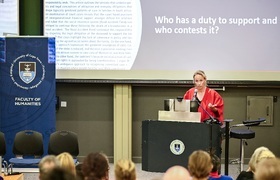
Friends of the institution, including current and past researchers, filled the Centre for African Studies Gallery on upper campus on Wednesday, 16 September, to mark the occasion. The festivities included celebrating the impactful research academics have produced over the years and the giant strides the centre has made in the field of social science research in South Africa since 2001.
The CSSR is an interdisciplinary research unit dedicated to conducting and building capacity for systematic, policy-relevant social science research in the country and across Africa. It’s headed by Professor Catherine Ward and comprises several research units, including the Safety and Violence Initiative; the Adolescent Accelerators Research Hub; and the Social Intervention Research Unit.
“It is very exciting to be celebrating our birthday,” Professor Ward said.
“A lot has changed in the world since 2001. We have internet on campus that doesn’t stop working when students start checking Facebook. We have artificial intelligence. We have a world where the funding environment has been very much affected by politics recently. But I think what hasn’t changed is the need for excellent social science research.”
Where it all started
Taking the audience back more than two decades in time, the CSSR’s founding director, Professor Nicoli Nattrass, said the idea to set up the centre was first discussed in the late 1990s. Back then, UCT was determined to build on the success of a Southern Africa Labour and Development Research Unit (SALDRU) study that focused on poverty and living standards in South Africa and prompted a collection of quantitative social science.
Professor Nattrass said UCT, along with one of its largest research funders, the Andrew W Mellon Foundation, suggested that the university establish a centre modelled on the Institute for Social Research at the University of Michigan in the United States. The idea, she explained, was to produce social science research of public interest at UCT.
“Just to pick up on something Cathy said. Funding is a huge problem now. For any young scholar, it’s a thing. For us, back then, it was the late 1990s, and funders were throwing money at South Africa. It was amazing,” Nattrass said. “And so, we were given this gift of this opportunity of being in charge of a major institution that had the backing of a big donor. Without that, we wouldn’t have gone anywhere.”
The first meaningful project
Nattrass said the centre committed to innovate social science in Southern Africa. And the goal was to produce interdisciplinary, ethical use surveys, critically independent research that builds capacity among its students. In time, the centre produced a strong qualitative base and scholars worked hard to integrate both quantitative and qualitative practices in their work.
Before officially establishing the CSSR, Nattrass had set up the AIDS and Society Research Unit (ASRU) within the Faculty of Commerce, which served as a way to respond to the HIV/AIDS epidemic at the time. She told the audience that the Memory Box Project – an outreach programme that worked directly with people living with HIV/AIDS to help them accept their status and discuss it with their loved ones – formed part of ASRU and was absorbed as one of the CSSR’s first projects.
“[The CSSR is a] space to facilitate a community of scholars, to talk across disciplines and to not have to set up your own space.”
“As we moved into the CSSR and we became a unit, this was [the time we started] the struggle for antiretroviral [treatment] and [there] was hope. So, the CSSR pulled in [ASRU] and transformed it into a different kind of outreach [programme],” Nattrass said.
Things blossomed from there. As its formation strengthened, various units sprouted, including the Social Surveys Unit, the Policy Research in International Services and Manufacturing (PRISM) research unit, the Families and Societies Research Unit and the Adolescence Accelerator Research Hub.


“The CSSR has always been a space for units to come and go. It’s a space to facilitate a community of scholars, to talk across disciplines and to not have to set up your own space,” she said.
Building research capacity
For Professor Jeremy Seekings, who served as the director of the CSSR from 2011 until 2023, the Andrew W Mellon Foundation’s funding helped the centre to develop capacity building in survey research in South Africa. Prior to 2000, he said, surveys had been conducted in the country but the analysis thereof had mostly been done by American nationals and scholars based at American universities.
“And Mellon said: ‘This is nuts. We want to develop capacity in South Africa to analyse data being collected in South Africa for South African policymakers, given the transition to the new, democratic government’,” Professor Seekings said.
“So, we suddenly had to embark on survey operations, which none of us had background in. And I really emphasise this [because] it’s difficult to exaggerate how little capacity and skill there was at UCT in 2000. But things changed rapidly.”
The CSSR’s real expertise, Seekings said, wasn’t simply conducting quantitative analysis. Instead, he said, it lay in mixed methods research. So, very early on, the centre combined quantitative data with more ethnographic work and the first example of this was the book: Growing Up in the New South Africa: Childhood and Adolescence in Post-Apartheid Cape Town.
Paying it forward
But more than conducting quantitative social science research, Seekings said, funders were determined that the centre develop a pipeline of qualified students who were funded through scholarships. And they delivered. The centre spent R9 million on scholarships in its first decade and a further R15 million in the second decade.
He said students in economics, sociology and politics were the main beneficiaries of these scholarships. In recent years, students in public health and psychology have also formed part of the funding pool. Seekings said most students were funded at PhD level (51 PhD students since 2001), with some at master’s level as well.
“I think that these kinds of multi-unit research centres are more sustainable because they comprise units which have a different kind of ebb and flow and time and scale.”
As he concluded his talk, Seekings shared his thoughts on what has contributed to the unit’s success and the reason it still stands more than two decades after it was established. His why? Because it serves as a multi-unit research centre, which he described as valuable.
“If you have multiple units, it looks like something is always happening. There’s always fundraising; there’s always data collection. There are always publications going out,” he said. “So, I think that these kinds of multi-unit research centres are more sustainable because they comprise units which have a different kind of ebb and flow and time and scale.”
 This work is licensed under a Creative Commons Attribution-NoDerivatives 4.0 International License.
Please view the republishing articles page for more information.